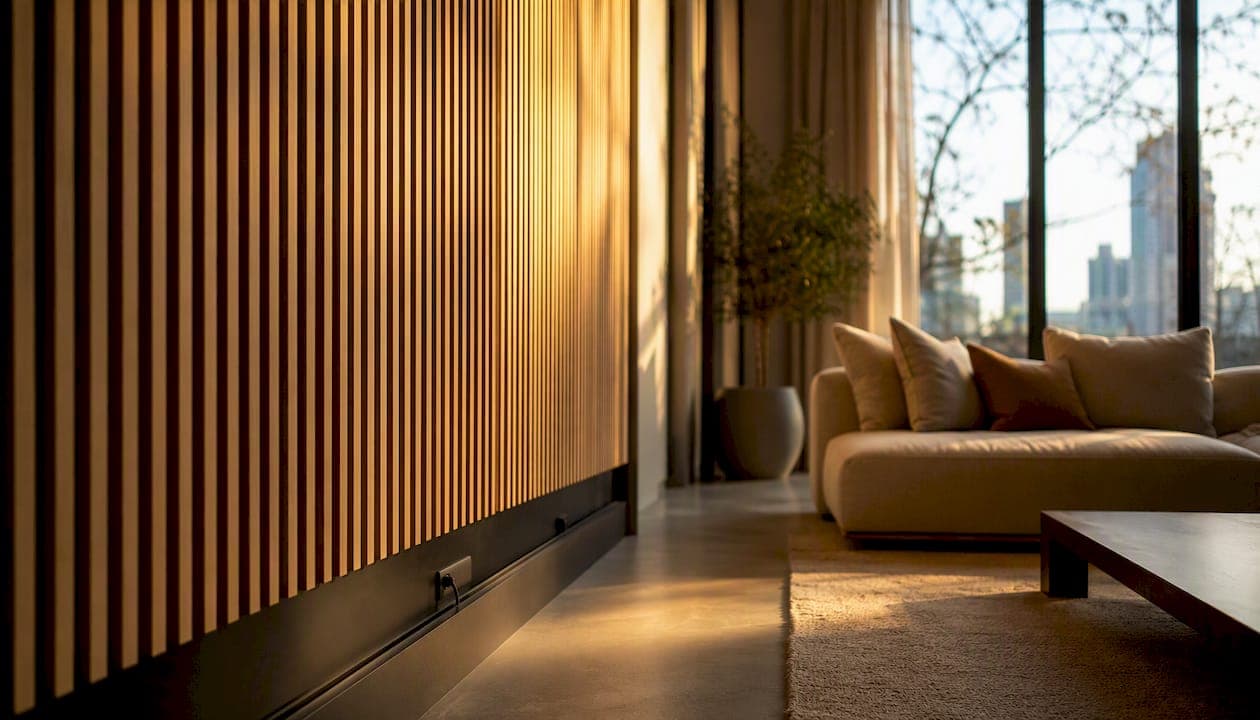
The Media Wall Store's Acoustic Slat Wall Panel (Red Walnut) is the best overall pick for homeowners who want premium sound control paired with a design-forward wood slat finish. It ships as a pre-cut, pre-labeled DIY kit with hidden wire management built in, so you get a furniture-grade media wall without hiring a contractor.
Three specialist picks round out the shortlist:
- Best for home theater: GIK Acoustics SlatFusor — oak veneer slats over a broadband absorber that pulls down midbass to roughly 150–250 Hz, deeper than most residential panels.
- Best budget-friendly option: ATS Acoustics slat-style panels — off-the-shelf availability and typically lower price points make them a practical starting point when you're testing coverage before committing.
- Best sustainable option: Primacoustic EcoScapes Slat Wall — a post-consumer PET core with manufacturer-published ASTM C423 NRC values ranging from 0.55 (A-mount) to 0.95 (C50-mount in cavities), the most transparent lab data of any panel on this list.
Key Takeaways
The Media Wall Store's Acoustic Slat Wall Panel (Red Walnut) is the strongest overall pick for homeowners who want a design-forward wood slat treatment with DIY-friendly installation and integrated cable management.
| Point | Details |
|---|---|
| Best overall pick | The Media Wall Store Red Walnut kit ships pre-cut and pre-labeled with hidden wire management for weekend installation. |
| Only panel with published lab data | Primacoustic EcoScapes publishes ASTM C423 NRC values: 0.55 (A-mount), 0.70 (D20), and 0.95 (C50 with 50 mm air gap). |
| Thickness drives low-frequency performance | Panels 2.5 inches or thicker, mounted with an air gap, absorb midbass; thin flat-mounted panels treat only high frequencies. |
| Coverage math before you order | Measure net wall area, divide by box coverage (e.g., 43 sq ft per EcoScapes box), round up, then add 10% for cuts and repairs. |
| The Media Wall Store | Offers pre-cut DIY slat kits with finish options, wire management, and white-glove installation in the SF Bay Area. |
Table of Contents
- What are the best acoustic slat panels right now?
- How we compared these panels
- What should you look for in wood slat acoustic panels?
- How many panels do you actually need?
- Which panel is right for your situation?
- The thing most buyers get wrong about acoustic slat panels
- Themediawallstore makes the panel-to-media-wall step straightforward
- Useful sources
- FAQ
What are the best acoustic slat panels right now?
The table below covers the top wood slat acoustic panels on the U.S. market. NRC figures are shown only where the manufacturer publishes ASTM C423 test results; entries without lab data are flagged.
| Panel | NRC / ASTM C423 | Material & Finish | Coverage | Price Range | Mounting | Best Use Case | Sustainability | Warranty / Lead Time |
|---|---|---|---|---|---|---|---|---|
| The Media Wall Store — Red Walnut | Not publicly listed | Wood veneer slats, MDF backing | Kit-based; see product page | Mid-range | Pre-cut DIY kit; Z-clip / adhesive | Media wall, living room TV wall | Not publicly listed | Risk-free returns; lead time varies |
| GIK Acoustics SlatFusor | Not individually published as single NRC; absorbs to ~150–250 Hz | Oak veneer slats over broadband absorber; ~2.75" thick | — | Mid-to-upper | Z-clips / wall hangers | Home studio, listening room | Not publicly listed | Standard GIK warranty |
| Primacoustic EcoScapes Slat Wall | A-mount: 0.55 / D20: 0.70 / C50: 0.95 (ASTM C423) | PET core, MDF slats, wood veneer | 43 sq ft per box (2 panels) | Mid-range | Adhesive or mechanical clips | Eco-conscious living room, studio | Up to 50% post-consumer PET | Manufacturer warranty; check site |
| Akupanel Signature Series | Not publicly listed | Wood veneer slats, MDF core | Verify with vendor | Mid-range | Adhesive / clip | Decorative accent wall | Not publicly listed | Verify with vendor |
| SlatWall Pro by Decibel Designs | Not publicly listed | MDF slats, modular frame | Modular; scalable | Upper | Modular rail system | Large residential / light commercial | Not publicly listed | Verify with vendor |
| ATS Acoustics slat-style panels | Not publicly listed | Various; verify per SKU | Varies per SKU | Budget-to-mid | Adhesive / hangers | Budget living room treatment | Not publicly listed | Standard ATS policy |
| WoodUphoria Acoustic Elements | Not publicly listed | Wood slat profiles, MDF | Verify with vendor | Mid-range | Adhesive / clip | Accent wall, feature installation | Not publicly listed | Verify with vendor |
| EchoWoods SoundMaster Series | Not publicly listed | Veneer slats, MDF | Varies by SKU | Mid-range | Adhesive / Z-clip | Home theater, living room | Not publicly listed | Verify with vendor |
| Vistacoustic Modular Panels | Not publicly listed | Slat + diffuser hybrid | Modular array | Mid-to-upper | Modular clip system | Mixed diffusion/absorption arrays | Not publicly listed | Verify with vendor |
| USA Builders Depot Premium Acoustic Panels | Not publicly listed | Varies | Varies | Budget-to-mid | Adhesive | General wall treatment | Not publicly listed | Verify with vendor |
| Dekiru Sound Absorption Panels | Not publicly listed | Fabric-wrapped foam core | Varies | Budget | Adhesive | Budget starter treatment | Not publicly listed | Varies |
| Art3d Designer Panels | Not publicly listed | PVC / wood-look veneer | Varies | Budget | Adhesive / peel-and-stick | Decorative accent | Not publicly listed | Varies |
| Acoustimac DMD Panels | Not publicly listed | Fabric-wrapped fiberglass | Varies | Budget-to-mid | Impaling clips / adhesive | Studio, home theater | Not publicly listed | Standard Acoustimac policy |
A note on missing NRC data: Most residential slat panels on this list do not publish ASTM C423 results. That is not automatically disqualifying — a well-built panel with a dense absorber core will still reduce flutter echo and early reflections. But if measured performance matters for your project (a dedicated home theater, a recording space), Primacoustic EcoScapes is currently the only widely available option with transparent lab numbers.
Statistic callout: Primacoustic's EcoScapes publishes three ASTM C423 mounting conditions: A-mount NRC 0.55, D20-mount NRC 0.70, and C50-mount NRC 0.95. The C50 figure requires a 50 mm air gap behind the panel — a meaningful installation detail that changes your wall depth by roughly 2 inches.
How we compared these panels
Every panel on this list was evaluated against the same set of criteria: published NRC values and ASTM C423 test method (mounting condition noted), core and slat materials, panel size and box coverage in square feet, typical price range, mounting method and installation difficulty, sustainability claims, and lead time or warranty.
Where a vendor publishes an ASTM C423 report, that figure is used directly. Where no lab data exists, the entry is flagged rather than estimated. ASTM C423 measures absorption across frequencies using standardized mounting conditions: A-mount (flat to wall), D20-mount (20 mm air gap), and C50-mount (50 mm air gap). The mounting method changes the measured NRC significantly, so comparing an A-mount figure from one vendor to a C50 figure from another is an apples-to-oranges mistake.
Trust signals checked for each vendor include published spec sheets with dimensions and coverage math, ASTM test reports or references, sample and return policies, and BBB presence for vendors without an established review base. Panels from vendors without verifiable U.S. specs or without a clear U.S. distribution channel were excluded.
What should you look for in wood slat acoustic panels?
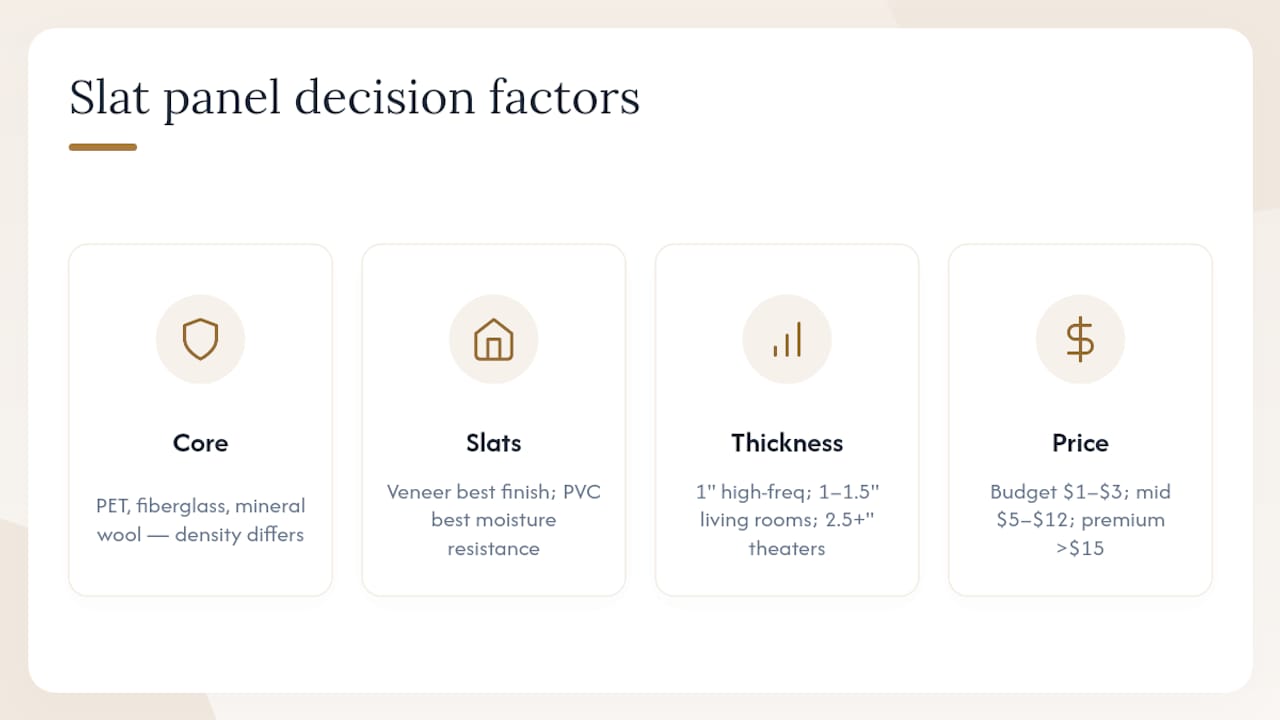
The decision comes down to four things: what the core is made of, what the slats are made of, how thick the assembly is, and whether the vendor can prove performance.
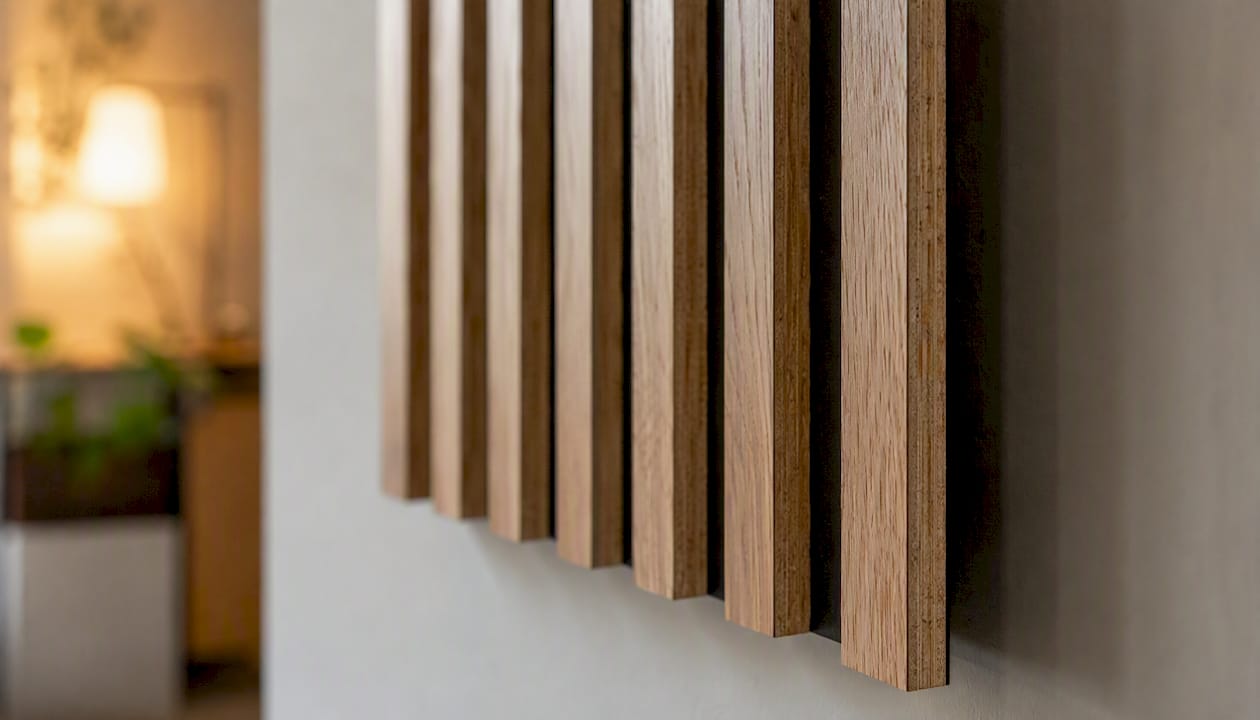
Core material drives most of the acoustic work. PET (polyethylene terephthalate) fiber cores, like the one in Primacoustic's EcoScapes, are made from recycled plastic bottles, carry no formaldehyde, and perform well in the mid-range. Fiberglass cores (used in panels like Acoustimac DMD) tend to offer slightly higher density and better low-frequency absorption at equivalent thickness, but they require careful handling during installation. Mineral wool cores sit between the two on density and cost.
Slat material is mostly an aesthetic and durability question. Real wood veneer over MDF looks better up close, takes stain evenly, and holds up to humidity better than painted MDF. Painted MDF slats are cheaper but can chip at cut edges and show wear faster in kitchens or bathrooms. PVC wood-look slats (Art3d) are the most moisture-resistant but read as artificial in person.
Thickness matters more than most buyers expect. A 1-inch panel glued flat to drywall absorbs mainly high frequencies. A 2.75-inch panel like the GIK SlatFusor, mounted with an air gap, starts pulling in midbass. For a living room TV wall, 1–1.5 inches of total assembly depth is usually enough to tame flutter echo and dialogue muddiness. A dedicated home theater benefits from 2.5 inches or more.
Price per square foot varies widely. Budget panels (Dekiru, Art3d) run roughly $1–$3/sq ft but offer limited acoustic performance. Mid-range wood slat panels typically fall in the $5–$12/sq ft range. Premium options with verified lab data or furniture-grade veneer can exceed $15/sq ft. Coverage math matters: a box that covers 43 sq ft at $X per box is a more useful number than a per-panel price with no coverage figure attached.
Pro Tip: Before ordering, ask the vendor for three things: the ASTM C423 mounting condition used for their NRC figure, a physical sample swatch of the veneer finish, and the lead time in weeks. A vendor who can answer all three quickly is one you can trust with a large order.
Design-forward acoustic panels can double as architectural features, according to Rolling Stone's acoustic panel roundup, which is why finish options and sample swatches matter as much as the NRC number for most homeowners.
How many panels do you actually need?
Start with the wall area, subtract openings (windows, doors, fireplace), divide by the panel's coverage figure, then round up and add 10% for cuts and pattern matching.
The formula:
- Measure wall width × height in feet to get total square footage.
- Subtract any openings (windows, doors) in square feet.
- Divide by the panel's coverage per box or per panel.
- Round up to the nearest whole box.
- Add 10% for waste, cuts, and future repairs.
| Wall Size | Net Wall Area | Primacoustic EcoScapes (43 sq ft/box) | Typical 4 sq ft panel (12-pack) |
|---|---|---|---|
| 10 ft × 9 ft TV wall (minus 15 sq ft openings) | 75 sq ft | 2 boxes (86 sq ft) | — |
| 12 ft × 9 ft home theater wall (no openings) | 108 sq ft | 3 boxes (129 sq ft) | — |
Living room TV wall example: A 10-foot-wide wall at standard 9-foot ceiling height gives you 90 sq ft. Subtract a 15 sq ft window opening: 75 sq ft net. Two boxes of Primacoustic EcoScapes cover 86 sq ft, which handles the wall with a small buffer. Add one extra box if you're wrapping a side return or doing a corner treatment.
Home theater full-wall example: A 12×9 ft front wall with no openings is 108 sq ft. Three EcoScapes boxes cover 129 sq ft, leaving enough material for the 10% waste allowance built into the calculation.
For a typical 2.5-meter-wide TV wall can be covered well with several standard-size panels, allowing enough mounting depth to route HDMI and power cables behind the slats.
Which panel is right for your situation?
Design-first living room: The Media Wall Store's Acoustic Slat Wall Panel (Red Walnut or Smoked Walnut) is the clearest fit. The pre-cut, pre-labeled kit format means you're not measuring and cutting veneer panels yourself, and the integrated wire management solves the cable problem that trips up most DIY TV wall projects. The finish quality reads as furniture-grade, not contractor-grade.
Dedicated home theater: GIK Acoustics SlatFusor earns its place here. The broadband absorber behind the oak veneer slats handles midbass down to roughly 150–250 Hz, which is the frequency range where home theaters typically struggle most. At 2.75 inches thick, it needs more wall depth than a flat-mount panel, but the acoustic return is proportional.
Budget-conscious starter: ATS Acoustics slat-style panels offer accessible price points and off-the-shelf availability. Specs vary by SKU, so verify coverage and core material before ordering. They work well as a first treatment to test placement before investing in premium panels.
Eco-conscious homeowner: Primacoustic EcoScapes is the only panel on this list with a post-consumer PET core and published ASTM C423 data across three mounting conditions. If you need to document sustainability for a green building project or simply want to know what you're buying, EcoScapes is the transparent choice.
The thing most buyers get wrong about acoustic slat panels
Most homeowners shopping for wood slat acoustic panels spend their time comparing finishes and almost no time comparing core materials or mounting depth. That's understandable — the veneer is what you see every day. But the core is what determines whether the panel actually changes how your room sounds or just looks like it does.
A 0.35-inch (9mm) PET core mounted flat to drywall will tame flutter echo and take the edge off hard reflections. That's genuinely useful. It will not fix bass buildup in the corners of a 12×14 ft room, and it won't make a home theater sound like one. The buyers who end up disappointed are almost always the ones who bought thin decorative panels expecting studio-level treatment.
The other thing worth saying: NRC numbers are marketing-friendly but context-dependent. Primacoustic's EcoScapes panel, for example, publishes ASTM C423 NRC values of 0.55 (A-mount), 0.70 (D20-mount), and 0.95 (C50-mount with a 50 mm air gap). That highest 0.95 rating requires an air cavity behind the panel that most TV wall installations don't have. Always ask which mounting condition the published NRC reflects before treating it as a performance guarantee.
The panels that hold up best over time are the ones where the finish was chosen with a physical sample in hand, not a product photo. Veneer tones photograph differently than they look under room lighting, and a warm walnut that looks perfect on a monitor can read orange on a north-facing wall. Order a swatch. It's a small step that eliminates the most common return reason on the entire category.
Themediawallstore makes the panel-to-media-wall step straightforward
Most acoustic slat panels solve one problem: sound. Themediawallstore's Acoustic Slat Wall Panel (Red Walnut) solves three at once: sound, aesthetics, and the cable management headache that turns a clean TV wall into a wire tangle. The pre-cut, pre-labeled kit format means no custom cutting, no guesswork on layout, and a realistic weekend installation timeline for most homeowners.

Finish options include Red Walnut, Smoked Walnut, and additional tones, so you can match the panel to your existing furniture rather than designing around it. For homeowners in the San Francisco Bay Area, Themediawallstore also offers white-glove custom installation for projects that go beyond a single panel wall. Sample swatches and risk-free returns back every order.
Browse the full range of DIY media wall kits or go straight to the Red Walnut panel page to check current availability and coverage specs.
Useful sources
- EcoScapes Slat Wall - Primacoustic
- SlatFusor Acoustic Slat Wall Panel | GIK Acoustics
- Acoustic Panel TV Wall – Design Guide | Silentwood
- The best acoustic panels for sound dampening — Rolling Stone
- Acoustic panels behind TV – stylish sound and clearer dialogue
- Can You Install Acoustic Panels Behind a TV? A Complete Guide - Northern Acoustics
- BBB listing — Newgen Depot profile
Reminder: When NRC performance is critical for your project, ask the vendor for the full ASTM C423 report, not just the headline NRC number. The mounting condition used during testing changes the result significantly.
FAQ
What NRC rating should acoustic slat panels have for a living room?
An NRC of 0.55 (A-mount) is sufficient for most living rooms. Higher ratings require thicker panels or air gaps that typical TV wall installations don't accommodate.
Do acoustic slat panels work behind a TV?
Yes. Panels placed behind a TV reduce early reflections and improve dialogue clarity. Extend them 4–6 inches beyond the screen edges on each side for the best effect.
How many acoustic slat panels does a 10-foot TV wall need?
A 10×9 ft wall with a 15 sq ft window opening leaves roughly 75 sq ft of net wall area. Two boxes of Primacoustic EcoScapes (43 sq ft each) cover that wall with a small buffer; add 10% for cuts.
Are wood veneer slat panels better than painted MDF slat panels?
Wood veneer takes stain evenly, holds up better to humidity, and looks more natural up close. Painted MDF costs less but chips at cut edges and shows wear faster over time.
What makes Themediawallstore's panels different from standard slat panels?
The pre-cut, pre-labeled kit format includes hidden wire management built in, which eliminates the cable-routing problem most DIY TV wall projects run into. White-glove installation is also available in the SF Bay Area for homeowners who prefer a managed install.