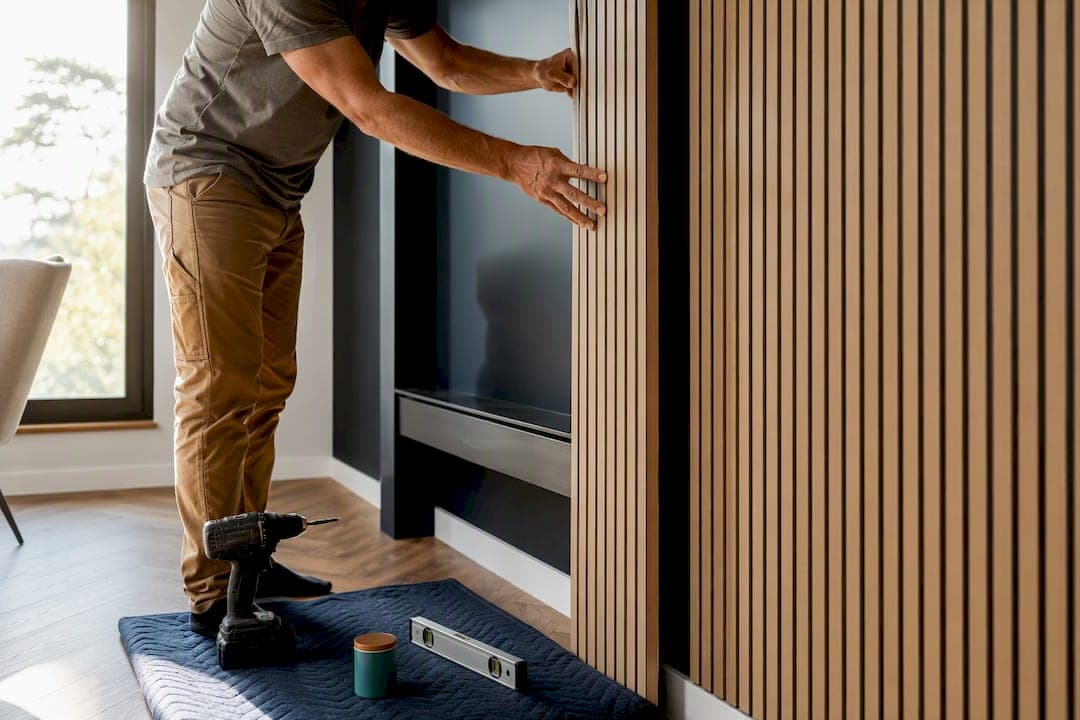
A pre-sized, pre-cut media wall kit is the fastest reliable way to build a wall around an 85" TV. It solves the three things custom carpentry struggles with on a deadline: exact fit for a screen that size, hidden wiring, and backing already positioned for the mount. Some companies sell these kits specifically labeled for panel order, which cuts a multi-week carpentry job down to a weekend.
TL;DR:
- A pre-sized, pre-cut media wall kit designed for an 85" TV simplifies installation by providing panels optimized for larger screens, with built-in hidden wiring channels.
- It is essential to confirm your TV's exact dimensions and your wall's width before ordering, aiming for a total wall width of 120 to 140 inches for proper proportions.
- The typical finished depth of an 85" TV wall is about 12 to 14 inches, accounting for framing, drywall, and cable clearance, with the TV center positioned around 42 to 48 inches from the floor.
- Installing a media wall involves locating studs, installing backing and blocking, and routing electrical outlets, with professional help recommended for electrical work.
- DIY installation of an 85" media wall generally takes two days with two people, focusing on prep, backing, panel assembly, and finishing, with design details like lighting and proportion enhancing a custom look.
Table of Contents
- What to Look for in an 85 Inch TV Wall Kit
- How Much Space Does an 85 Inch TV Wall Need?
- What Should You Check Before Ordering the Kit?
- How Long Does an 85 Inch TV Wall Installation Take?
- Which Design Details Make the Wall Look Custom?
- Why Kits Beat Custom Carpentry for Most Homeowners
- Ready to Order Your 85 Inch TV Wall Kit?
- A Publisher's Take on Kits vs. Custom Builds
- Sources
- FAQ
What to Look for in an 85 Inch TV Wall Kit
Not every media wall kit built for a 65" TV scales up cleanly to an 85". The panel widths, backing placement, and cable routing all shift once the screen gets that much bigger, so the kit needs to be engineered for the larger frame from the start.
A kit built for an 85 inch TV wall should include:
- Pre-cut, pre-labeled panels that match a documented layout, so assembly doesn't turn into a guessing game with a circular saw.
- Mounting backing already positioned for standard 85" VESA patterns, which removes the need to hunt for studs mid-install.
- Hidden wire channels built into the panel structure instead of surface-mounted raceways.
- Integrated LED lighting options for shadow lines or accent glow behind slat panels.
- Multiple finish choices (matte, wood grain, stone-look) so the wall reads as custom rather than assembled from a box.
Three kit styles tend to suit an 85" TV best. A floating lower run keeps the screen visually anchored with a console below it, which works well in living rooms with lower ceilings. A full-width wall with flanking storage suits larger rooms and gives you closed cabinets on either side of the screen. A slat-accent feature wall adds texture behind the TV without competing with it visually, and it's often the easiest style to make look intentional in a smaller room.
Before ordering, confirm your TV's exact width, height, and depth (manufacturers list these under "dimensions without stand"), your available wall width, whether a fireplace insert is part of the plan, and whether you can get a physical finish sample. A finish that looks right on a screen rarely looks right at full scale.
How Much Space Does an 85 Inch TV Wall Need?
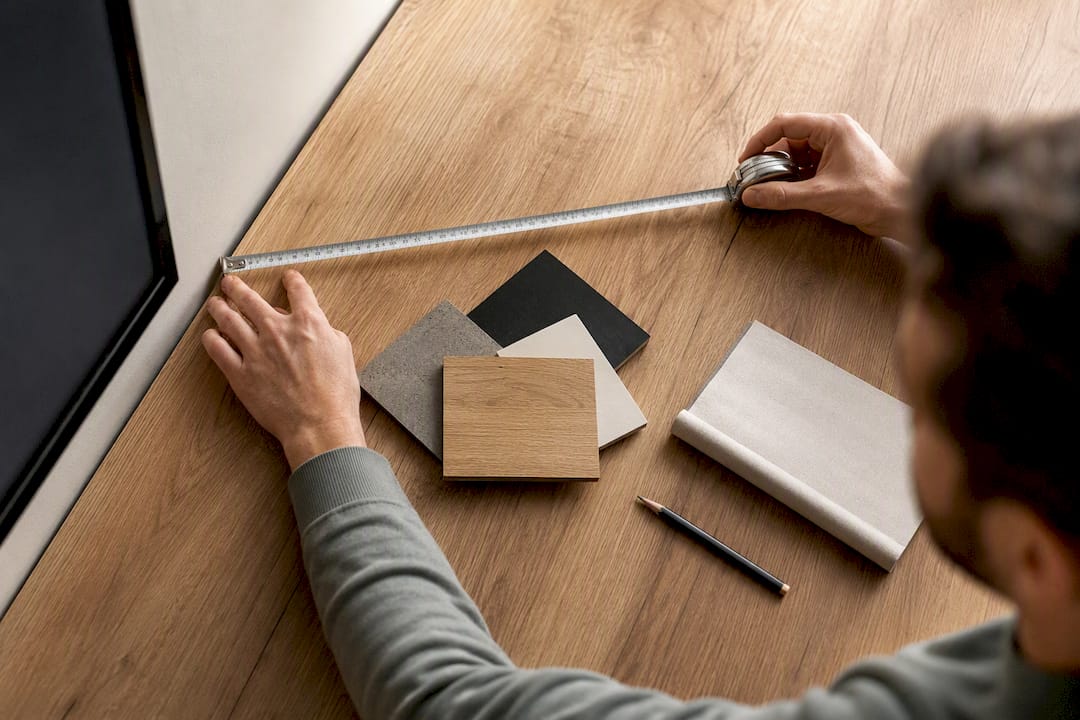
An 85" TV measures roughly 74.5 inches wide and about 43 inches tall, though exact figures vary slightly by manufacturer. Plan the wall around it, not the other way around.
- Set the total media wall width. Aim for roughly 120 to 140 inches of combined width for an 85" TV, which leaves about 12 inches of margin on each side. That margin follows the 2/3 rule: the TV should occupy roughly two-thirds of the wall's visual width, not the full span.
- Calculate the finished depth. Add up framing, drywall thickness, the TV's own depth, and clearance for cables behind the panel. Once you stack those together, the finished wall typically projects about 12 to 14 inches from the original wall surface.
- Set the TV's center height. For most seated viewing, the center of the screen should be around typical seated eye level. Measure from your couch cushion to eye level while seated, then adjust accordingly rather than defaulting to a fixed number.
- Add fireplace clearance if you're including one. An integrated fireplace insert usually adds several inches to the depth build-up and requires its own clearance zone above and around the unit, separate from the TV mounting area.
Quick reference: 120–140" total width, 12–14" finished depth, 42–48" TV center height for seated viewing.
Skipping the measuring stage is the single most common reason DIY media walls end up crowded or off-center once the TV goes up.
What Should You Check Before Ordering the Kit?
A little planning before the panels arrive saves you from cutting into a finished wall later. Run through this before you place an order.
Structural basics:
- Locate studs across the full mounting width and mark spacing on paper, not just in your head.
- Add plywood backing behind the TV mount location. Standard drywall alone won't hold an 85" TV's mount hardware securely over time.
- If a stud bay will carry close to 250 to 300 pounds of combined load from cabinetry, TV, and mount, plan for a cleat or backer system instead of relying on a single stud.
Electrical and safety:
- Install a recessed in-wall outlet behind the TV location so cords don't hang below the panel line.
- Use code-rated in-wall power kits rather than standard extension cords run through wall cavities. Standard cords aren't rated for that use.
- Hire a licensed electrician for the outlet relocation. Expect a service call in the $150 to $300 range depending on your market, and check whether your municipality requires a permit for the work.
- If a fireplace insert is part of the build, put it on its own dedicated circuit and run it briefly at full heat before you close up the wall, to confirm airflow and rule out hidden overheating.
Order alongside the kit: extra blocking screws, cable grommets, and a bit more cable than you think you'll need.
Pro Tip: Leave 6 to 12 inches of extra cable slack at both ends of every run. It costs nothing now and saves you from a stressed connection or a redo later.
How Long Does an 85 Inch TV Wall Installation Take?
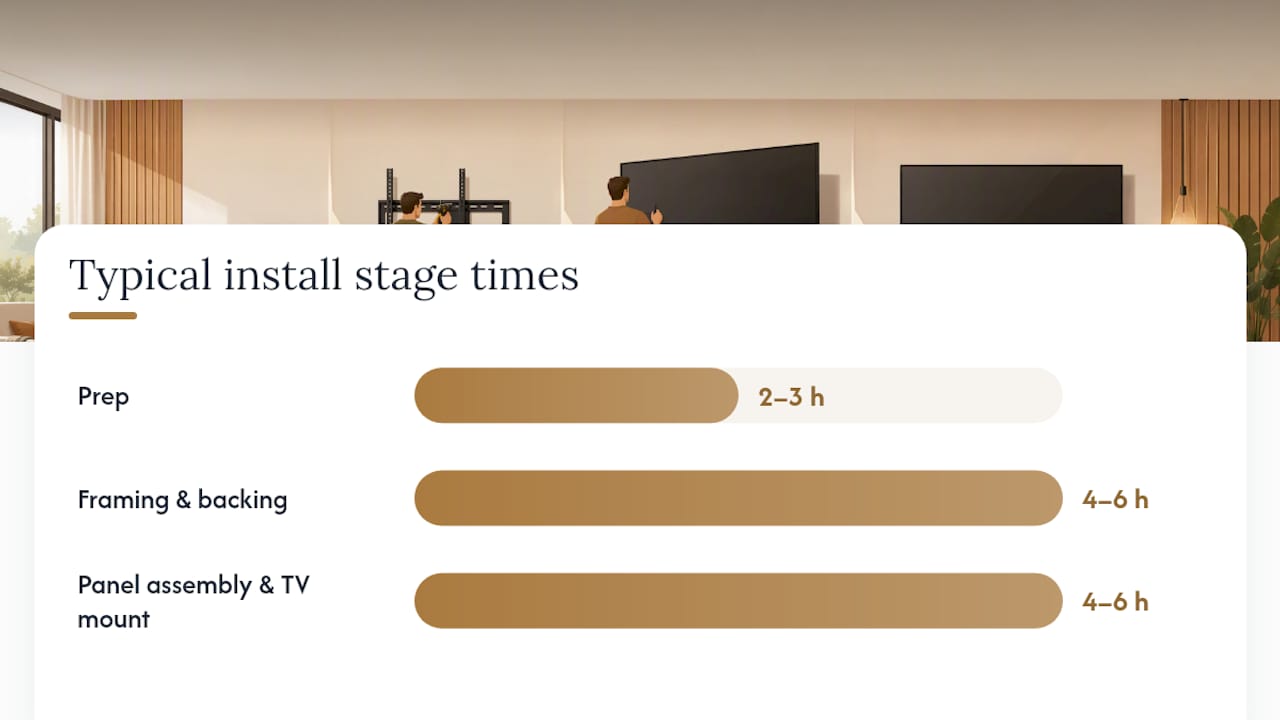
Most DIY installs break into four stages, and two of them can genuinely happen in a weekend.
- Prep (2 to 3 hours): Locate studs, mark the layout, confirm outlet placement, and dry-fit panels before any cutting or fastening.
- Framing and backing (4 to 6 hours): Install plywood backing, add blocking where needed, and mount any structural cleats.
- Panel assembly and TV mount (4 to 6 hours): Attach pre-cut panels per the labeled layout, route cables through the built-in channels, and mount the TV.
- Finishing (variable, often extends past the weekend): Caulking, touch-up paint, LED wiring, and trim work. This is the stage most likely to spill into a following weekend, especially with lighting or a fireplace insert involved.
Plan for two people on the heavier stages. Panels sized for an 85" wall are large and awkward for one person to hold level while fastening, and mounting the TV itself is far easier with a second set of hands.
Tools to have on hand: a stud finder, a cordless drill/driver, a 4-foot level, and a ladder. A miter saw is worth renting rather than buying if you don't already own one. If drywall patching is part of the job, either budget extra time to learn it or line up a subcontractor for that piece alone.
Which Design Details Make the Wall Look Custom?
Proportion does more work than finish quality when it comes to making a media wall look built-in rather than assembled. On a 12 to 16 footwall, keeping the TV at roughly two-thirds of the total width, with balanced margins on each side, is what prevents the "screen floating in space" look.
- Match cabinetry paint to the wall color, or run the same panel grain unbroken across the full width, to hide seams between sections.
- Recess LED lighting behind slat panels or floating shelves to add a shadow line instead of a flat, boxy edge.
- Stagger shelf heights slightly rather than lining everything up in a single row. It reads as designed rather than assembled from a kit.
- Avoid mounting the TV on an undersized base or narrow console. A screen that big on a skinny stand creates the "lollipop effect," where the TV visually overwhelms whatever it's sitting on.
- Keep AV components tucked into closed cabinetry rather than stacked on an open shelf where cables show.
Pro Tip: If you're using slat accent panels, run them floor to ceiling rather than stopping at the TV's top edge. It reads as architecture, not decoration.
Why Kits Beat Custom Carpentry for Most Homeowners
Custom carpentry still wins in specific situations: irregular wall angles, historic homes with plaster and lath instead of drywall, or a homeowner who wants specialty millwork no kit will replicate. Outside those cases, a pre-cut kit is the better bet for most people reading this.
Modular kits are often cited as roughly 70% cheaper than fully custom built-ins, and they arrive on a timeline measured in days, not weeks of contractor scheduling. Pre-cut, pre-labeled panels also remove the most common DIY failure point: cutting a panel wrong and having no way to fix it without ordering new material. That single change, going from "cut it yourself" to "assemble what's already cut," is what actually shortens the install.
Ready to Order Your 85 Inch TV Wall Kit?
Once your measurements are confirmed, the next step is picking a style and locking in a finish. Some kits are pre-cut and pre-labeled specifically for widths and depths like the ones covered above, which helps panels line up correctly on assembly.
Start by confirming your TV dimensions and wall width against the ranges covered here, then browse the full shop for DIY media wall kits to compare styles. If you want to see finish and texture options up close before committing, the Oslo slat wall kit and the Luxe Marble Glow kit are good places to start. Need lighting, grommets, or a fireplace insert added to your build? The accessories catalog covers those add-ons directly.
Some kits come with expert support and risk-free returns, and many customers have completed installs using pre-cut panel systems. If you're not sure which style fits your wall, reach out for a design consult before you order. Confirm your measurements, pick a kit, order a finish sample, and get on the schedule for your build.
A Publisher's Take on Kits vs. Custom Builds
The kit-versus-custom debate gets framed as a quality tradeoff, and that's mostly wrong. The real difference is error tolerance. Custom carpentry demands the carpenter get every cut right the first time, on-site, with no do-over. A pre-cut kit shifts that risk to the factory, where the tolerances are tighter and the mistakes get caught before the box ships.
That's not a knock on skilled carpenters. It's just math: fewer on-site variables mean fewer ways for an 85" installation to go sideways. Custom work still earns its price tag on genuinely irregular walls or in older homes where nothing is square. For a standard wall in a standard room, though, the kit route gets you to the same visual result with less risk and a shorter timeline.
— Jake
Sources
For deeper detail on framing, in-wall power kits, and depth planning, the DIY Media Wall Build Guide and the Floating Entertainment Center Buying Guide both cover technical build steps in more depth. For styling inspiration once your kit is ordered, see 10 stylish TV wall decor upgrades and home organization systems for flanking storage ideas.
- DIY Media Wall Build Guide: Costs, Steps, Pitfalls - Stewart Milne Homes
- Modular Media Wall: Custom Storage with Sideboards (2026) – CHITA LIVING
- Floating Entertainment Center Buying Guide 2026 - POVISON Blogs
- Why I Traded Expensive Built-Ins for a TV Modular Wall Unit
FAQ
How wide should a media wall be for an 85" TV?
Plan for roughly 120 to 140 inches of total width, which keeps the TV at about two-thirds of the visual span with balanced margins on each side.
How far off the wall does an 85" media wall stick out?
Once framing, drywall, TV depth, and cable clearance are factored in, most finished media walls project about 12 to 14 inches from the original wall.
Do I need an electrician to install an 85 inch TV wall?
You need one for any recessed, in-wall outlet or code-rated in-wall power run behind the TV; standard extension cords aren't rated for that use, and many municipalities require a permit for the outlet relocation.
How high should an 85" TV be mounted?
For most seated viewing, the center of the screen should land around 42 to 48 inches off the floor, adjusted based on your specific couch height.
Is a media wall kit cheaper than custom built-ins?
Yes.