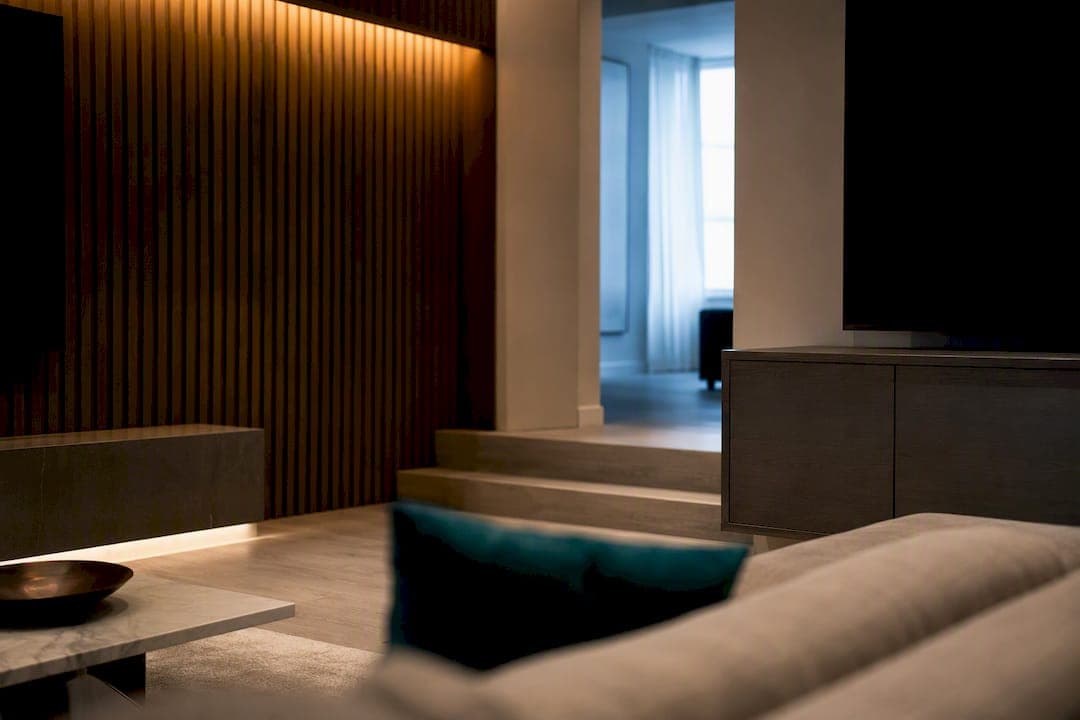
If you own your home and want a permanent, high-design focal point with wiring hidden inside the wall, build a media wall. If you rent, move often, or want to keep costs low and options flexible, a freestanding entertainment center is the smarter buy. The real trade-off is permanence and polish versus mobility and price.
TL;DR:
- Media walls are permanent fixtures built into the wall, costing more initially but increasing home value, especially if staying long-term.
- Installation of a media wall involves drywall, electrical work, and finishing, taking several days to weeks for custom builds, whereas entertainment centers are assembled quickly and are moveable.
- Media walls manage cables inside the wall for a cleaner look and accommodate integrated lighting or fireplaces, while entertainment centers route cables behind or through the unit.
- Entertainment centers are more adaptable to different TV sizes and upgrades, making them ideal for renters or those planning frequent electronics replacements.
- DIY media wall kits offer an affordable, quick-to-install middle ground, but structural quirks and electrical work may require professional support.
Table of Contents
- Media Wall vs Entertainment Center at a Glance
- How Do Media Walls and Entertainment Centers Really Differ?
- Which Setup Should You Choose? A Quick Checklist
- What Will It Cost, and How Long Will It Take?
- DIY Media Wall Kits vs Full Custom Builds
- What Exactly Is an Entertainment Center?
- Will Your TV and Sound System Actually Fit?
- Can You Upgrade Your Electronics Easily Later?
- How Much Upkeep Does Each Option Need?
- Author Perspective: What Actually Tips the Decision
- Want the Media Wall Look Without a Full Custom Build?
- Sources
- FAQ
Media Wall vs Entertainment Center at a Glance
The two options solve the same problem, showing off your TV, in almost opposite ways. One is built into the architecture of your room. The other sits in it.
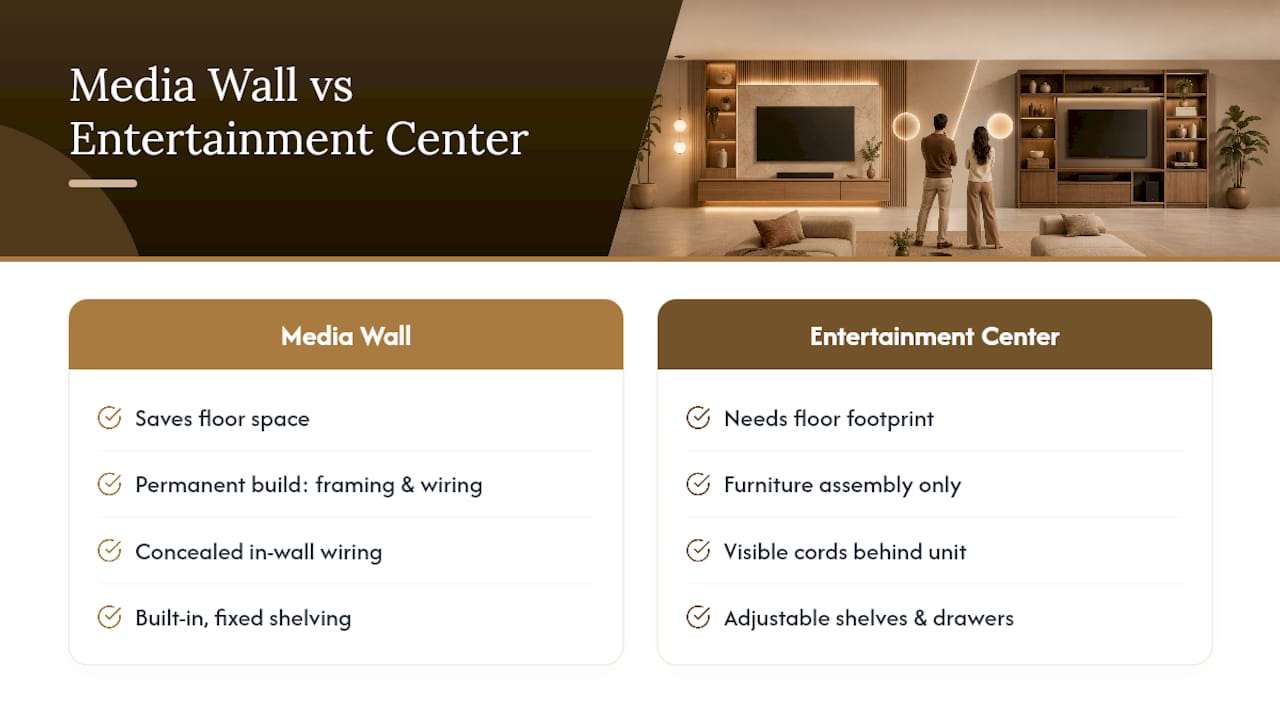
- Permanence: Media walls are fixed to the wall; entertainment centers can be moved or sold.
- Cost: Entertainment centers cost less upfront; media walls run higher but scale with finish level.
- Installation: A DIY media wall kit can go up in a weekend; a flat-pack entertainment center takes an afternoon.
- Mobility: Entertainment centers travel with you; media walls stay with the house.
- Cable management: Media walls hide wiring inside the wall; entertainment centers route cables behind or through the unit.
- Storage: Media walls offer built-in niches and floating cabinetry; entertainment centers rely on shelves and drawers.
- Aesthetic impact: Media walls read as architecture; entertainment centers read as furniture.
- Resale value: A well-built media wall can be perceived as a home upgrade; furniture leaves with the seller.
If you're staging a rental apartment for two years, skip the wall work. If you just closed on a house you plan to stay in for a decade, the wall is worth the investment.
How Do Media Walls and Entertainment Centers Really Differ?
Size and spatial impact. A media wall can be designed to save floor footprint, using floating cabinetry or vertical slat panels that sit flush against the wall instead of pushing furniture into the room. That matters most in smaller living rooms, where every extra foot of floor space between the sofa and the TV counts. Entertainment centers, by contrast, need floor space to stand on, and a bulky unit in a tight room can make the whole space feel smaller than it is.
Installation and permanence. A media wall is an architectural project. Depending on scope, that means framing, electrical work for outlets and lighting, and drywall or panel finishing before the TV even goes up. An entertainment center needs none of that. You unbox it, assemble the panels, and slide it into place. One is construction; the other is furniture assembly.
Cable management and AV integration. This is where media walls earn their reputation. Wiring for the TV, soundbar, and streaming devices runs inside the wall itself, so nothing is visible except the screen. Many designs also fold in an electric fireplace, ambient LED lighting, and recessed AV shelving as part of one architectural feature. Entertainment centers manage cables with tidies, sleeves, or a back panel with cutouts. It works, but you'll still see a bundle of cords if you look behind the unit.
Storage and display. Media walls typically include built-in shelving, recessed niches, and floating cabinets designed around the specific dimensions of your TV and components. Entertainment centers offer more universal storage: adjustable shelves, drawers, and a flat top surface for decor. If you own a lot of physical media or gaming hardware, the flexible shelving of a freestanding unit might actually serve you better.
Aesthetic impact. A media wall layered with vertical slats, floating cabinetry, and recessed lighting looks bespoke because it's built to the room, not placed in it. Simply mounting a TV and hanging a shelf rarely produces that same effect. Entertainment centers depend more on furniture style and how you decorate around them.
Resale and value. A well-executed media wall often reads as a permanent upgrade to buyers and real estate agents, similar to a renovated kitchen. Freestanding furniture doesn't carry that same weight since it leaves with you.
Which Setup Should You Choose? A Quick Checklist
Answer these questions honestly before you commit to either option.
- How long will you stay in this home? Under two years favors an entertainment center; five-plus years favors a media wall.
- Does your lease or HOA allow wall modifications? Renters and many condo owners should default to freestanding furniture.
- What's your budget ceiling? If you're working with a tight number, furniture wins on cost predictability.
- How much storage do you actually need? Heavy media or gaming collections often fit better in open shelving.
- What size is your TV, and where will it sit relative to eye level when seated? This affects both mount type and wall design.
- Do you want an integrated fireplace or ambient lighting? That points toward a media wall build.
- How much disruption can you tolerate? Drywall dust and a few days without your living room is a real cost, not just a time cost.
Choose a media wall if you own the home, want the fireplace and lighting integration, and plan to stay put. Choose an entertainment center if you're renting, budget-conscious, or likely to move within a few years. Before hiring a contractor or buying a kit, ask directly: What's included in the quoted price? Who handles the electrical work? What happens if the wall isn't structurally simple to work with?
What Will It Cost, and How Long Will It Take?
Entry-level DIY media wall kits sit well below full custom builds, since the panels arrive pre-cut and pre-labeled instead of requiring a carpenter to fabricate everything on-site. Mid-range custom media walls cost more once you add an electrician, drywall finishing, and custom cabinetry, and luxury custom builds with stone finishes or integrated fireplaces run higher still. Actual numbers vary a lot by region and finish level, so treat any online estimate as directional guidance rather than a quote.
Timelines follow the same split. A weekend is realistic for a pre-cut kit install. A contractor-built media wall with electrical and finish work can take several days to a week, depending on how much of the wall needs opening up. An entertainment center takes only a short time to assemble.
Watch for hidden costs on either path: an electrician to add or move an outlet, the TV mount hardware itself (not always included), paint or finish materials to match your wall, and in some areas, a permit if you're altering framing or wiring. None of these are dealbreakers, but they add up if you're not planning for them.
DIY Media Wall Kits vs Full Custom Builds
A DIY kit occupies the middle ground between a big-box entertainment center and a fully custom media wall. Panels arrive pre-cut and pre-labeled, so assembly follows a sequence instead of requiring a carpenter to measure and cut on-site. That cuts both cost and time compared to a bespoke build.
The trade-offs are real, though. Some kits still require basic electrical work, like adding an outlet behind the panel or running a cable to a soundbar. Once installed, a kit is close to permanent, so it suits owners more than renters. And every wall has quirks, studs, outlets, uneven framing, that can complicate even a well-labeled kit.
- Speed: a weekend install versus weeks for a custom build.
- Cost: lower than a bespoke wall, higher than flat-pack furniture.
- Finish quality: integrated lighting and floating cabinetry without hiring a designer.
- Limitation: structural quirks in older homes may need a contractor's eye first.
Pro Tip: Before ordering a kit, measure your wall twice and confirm your TV's VESA mount pattern. A mismatch between bracket and TV is the most common reason installs stall halfway through.
Companies like The Media Wall Store build kits around this exact gap, with more than 1,000 customers who've used the pre-cut panel system, weekend install process, and included support. Before buying, confirm your wall measurements, verify TV size and VESA compatibility, plan for any electrician work, decide on paint or finish, and check the return policy in writing.
What Exactly Is an Entertainment Center?
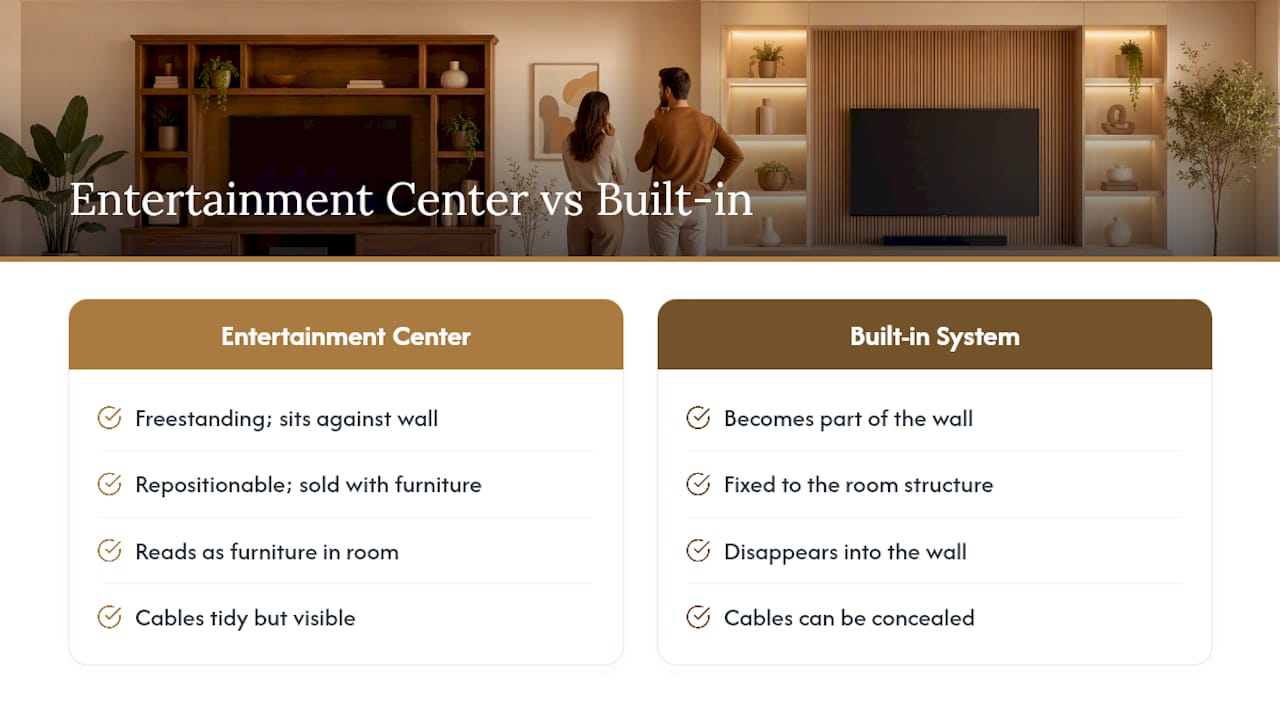
An entertainment center is freestanding furniture built to hold a TV and its supporting electronics. Think of it as a piece you buy the way you'd buy a dresser or a bookshelf: it arrives assembled or flat-packed, you place it against a wall, and it stays a piece of furniture rather than becoming part of the wall itself.
Most entertainment centers include a mix of open shelving for the TV and closed cabinets or drawers for consoles, cable boxes, and media storage. Styles range from simple two-shelf stands to large armoire-style units with doors that conceal the screen entirely when not in use. Materials vary widely too, from particleboard with a veneer finish to solid wood construction that can last decades.
The defining trait is mobility. An entertainment center can be repositioned, rearranged, or sold with the rest of your furniture when you move. That makes it the practical default for renters and frequent movers, since nothing about the setup is tied to the structure of the room. If you want a media wall feel without the commitment, adding a smart RGB light bar behind the TV on top of an entertainment center is a low-cost way to approximate that ambient glow.
The trade-off is that an entertainment center will never disappear into the wall the way a built-in system does. Cables can be tidied but rarely vanish completely, and the unit itself always reads as an object in the room rather than part of its architecture.
Will Your TV and Sound System Actually Fit?
Both setups can handle nearly any TV size, but the planning differs. A media wall is typically designed around your exact TV dimensions and VESA mount pattern before construction starts, so the recess, floating shelf, or in-wall bracket fits that screen specifically. Swap to a much larger or smaller TV later, and you may need to adjust the opening or bracket.
An entertainment center is more forgiving on size, since most units are designed with a shelf or open bay that accommodates a range of TV widths and stand types. The trade-off is that a mismatched TV can look visually off, either dwarfed by an oversized cabinet or overhanging a shelf that's too narrow.
Sound systems follow a similar pattern. Media walls often route soundbar or in-wall speaker wiring during the build, which means clean integration but less flexibility if you upgrade your audio setup later. You may need to open a panel or access a cavity to run new cable. Entertainment centers make swapping a soundbar or adding a subwoofer simple: unplug, reposition, plug back in. If you're the type to chase every new audio release, that flexibility has real value.
For surround sound setups with satellite speakers, neither option solves wiring on its own. Floor speakers still need their own cable runs regardless of what's holding the TV, though a media wall can sometimes accommodate in-wall speaker wiring as part of the initial build if you plan for it upfront.
Can You Upgrade Your Electronics Easily Later?
Entertainment centers win decisively here. Swapping a cable box, adding a new streaming device, or replacing a soundbar means reaching behind an open shelf or through a cutout. No tools, no wall access, no planning required.
Media walls make you think ahead. Because wiring runs inside the wall, adding a new device that needs a fresh cable run, say, upgrading from a basic soundbar to a full surround system, can mean opening a panel or running cable through an existing conduit if one was built in. This is exactly why the in-wall routing on a well-planned media wall matters so much at the design stage: leaving even one spare conduit run can save a headache two TV upgrades from now.
TVs themselves are usually the easy part either way, since most modern sets use the same VESA mount standard regardless of brand. The friction shows up with peripherals: game consoles, streaming boxes, or a receiver upgrade that needs an HDMI run you didn't originally plan for.
If you expect to upgrade your setup frequently, chasing the newest console or swapping streaming boxes every year or two, an entertainment center's open access is a genuine practical advantage, not just a cost-saving one. If your electronics are fairly stable and you're building for the long term, a media wall's cleaner look outweighs the minor inconvenience of occasional wall access.
How Much Upkeep Does Each Option Need?
Entertainment centers show wear the way most furniture does: scuffed veneer, loosening hardware, drawer slides that eventually stick. Solid wood pieces hold up for decades with occasional polish; particleboard units tend to show their age faster, especially at corners and joints.
Media walls, once built, are largely maintenance-free in the traditional furniture sense, there's no hardware to tighten or drawer to realign. The upkeep shifts instead to the finish. Painted surfaces may need occasional touch-ups, integrated lighting components can need bulb or driver replacement over the years, and any electric fireplace insert has its own service schedule separate from the wall structure itself.
Durability also depends heavily on build quality rather than which category you chose. A cheap flat-pack entertainment center from a big-box store may not survive a cross-country move, while a well-made one lasts through several. Similarly, a media wall built with quality panels and proper wall anchoring will outlast one that cut corners on materials or skipped proper stud support.
One practical difference: because a media wall is fixed, any repair, patching a scuff, replacing a light strip, generally happens in place. An entertainment center's damage can sometimes be solved by simply replacing a shelf or the whole unit, which is often cheaper than a wall repair.
Author Perspective: What Actually Tips the Decision
Most people overthink the aesthetics and underthink the timeline. A media wall wins on almost every design metric, but it only makes sense if you're staying long enough to justify the disruption of getting there. Permanence and flexibility are the whole decision. Everything else is detail.
— Jake
Want the Media Wall Look Without a Full Custom Build?
There's a real gap between a $200 flat-pack TV stand and a $15,000 custom-built wall with an electrician and a carpenter on payroll. That gap is exactly what a pre-cut, pre-labeled kit closes: the architectural look of a built-in wall, assembled by you in a weekend, without a construction crew in your living room for a week.
Kits from The Media Wall Store come with integrated LED lighting, floating cabinetry, and modular finish options, including slat accent panels and electric fireplace configurations, all pre-cut and labeled for assembly. Before ordering, measure your wall, confirm your TV's VESA mount size, and plan for any outlet work an electrician might need to handle. If you want something bolder, browse design collections for finish inspiration, or check availability by region to see sizing options near you. Every kit ships with support access and a returns policy to assist during assembly.
Ready to see what fits your wall? Start with the kit shop and measure twice before you order.
Sources
- TV Media Wall vs Entertainment Center | Modern Living Room Design
- Cost to build a media wall vs buying a pre-built entertainment center
FAQ
Why don't TVs come with center stands anymore?
Modern flat-panel TVs are designed for wall mounting or slim pedestal stands because their thin profile no longer needs a bulky center base for support, which pushed design toward media walls and low-profile entertainment centers instead.
Where should you avoid placing a TV?
Avoid direct sunlight exposure, spots above a fireplace without planning for proper eye-level height when seated, and walls without nearby power access, since all three create glare, neck strain, or awkward cable runs.
Which type of TV mount is best?
A full-motion mount offers the most flexibility for viewing angles, while a fixed or low-profile mount works best inside a media wall recess where the TV sits flush against the surface.
Should an entertainment center be longer than the TV?
Yes, most designers recommend an entertainment center that extends beyond the TV's width on both sides, roughly a few inches per side, so the screen doesn't visually overhang the furniture below it.
Is a DIY media wall kit a good middle option?
For many homeowners, yes. A kit from a company like The Media Wall Store offers the integrated look of a custom media wall at a lower cost and with a weekend installation timeline instead of a multi-week build.