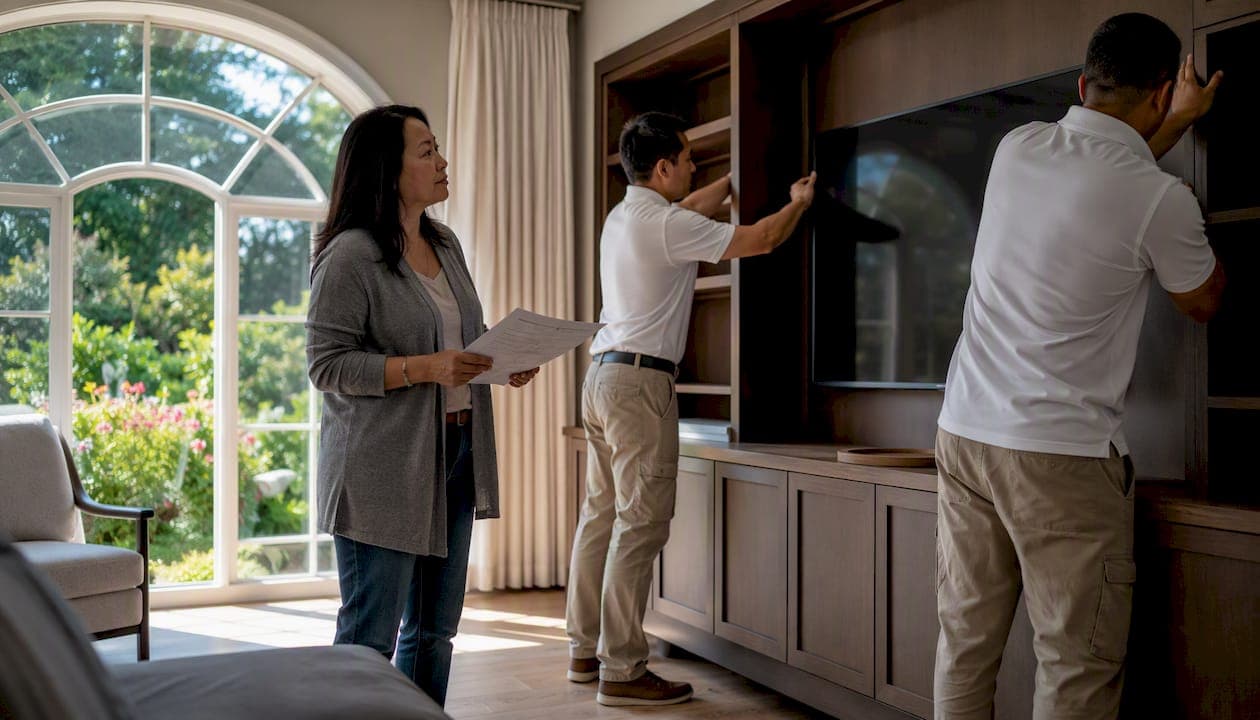
White glove installation is a premium in-home service that covers room-of-choice placement, professional assembly, technical setup, and complete removal of all packaging. If you're dealing with a large TV, integrated media wall, built-in cabinetry, or any item where a botched install voids the warranty, this is the service tier worth paying for. For homeowners in the San Francisco Bay Area, Themediawallstore offers exactly this: local white-glove installation for custom media walls, with trained crews handling everything from pre-cut panel alignment to LED integration and concealed wiring.
Table of Contents
- What does white glove installation actually include?
- Who actually benefits from white-glove service?
- How is white-glove installation priced?
- What should you expect on installation day?
- How do you choose a trustworthy white-glove installer?
- Why Themediawallstore is a strong choice for media wall installs
- How does white-glove service compare to standard installation?
- Where is white-glove installation available?
- Key Takeaways
- Why professional installation matters more than people think
- Themediawallstore's white-glove installation for media walls
- Useful sources
- FAQ
What does white glove installation actually include?
The short answer: a lot more than most people expect. White glove installation goes well beyond doorstep delivery to include in-home placement in the room of your choice, professional assembly to manufacturer specs, technical setup and functional testing, and full removal of all packaging debris.
Here's what a complete scope typically covers:
- Room-of-choice delivery and careful handling: The crew brings items to the exact room, not just the front door. On arrival, they inspect for visible transit damage before anything comes inside.
- Unpacking and damage check: Every component is opened and inspected on-site. Any damage gets documented immediately, which establishes liability and speeds up claims if needed.
- Professional assembly and installation: Furniture, window treatments, media wall panels, and electronics are assembled to manufacturer specifications, not just "put together."
- Technical setup and testing: This includes TV mounting, electrical hookups, motorization calibration for window treatments, and AV system verification. The installer confirms everything works before leaving.
- Debris and packaging removal: All boxes, foam, and wrapping leave with the crew. Some providers also offer haul-away of old items, though that's worth confirming in advance.
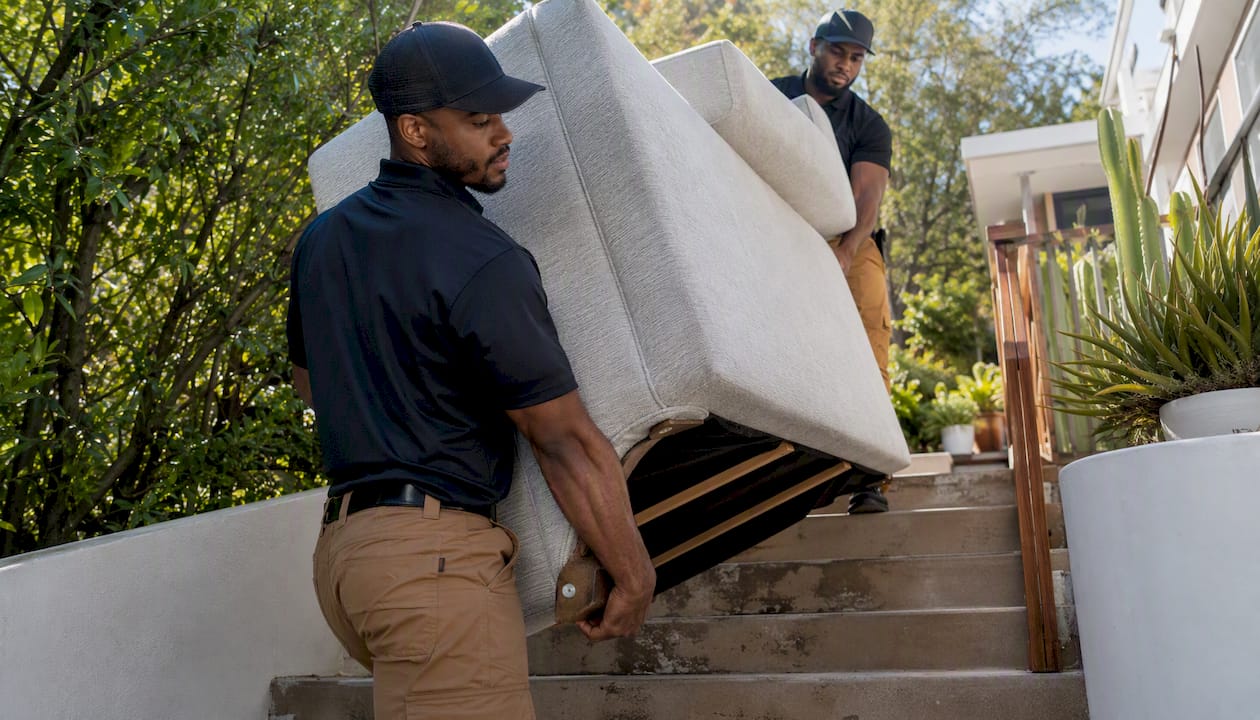
- Scheduling and logistics: Most reputable providers schedule a 4-hour appointment window rather than an all-day wait. Large or heavy items typically arrive with a two-person crew using specialized equipment like stair rollers or furniture lifts.
One thing worth knowing: the term "white glove" is not regulated, so what one provider calls white glove may not include debris removal, old-item disposal, or technical calibration. Always confirm the exact scope in writing before booking.
Pro Tip: Ask for a written scope of work that lists every deliverable. If debris removal, stair carries, or electrical hookups aren't on the list, assume they're not included.
Who actually benefits from white-glove service?
White glove is worth the premium when the cost of a mistake is higher than the service fee. That's the clearest way to think about it.
High-value and technical items are the obvious candidates. A 75" OLED mounted incorrectly can crack the panel or strip the wall anchor, turning a $200 install into a $2,000 problem. Integrated media walls with LED lighting, floating cabinetry, and concealed wiring have enough interdependent components that a single misaligned panel throws off the whole system. White glove service limits damage, reduces returns, and preserves warranties for exactly these scenarios.
Common use cases where it pays off:
- Integrated media walls with slat panels, LED strips, and wire management
- Oversized sofas, sectionals, or modular furniture that requires disassembly to fit through doorways
- Large TVs and full AV systems requiring wall anchoring and cable routing
- Built-in cabinetry and entertainment units
- Heavy appliances (refrigerators, washers, fitness equipment) needing hookups
- Fragile or high-value items like artwork, antiques, or custom pieces
Awkward access makes it even more compelling. Narrow hallways, tight staircases, and multi-story homes are exactly where DIY attempts go wrong. If the item requires a manufacturer-certified installer to keep the warranty valid, that alone settles the question.
When white glove probably isn't necessary: small flat-pack furniture with minimal assembly, lightweight electronics you can carry yourself, or any item where the assembly is genuinely simple and the stakes are low.
How is white-glove installation priced?
Consumer price ranges typically vary for small electronics, medium furniture, and large or complex installs, depending on access, labor, and scope. A full media wall installation with electrical integration and custom panel alignment sits at the higher end of that range.
| Install Type | Typical Range | Key Cost Drivers |
|---|---|---|
| Small electronics (soundbars, monitors) | $50–$150 | Minimal labor, no heavy lift |
| Medium furniture (sofas, beds) | $100–$300 | Assembly complexity, access |
| Large furniture or built-ins | $150–$500+ | Crew size, stair carries, time |
| Integrated media walls | $300–$500+ | Electrical, LED, wire management |
| Appliances with hookups | $150–$400 | Specialty trades, permits |
The primary cost drivers beyond item size:
- Stair and long carries: Most providers charge extra for stairs or long distances from the truck to the room. Ask upfront whether this is included or billed separately.
- Haul-away of old items: Removing an old TV stand or sofa typically adds to the total.
- Specialty trades: Electrical or gas hookups often require a licensed subcontractor, which adds both cost and scheduling complexity.
- Travel distance: Providers serving rural or remote areas may add a travel fee.
- Peak scheduling: Weekend or same-week slots often carry a premium.
Get an itemized estimate that separates labor, travel, haul-away, and any specialty trade costs. A single-line quote makes it nearly impossible to compare providers accurately or spot what's missing.
What should you expect on installation day?
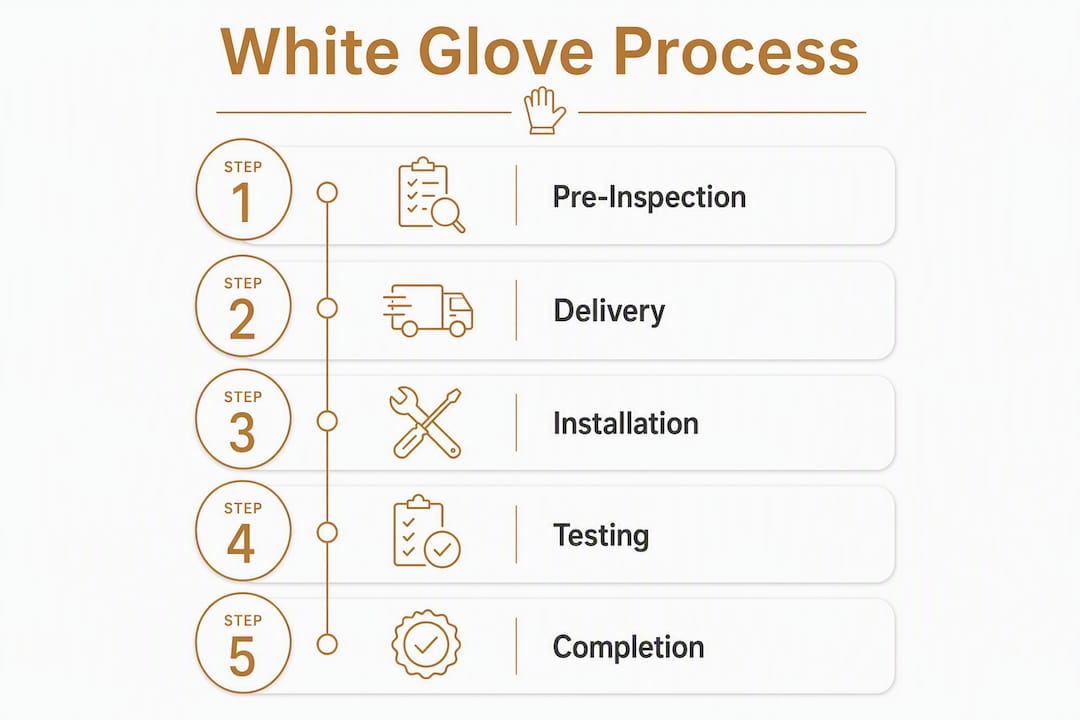
Most white-glove installs follow a predictable sequence, and knowing it helps you prepare.
Before the crew arrives: You'll typically get a confirmation call or text the day before, along with a 4-hour arrival window. Clear a path from the entry to the installation room, measure doorways if you have any concerns about clearance, protect hardwood floors with moving blankets or cardboard, and secure pets. Have any building access codes or elevator keys ready.

On arrival: The crew performs an on-site inspection and notes any visible transit damage before bringing the item inside. This step matters. Documenting damage at the door establishes liability clearly and speeds up any claims. Providers increasingly use photo proof-of-delivery and digital checklists to verify the install was completed correctly.
For complex installs, a good provider may have requested pre-installation photos in advance: wall material (drywall vs. brick), TV VESA mounting pattern, or floor load limits. This lets them bring the correct anchors and tools and avoid on-site delays.
During the install: Assembly, mounting, wiring, and testing happen in sequence. A two-person crew handles heavy lifts safely. Once everything is assembled and mounted, the installer runs a full function test before asking for your sign-off.
At completion: You do a walkthrough, test all functions yourself, and receive written documentation of the work completed. Ask for the workmanship warranty in writing at this point if you haven't already.
Pro Tip: Photograph the finished installation from multiple angles and keep the installer's written scope of work on file. If a warranty claim comes up six months later, that documentation is what gets it resolved quickly.
How do you choose a trustworthy white-glove installer?
The term "white glove" carries no industry certification requirement, so the quality gap between providers is real. Here's how to evaluate one before you commit.
The decision checklist:
- Liability insurance and workers' comp: Ask for a certificate of insurance. If a crew member is injured in your home and the provider has no workers' comp, you could be liable.
- Manufacturer certifications: For window treatments, look for Hunter Douglas certification or equivalent. For AV installs, ask about CEDIA training or manufacturer-specific credentials.
- Written scope of work: Every deliverable, every exclusion, in writing before the job starts.
- Itemized estimate: Labor, travel, haul-away, and specialty trades listed separately.
- Workmanship guarantee: How long does it cover, and what's the resolution process?
- References and project photos: A provider who can't show before/after photos or provide references is a provider who hasn't done enough of this work.
Key questions to ask during quoting:
- What exactly is included in your white-glove scope?
- Are stair carries and long carries included, or billed separately?
- Do you perform electrical or gas hookups in-house, or do you subcontract those trades?
- What is your damage policy, and what's the typical resolution timeline?
- Can you provide a sample scope of work from a similar project?
Red flags to watch for:
- Verbal-only estimates with no written follow-up
- No proof of insurance when you ask
- Generic or unverifiable references
- Unwillingness to share before/after photos or describe their inspection protocol
- A single-line quote with no itemization
For built-ins, cabinetry, and home organization systems, One Day Doors & Closets is one example of a specialist installer that works from written scopes with defined installation standards, which is the model to look for regardless of the trade.
| Criterion | What to look for | Red flag |
|---|---|---|
| Insurance | Certificate of liability + workers' comp | "We're covered" with no documentation |
| Certifications | Manufacturer badges, CEDIA, AAMA | No credentials mentioned |
| Estimate format | Itemized by labor, travel, extras | Single-line total only |
| References | Named clients, project photos | Generic reviews, no photos |
| Warranty | Written, specific duration | Verbal promise only |
Why Themediawallstore is a strong choice for media wall installs
Themediawallstore offers local white-glove installation for media walls in the San Francisco Bay Area, covering the full scope: panel alignment, TV mounting, LED integration, wire management, and cleanup. Their kits arrive pre-cut and pre-labeled, which means the installation crew isn't improvising on-site. Every component is designed to fit together, which reduces install time and the risk of finish damage.
The proof points matter here. Over 1,000 satisfied customers, risk-free returns, and a product line built around precision manufacturing mean the installation team is working with components that are already engineered for clean results. The Monaco Noir™ Luxury Media Wall Kit and similar high-end kits are exactly the type of multi-component install where professional handling preserves both the finish and the integrated electronics.
Booking a white-glove install with Themediawallstore means a trained local crew handles panel placement, TV mounting, LED strip integration, and full wire concealment. You get a finished media wall that looks custom-built, without the risk of a DIY mistake on a high-value kit.
What to have ready when you request a quote:
- Room dimensions and wall measurements
- TV size and VESA mounting pattern
- Wall material (drywall, plaster, brick)
- Any access considerations (stairs, elevator, narrow hallway)
- Preferred installation window
How does white-glove service compare to standard installation?
Standard installation typically means a single technician who assembles the item per the manual and leaves. There's no room-of-choice placement, no damage inspection on arrival, no debris removal, and no functional testing beyond basic assembly. For a $300 bookshelf, that's probably fine.
The gap widens fast with complexity. A standard install for a media wall might get the panels on the wall, but it won't include LED calibration, concealed wiring, or a final AV function test. If something is wrong, you're calling back and scheduling a second visit. White-glove providers build the inspection, testing, and cleanup into the original appointment, so the job is genuinely done when they leave.
The other difference is accountability. White-glove providers document the install with photos and a written scope, which creates a clear record if something needs to be addressed later. Standard installation rarely includes that paper trail.
Where is white-glove installation available?
White-glove installation is widely available in major U.S. metro areas through national logistics providers and local specialty installers. Coverage thins out in rural areas, where travel fees apply and scheduling lead times are longer.
For media walls specifically, Themediawallstore's professional installation service covers the San Francisco Bay Area. Homeowners outside that area can still order DIY media wall kits with pre-cut, pre-labeled panels designed for weekend assembly, and the company's support team is available to guide the process. For buyers who want professional installation outside the Bay Area, the right approach is to source a local AV or custom furniture installer and confirm they can work with the kit's specifications before booking.
National white-glove logistics providers (Ryder, for example) serve retailers and manufacturers across the U.S., but their consumer-facing availability depends on the retailer's service agreement, not a direct booking.
Key Takeaways
White glove installation is worth the cost when the item is high-value, technically complex, or carries a warranty that requires professional handling, and Themediawallstore offers exactly this service for media walls in the San Francisco Bay Area.
| Point | Details |
|---|---|
| What it includes | Room-of-choice placement, assembly, technical setup, testing, and full debris removal. |
| Best use cases | Integrated media walls, large TVs, built-ins, heavy appliances, and any item where a DIY mistake voids the warranty. |
| Typical price ranges | $50–$150 for small electronics; $100–$300 for medium furniture; $150–$500+ for large or complex installs. (Integrated media walls: $300–$500+) |
| Must-ask questions | Request an itemized estimate, written scope of work, proof of insurance, and a workmanship guarantee before booking. |
| Themediawallstore | Offers local white-glove installation for media walls in the SF Bay Area, with pre-cut kits, LED integration, and trained crews. |
Why professional installation matters more than people think
The conventional wisdom is that white glove is a luxury upsell, something retailers push to pad margins. That framing misses the actual math. The cost of a failed DIY install on a $2,000 media wall kit isn't just the repair bill. It's the time lost, the finish damage that can't be undone, and the voided warranty on the TV you just mounted into a wall that wasn't properly anchored.
What I find more interesting is the documentation angle. The best white-glove providers now use photo proof-of-delivery and digital checklists as standard practice, not as a premium add-on. That paper trail is what separates a provider who stands behind their work from one who disappears after the invoice is paid. For a media wall with integrated electronics, that documentation is the difference between a warranty claim that gets resolved in a week and one that drags on for months.
The one thing most guides skip: ask for the scope of work before you agree to anything. Not after. A provider who hesitates to put their deliverables in writing before the job starts is telling you something important about how they'll handle problems after it's done.
Themediawallstore's white-glove installation for media walls
If you're in the San Francisco Bay Area and want a media wall that's built right the first time, Themediawallstore's white-glove installation service covers the full job: panel placement, TV mounting, LED strip integration, wire concealment, and cleanup. No subcontractors, no guesswork about whether the crew knows the kit.

The process starts with a consultation where you share your room dimensions, wall type, and TV specs. From there, you get a scheduled installation window, an on-site inspection, and a finished media wall that's tested and ready to use before the crew leaves. Kits like the All-Black Luxe Marble Glow are engineered for clean installs, and the professional service ensures the integrated lighting and concealed wiring are done to the same standard as the kit itself.
Browse the full media wall kit catalog or contact Themediawallstore directly to request a local installation estimate.
Useful sources
- What You Need to Know About White Glove Shipping — ARCB: Defines white-glove scope, scheduling norms, and the 4-hour appointment window standard.
- The Ultimate Guide to White Glove Delivery — Ryder: Covers service tiers, two-person crew practices, and the cost-benefit case for premium delivery.
- White Glove Delivery: Giving Your Shipments the Red-Carpet Treatment — Inbound Logistics: Explains photo proof-of-delivery, digital checklists, and day-of documentation practices.
- White-Glove Installation: What Premium Service Includes and Why It Matters — Concierge Technology: Source for consumer price ranges and the damage-inspection protocol.
- White Glove Logistics — AlphaZero Logistics: Covers pre-installation site assessments, scope documentation, and the unregulated nature of the term.
- What Is White Glove Delivery? — Corrigan Logistics: Practical overview of when white-glove delivery is the right choice and what it entails.
- Themediawallstore — Media Wall Kits and Local Installation: Product catalog and Bay Area installation service information.
FAQ
What is free white glove installation?
Free white-glove installation is a promotional offer where a retailer or manufacturer absorbs the installation fee as part of the purchase price. It typically includes the same scope as paid white-glove service: room-of-choice delivery, assembly, and debris removal, though the exact inclusions vary by retailer.
Is white glove assembly worth it?
For high-value, heavy, or technically complex items, yes. White-glove service limits damage, preserves manufacturer warranties, and handles the technical setup that standard delivery skips, making it cost-effective when the risk of a DIY mistake is high.
How much does white glove service cost?
Consumer prices typically range from $50–$150 for small electronics, $100–$300 for medium furniture, $150–$500+ for large or complex installs, and $300–$500+ for integrated media walls. Stair carries, haul-away, and specialty trades like electrical hookups add to the base cost.
What are the drawbacks of white glove service?
The primary drawback is cost. Scheduling lead times can also be longer than standard delivery, and availability is limited in rural areas. Because the term is unregulated, scope varies by provider, so you need a written scope of work to know exactly what you're paying for.
Does Themediawallstore offer white-glove installation?
Yes. Themediawallstore offers local white-glove installation for media walls in the San Francisco Bay Area, covering panel alignment, TV mounting, LED integration, wire management, and cleanup for their pre-cut media wall kits.