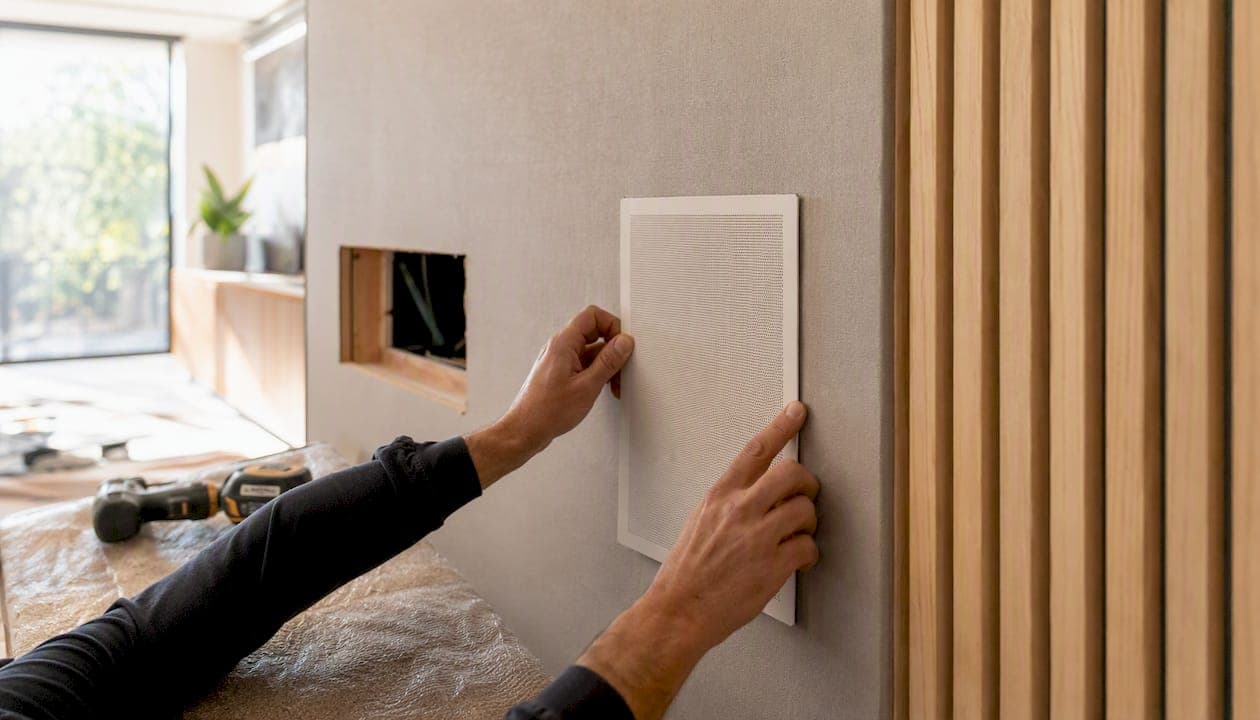
The most reliable ways to hide speakers in a media wall are in-wall or in-ceiling architectural speakers, acoustically transparent fabric panels, slatted accent panels, and built-in cabinetry with proper venting. Each approach works, but none is free of trade-offs.
Here's the honest short version before you commit to anything:
- In-wall / in-ceiling speakers disappear completely and sound excellent with back boxes installed, but they require cutting drywall and running wire before the wall is finished.
- Acoustically transparent fabric or paintable grilles let you hide surface-mounted speakers behind a seamless panel. Sound passes through with minimal loss when you use audio-rated grill cloth rather than generic textile.
- Slatted accent panels (the kind you see on modern media walls) can conceal shallow on-wall speakers behind the slat gaps while adding a design feature. The slat spacing matters for high-frequency transmission.
- Built-in cabinetry works for subwoofers and even mid-range speakers, but only if you vent it properly and decouple the driver from the cabinet structure.
The three trade-offs you need to accept upfront: hiding speakers almost always narrows the dispersion angle slightly, subwoofers are the hardest component to conceal without sound degradation, and the more invisible you want the system, the greater the installation effort required. Plan for all three before you pick a method.
Key Takeaways
Hiding speakers in a media wall works best when you pair the right concealment method with proper acoustic mitigation: back boxes for in-wall speakers, isolation and venting for subwoofers, and audio-rated fabric for fabric-panel installs.
| Point | Details |
|---|---|
| Choose the method by room type | In-wall speakers suit new builds; fabric panels and slat covers suit retrofits. |
| Back boxes are required for in-wall speakers | They contain the rear wave, prevent sound bleed, and tighten bass response. |
| Subwoofers need venting and decoupling | Use isolation pads and a toe-kick vent; never seal a sub in an unvented cabinet. |
| Test before you finish the wall | A provisional listening session catches placement and rattle problems before they become permanent. |
| Themediawallstore kits simplify the process | Pre-cut openings, cable channels, and acoustic slat panels reduce the carpentry variables in a concealed audio install. |
Table of Contents
- How can you hide speakers in a media wall? A practical look at every approach
- How does hiding speakers affect sound, and what can you do about it?
- Step-by-step: how to install hidden speakers in a media wall
- Which speaker types work best when you want them hidden?
- What homeowners consistently underestimate about hiding speakers
- Themediawallstore makes concealed audio easier from the start
- Sources
- FAQ
How can you hide speakers in a media wall? A practical look at every approach
Every concealment method sits somewhere on a spectrum between "completely invisible" and "sounds exactly like a free-standing speaker." Understanding where each lands helps you pick the right one for your room.
In-wall and in-ceiling speakers
These are the gold standard for hidden speaker placement. The speaker mounts flush with the drywall, the grille sits flat against the surface, and with a paintable grille, the whole thing disappears. AVSForum installer discussions consistently recommend back boxes to contain sound and prevent bleed into adjacent rooms. Without a back box, bass leaks through the wall cavity and the speaker's low-frequency response suffers.
Pros: Maximum invisibility, excellent sound with proper installation, permanent and clean. Cons: Requires wall access during framing or a retrofit cut, back boxes add cost and depth, and servicing later means opening the wall.
Acoustically transparent fabric and grille covers
A fabric-covered frame sits in front of the speaker, hiding it behind what looks like a decorative panel. This works beautifully on media walls where a fabric section reads as a design element rather than a speaker cover. The critical detail: use cloth specifically rated for audio transparency. Generic upholstery fabric blocks high frequencies noticeably.
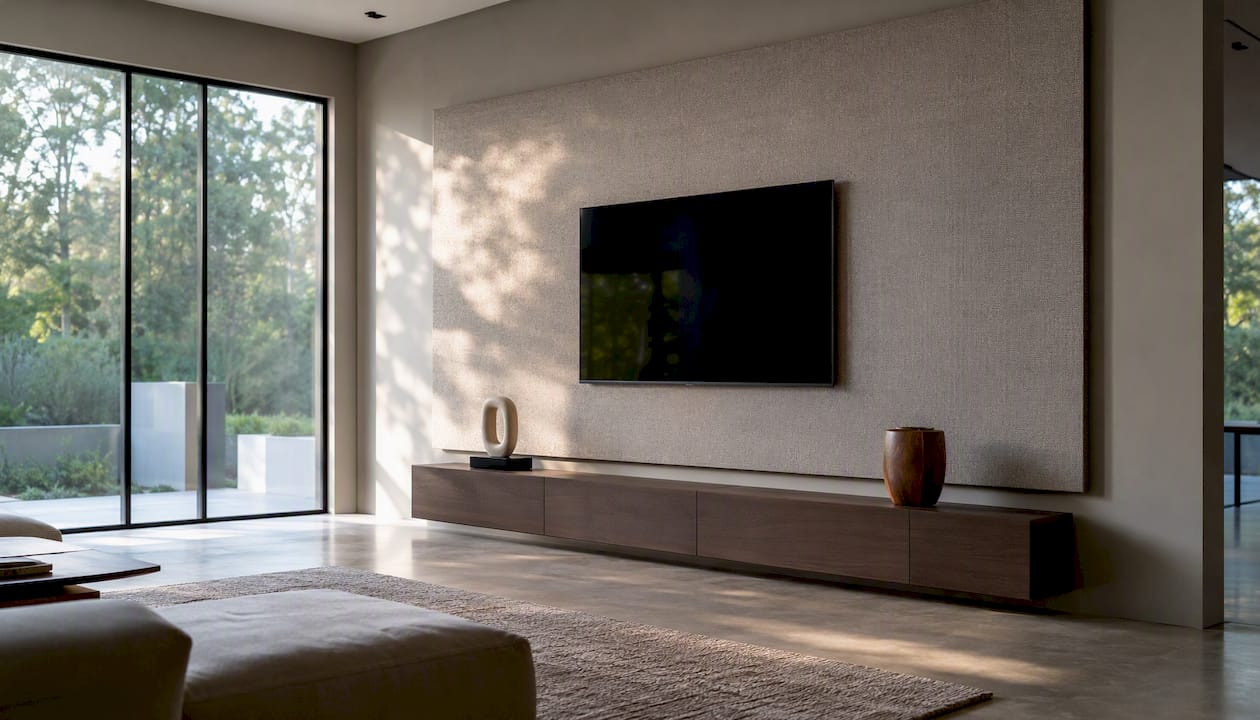
Pros: No wall cutting required, reversible, works with existing speakers. Cons: Adds a few inches of depth, fabric must be chosen carefully, and the frame needs to be rigid enough not to rattle.
Slatted and accent panels
Vertical slat panels are everywhere on modern media walls, and they double as speaker covers when the gap width is sized correctly. Narrow gaps filter high frequencies; wider gaps (roughly 1/2 inch or more) pass sound more cleanly. Pair slat panels with shallow on-wall speakers mounted behind them, and the result looks intentional rather than hidden. For design inspiration on how slat panels integrate with a full media wall, the panel interior design guide at Themediawallstore covers finish combinations that work well with concealed audio.
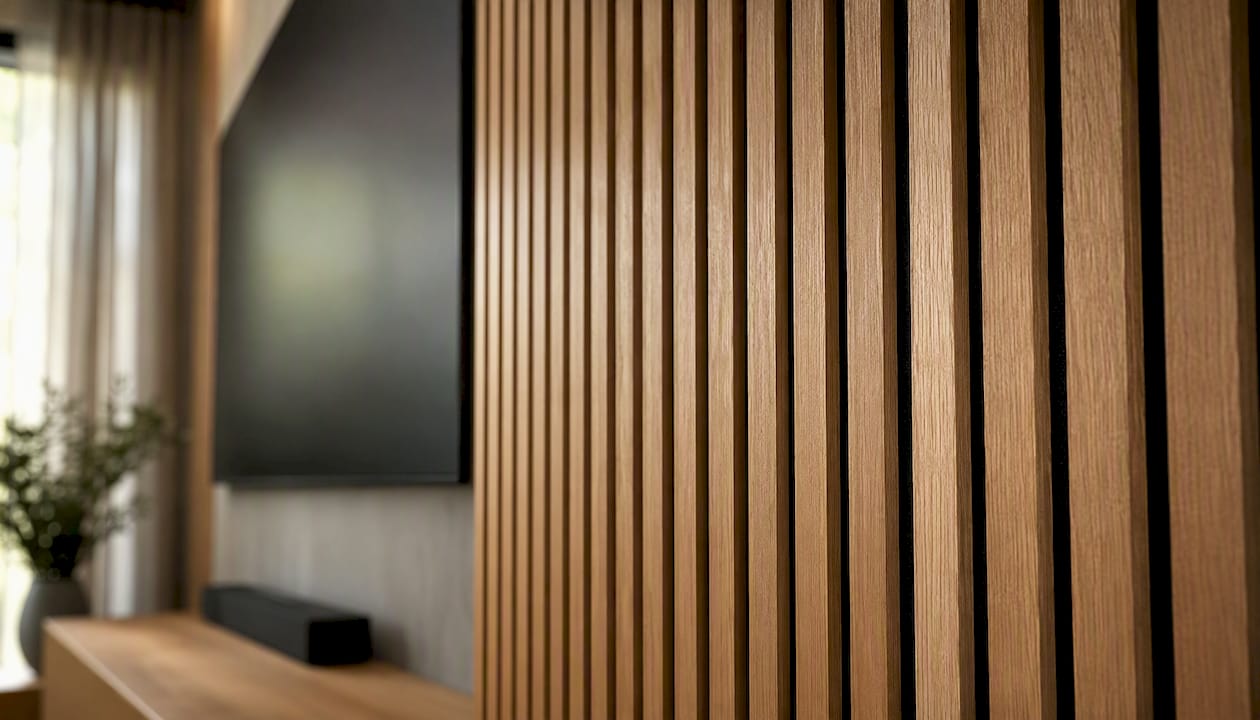
Pros: Doubles as a design feature, no grille visible, works with on-wall speakers. Cons: Slat spacing affects treble transmission, speaker depth must fit behind the panel thickness.
Inside cabinetry or furniture
Placing speakers inside closed cabinets is the most common DIY approach and the most acoustically risky. Midrange and treble speakers in sealed cabinets sound muffled. Subwoofers in cabinets can work, but Sound & Vision's guidance on cabinet subwoofers is clear: you need vibration isolation, proper venting, and thicker panels (5/8 inch to 3/4 inch) to avoid resonance and rattles.
Pros: Uses existing furniture, no wall work needed. Cons: Sealed cabinets degrade midrange and treble significantly; subs need venting and decoupling.
Disguised as artwork or decorative frames
Speakers mounted behind canvas-wrapped frames or framed acoustic panels look like wall art. This works best for surround channels where the speaker is not the primary focus. The frame needs an air gap behind the canvas and acoustically transparent material at the face.
Pros: Genuinely decorative, works anywhere on the wall. Cons: Limited to smaller speakers, requires custom framing, not ideal for front LCR channels.
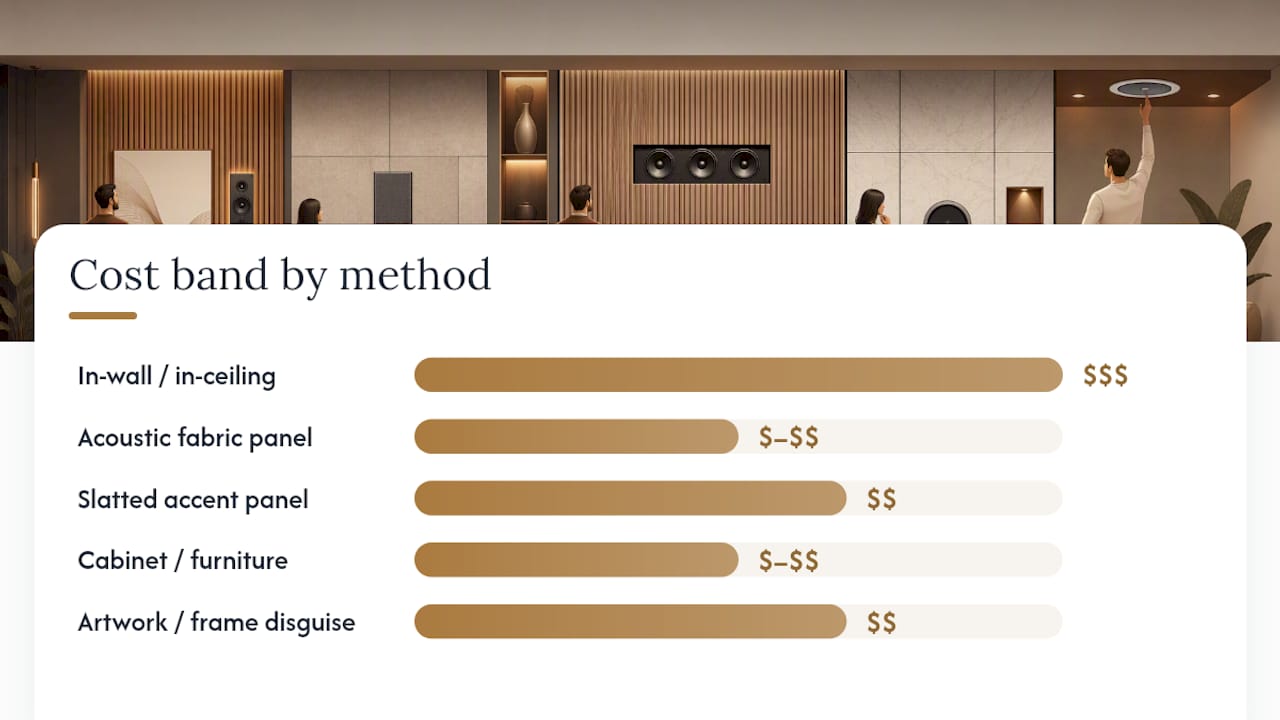
| Method | Invisibility | Acoustic fidelity | Installation complexity | Cost band |
|---|---|---|---|---|
| In-wall / in-ceiling | Highest | Excellent (with back box) | High | $$$ |
| Acoustic fabric panel | High | Very good | Low–Medium | $–$$ |
| Slatted accent panel | Medium–High | Good (gap-dependent) | Medium | $$ |
| Cabinet / furniture | Medium | Fair (requires venting) | Low | $–$$ |
| Artwork / frame disguise | High | Good | Medium | $$ |
How does hiding speakers affect sound, and what can you do about it?
Concealment always has acoustic consequences. The question is whether you manage them or ignore them.
Back boxes: non-optional for in-wall speakers
Without a back box, an in-wall speaker fires sound in both directions. The rear wave bounces around the wall cavity, leaks into adjacent rooms, and muddies the bass. A properly sized back box contains the rear wave, tightens low-frequency response, and prevents sound from traveling through shared walls. Installer communities on AVSForum treat back boxes as standard practice, not an optional upgrade.
If you're retrofitting into an existing wall, sealed back boxes are available in plastic and metal and can be installed through the speaker cutout before mounting the driver.
Subwoofer-specific challenges
Hiding a subwoofer in a cabinet is harder than hiding any other speaker type. The problems are predictable: cabinet panels resonate at bass frequencies, airflow restriction chokes the driver's output, and an oversized cavity creates internal reflections that muddy the bass. Sound & Vision's cabinet subwoofer guidance recommends isolation pads or SubDude-style platforms to decouple the sub from the cabinet floor, plus venting sized to at least match the driver's cone area.
Purpose-built in-cabinet sub systems sidestep most of these problems. Next Level Acoustics' in-cab sub manual describes downward-firing bandpass designs with dedicated toe-kick vent slots that preserve in-room bass response even when the driver is fully enclosed. These are worth considering if you want a clean, furniture-integrated sub without the guesswork.
Off-axis dispersion and seating coverage
Speakers maintain useful high-frequency detail within roughly 30 degrees off-axis. Seat someone outside that window and they lose treble clarity, which makes dialogue sound dull. When you hide speakers inside panels or behind fabric, the speaker's physical position is fixed, so seating layout matters more than it does with adjustable floor-standing monitors. Angled tweeters or wide-dispersion in-wall models extend that coverage window and are worth the small price premium in rooms with wide seating arrangements.
Common DIY mistakes to avoid
- Placing a subwoofer in a sealed cabinet with no vent outlet
- Using thin, cheap cabinet panels (under 1/2 inch) that flex and rattle under bass
- Choosing generic fabric instead of audio-rated acoustically transparent cloth
- Skipping gasket tape between the speaker flange and the wall or panel surface
- Placing floorstanding speakers inside shallow cubbies, which causes boomy, congested bass
Pro Tip: Before you finish the wall or install permanent panels, run a low-frequency sweep and listen from every seating position with the speakers in provisional position. Installer communities consistently report that this single step prevents the most expensive rework.
Step-by-step: how to install hidden speakers in a media wall
Pre-install checklist
- Measure the room and mark every seating position on a floor plan
- Identify stud locations and any fire blocks in the wall cavity
- Confirm local building codes for in-wall wiring (NM cable vs. CL-rated speaker wire)
- Decide on back box depth before cutting any openings
Wiring and access
- Run speaker wire during framing if the wall is open. For retrofits, use a fish tape or flexible drill bit to route wire through existing cavities.
- Use CL2 or CL3-rated in-wall speaker cable for any wire inside a wall cavity.
- Label every run at both ends before closing the wall.
- Plan at least one removable access panel per speaker location for future servicing. Door installation guidance from One Day Doors & Closets covers practical access panel framing techniques worth reviewing.
Mounting best practices
- Use the manufacturer's paper template to mark cutouts precisely.
- Install back boxes before mounting speakers. Seal the back box to the drywall with acoustic sealant.
- Apply foam gasket tape to the speaker flange before pressing it against the wall surface. This prevents rattles and improves the acoustic seal.
- Secure any surrounding cabinetry to wall studs, not just drywall anchors.
Subwoofer-specific steps
- Choose a down-firing or vented in-cabinet sub rather than a standard ported sub placed in a sealed enclosure.
- Add an isolation pad or SubDude platform under the sub to decouple it from the cabinet floor.
- Provide a toe-kick vent or bottom-panel vent with free area at least equal to the driver's cone surface area.
- Avoid oversized cavities. If the cabinet is significantly larger than the sub, add acoustic batting to reduce internal reflections.
Finishing and testing
- Install acoustically transparent fabric or paintable grilles as the final layer.
- Run a low-frequency sweep (20 Hz–200 Hz) and listen for cabinet rattles. Tighten any loose panels or hardware.
- Add damping material (mass-loaded vinyl or dense foam) to any panel that buzzes under bass.
- Listen to real content from every seating position and confirm dialogue clarity before calling it done.
Materials you'll need: CL2/CL3 speaker wire, back boxes, acoustic sealant, foam gasket tape, isolation pads, acoustically transparent fabric or paintable grilles, fish tape, stud finder, oscillating multi-tool for cutouts.
Safety notes: Turn off circuit breakers before working near electrical boxes. Follow local codes for in-wall wiring. Wear eye protection when cutting drywall.
Which speaker types work best when you want them hidden?
Front LCR channels
In-wall speakers are the strongest choice for front left, center, and right channels on a media wall. They disappear completely, and with back boxes and proper placement, they deliver the dispersion and dynamics a front soundstage needs. On-wall speakers behind a fabric panel are a close second and easier to retrofit.
A soundbar is a pragmatic option for smaller rooms or situations where wall cutting is not possible. The trade-off is real: soundbars sacrifice soundstage width and driver size compared with properly installed in-wall speakers, but they install in minutes and look clean on any media wall.
Surround channels
Surround speakers are easier to hide because their placement is more flexible. In-ceiling speakers work well for Dolby Atmos height channels. On-wall speakers disguised as artwork frames work for side surrounds. The 30-degree off-axis rule matters less here because surround content is diffuse by design.
Subwoofers
For hidden subwoofer placement, three options work reliably: a purpose-built in-cabinet sub with a toe-kick vent, a sealed sub placed inside a vented cabinet with isolation pads, or a small high-output sealed sub tucked into a corner with acoustic isolation. Avoid ported subs in sealed enclosures. The port needs free space to function, and blocking it turns a ported design into a poorly sealed one.
Buying checklist for hidden speakers:
- Confirm mounting depth fits your wall or cabinet cavity
- Check whether the manufacturer offers a matching back box
- Verify grille or fabric options for the model
- Confirm the driver size matches your vent area if placing in a cabinet
- Plan a service access point before finalizing the install
What homeowners consistently underestimate about hiding speakers
The part nobody warns you about is the iteration. You finish the wall, run the first movie, and there's a rattle from the cabinet door at 60 Hz. Or the center channel sounds slightly muffled because the fabric panel was one layer too thick. Or the subwoofer sounds great in the sweet spot but disappears when you sit on the left end of the couch.
Getting a concealed audio setup right almost always involves at least one round of rework. That's not a failure of planning; it's just the nature of integrating acoustics into carpentry. The homeowners who end up happiest are the ones who planned access panels from the start, tested placement before finishing the wall, and gave themselves permission to adjust.
Subwoofers take the most effort by a wide margin. Placing a floorstanding speaker inside a shallow cubby, as forum practitioners on Audioholics have noted, typically produces boomy, congested bass unless the cavity is treated or the speaker is allowed to couple properly to the room. A prefab media wall kit with pre-cut openings, integrated cable channels, and removable panels removes several of those variables before you even start. The carpentry is already solved; you're just solving the acoustics.
Themediawallstore makes concealed audio easier from the start
Hiding speakers in a custom-built media wall from scratch means solving two problems at once: the carpentry and the acoustics. Themediawallstore's DIY media wall kits separate those problems by handling the carpentry for you. Kits arrive pre-cut and pre-labeled, with integrated cable chase channels, removable access panels, and options for slat accent panels and fabric channels that are already sized for speaker integration.

The acoustic slat wall panels in the Themediawallstore lineup work as both a design feature and a speaker cover, with slat spacing designed to pass sound rather than block it. Floating cabinetry options include toe-kick venting that suits in-cabinet subwoofer placement without custom carpentry. For homeowners who want a complete picture before committing, the media wall designs gallery shows how different kit configurations handle speaker integration across room sizes and styles. Browse the shop or request a design consultation to find the kit that fits your room and your audio goals.
Sources
- The Cabinet & the Subwoofer | Sound & Vision
- IN-CAB-SUB-MANUAL-FINAL.pdf
- Acoustically transparent materials to hide speakers in walls/furniture.
- Soundbar vs In Wall Speakers: Which Audio Solution Is Best?
FAQ
What is the 38% rule for speaker placement?
It's a starting point for room setup, not a hard rule, and works best combined with a listening test.
What is the 83% rule for speakers?
How do you hide wall-mounted speakers effectively?
The most effective methods are mounting in-wall speakers with back boxes and paintable grilles, covering surface-mounted speakers with audio-rated acoustically transparent fabric panels, or positioning speakers behind slatted accent panels with adequate gap spacing for sound transmission.
How do you disguise a subwoofer in a cabinet?
Place the subwoofer on an isolation pad, provide a toe-kick or bottom-panel vent with free area matching the driver's cone size, and use cabinet panels at least 5/8 inch thick to reduce resonance. Purpose-built in-cabinet sub systems with downward-firing bandpass designs, as described in Next Level Acoustics' in-cab sub manual, perform more reliably than adapting a standard subwoofer to a sealed enclosure.
Is a soundbar a good alternative to hidden in-wall speakers?
For smaller rooms or low-disruption installs, yes. A soundbar is faster to install and looks clean on any media wall, but it trades soundstage width and driver size for that convenience compared with properly installed in-wall speakers.