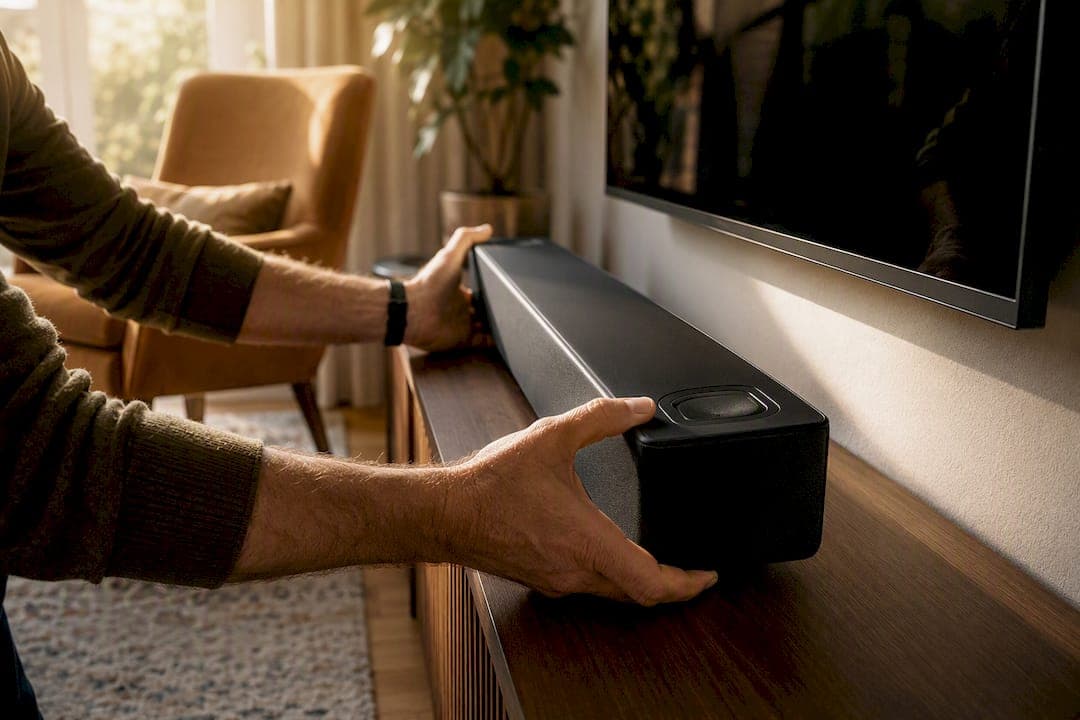
Center your soundbar directly below the TV, aimed as close to seated ear height as you can get, and keep it near the screen without blocking upward or side firing drivers. That's the whole rule. Everything else is fine tuning.
Most people get most of the benefit from three quick checks:
- Height: the bar sits at approximately seated ear height, around 38 to 48 inches off the floor, matching where your ears land when seated on the couch.
- Gap: leave about 2 to 4 inches between the top of the soundbar and the bottom of the TV, tighter for fixed mounts, wider for tilting ones.
- Exceptions: full-motion arms and fireplace walls change the math. If the TV moves, the soundbar usually needs to move with it.
Key Takeaways
Correct soundbar placement means centering the bar below the TV at seated ear height while keeping upward, side, and rear drivers completely unobstructed.
| Point | Details |
|---|---|
| Target height | Aim for 38 to 48 inches off the floor, matched to your actual seated ear height. |
| Mounting gap | Leave 2 inches below a fixed TV mount and about 3 inches for tilt mounts. |
| Bolt vs. bracket | Bolt the bar to the TV on full-motion or pull-down mounts; use a wall bracket for fixed setups. |
| Atmos clearance | Leave 4 to 6 inches above the bar and favor flat ceilings for upward-firing drivers. |
| Media wall design | Themediawallstore kits build in cable channels and front-edge shelving that keep drivers clear without custom carpentry. |
Table of Contents
- What Are the Best Soundbar Placement Rules for Height and Clearance?
- Should You Mount the Soundbar to the Wall or Bolt It to the TV?
- How Much Space Does an Atmos Soundbar Need Above It?
- What Common Soundbar Placement Mistakes Hurt Sound Quality?
- How Do You Test and Fine-Tune Your Soundbar Placement?
- How Does Media Wall Design Affect Soundbar Placement?
- Why Most Soundbar Advice Skips the Real Problem
- Build a Media Wall That Keeps Your Soundbar Sounding Right
- Sources
- FAQ
What Are the Best Soundbar Placement Rules for Height and Clearance?
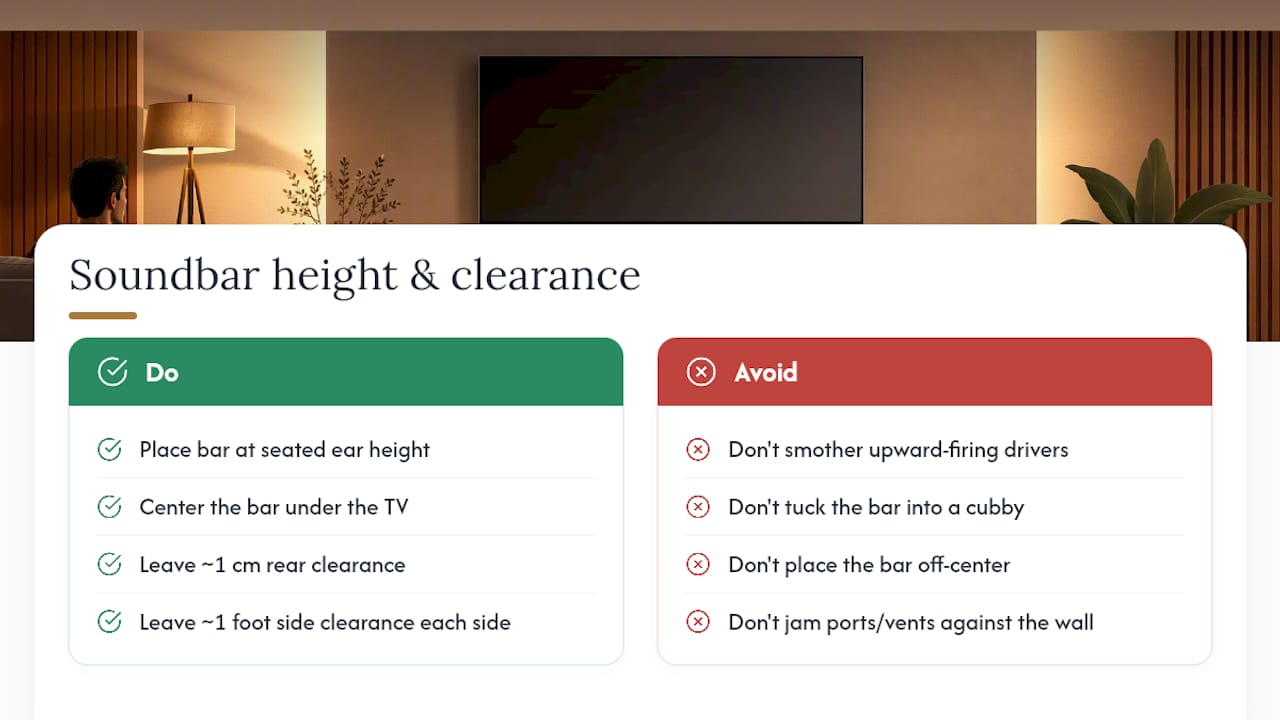
Dolby's own placement guidance says to put the bar level with your ears when seated and as close to the TV as practical without smothering the upward-firing drivers. That single sentence covers most of what matters, but the numbers behind it are worth knowing.
Seated ear height for a typical living room sofa runs about between three and four feet off the floor. Measure your own setup instead of trusting an average. Sit where you actually watch TV, measure from the floor to your ear, and use that number to set bar height. A couch with deep cushions or a low sectional can shift that range by several inches either direction.
Centering matters just as much as height. An off-center bar throws dialogue timing slightly off from one side of the room to the other, and on wider screens the effect gets more noticeable. Bose recommends placing the bar below and in front of the TV, front edge exposed, with upward and side-firing drivers left completely clear.
Rear clearance is easy to overlook. Keep at least a fingertip's width, around 1 centimeter, behind the bar so ports and vents aren't jammed against a wall or cabinet back. Side clearance matters too: if your bar has side-firing drivers, leave roughly a foot of open space on each side, a figure echoed repeatedly in Sonos community placement threads. Front-edge placement on an open shelf beats tucking the bar back into a cubby every time.
Should You Mount the Soundbar to the Wall or Bolt It to the TV?
The answer depends entirely on how your TV is mounted, not personal preference.
- If your TV is on a full-motion or pull-down arm, bolt the soundbar to the TV itself using an under-TV bracket attached to the VESA points. Express Mounting's guidance is blunt about this: when the screen moves, the sound needs to move with it, or the acoustic alignment falls apart every time someone swivels the TV to cut glare.
- If your TV is fixed or on a simple tilt mount, a standalone wall bracket works fine, as long as clearance holds up.
- Set the gap correctly for your mount type. Aim for about 2 inches below a fixed TV and closer to 3 inches for a tilt mount, which needs the extra room so the screen doesn't strike the bar when it angles down.
- Check clearance at maximum downward tilt, not just the resting position. A bar that clears fine when the TV sits flat can clip the top edge the moment the mount tilts forward, which is one of the more common and avoidable mounting mistakes.
- Leave 12 to 18 inches of cable slack for any articulating mount, and confirm the bracket's weight rating covers the combined TV and soundbar load before you drill anything.
Pro Tip: Always mount into studs with properly rated anchors for anything heavier than a few pounds. Standard drywall anchors are not rated for a soundbar swinging on an articulating arm, and a failure here means a broken TV, not just a dented wall.
How Much Space Does an Atmos Soundbar Need Above It?
Bars with upward-firing drivers need real breathing room to bounce sound off the ceiling convincingly. Plan for 4 to 6 inches of clear vertical space between the top of the bar and the bottom of the TV, and make sure nothing else sits in that gap.
Ceiling type matters more than most buyers expect:
- Flat ceilings between roughly 7.5 and 12 feet give upward-firing drivers a clean surface to bounce sound off.
- Sloped ceilings, exposed beams, and heavily upholstered or acoustic-tile ceilings scatter or absorb that reflection, flattening the height effect.
- If your ceiling isn't cooperating, a slight downward tilt of the bar can help recover some of the effect, but it's a workaround, not a fix.
What Common Soundbar Placement Mistakes Hurt Sound Quality?
- Hiding the bar in an enclosed cabinet. This is the single most damaging placement mistake, and it's everywhere. Doors, glass fronts, and deep cubbies trap sound and muffle it into a boxy mess. Pull the bar forward to the front edge of the shelf, or cut a ventilation gap if the cabinet is staying.
- Mounting the bar too high, usually because it got slapped above the TV instead of below it. Switch to an under-TV bracket tied into the VESA mount, or use a pull-down mount if the wall geometry forces the issue.
- Blocking the TV's infrared receiver. Leave about 2 inches of clearance in front of the sensor, or add a cheap IR extender if the bar has to sit closer.
- Vibration rattling against a shelf or stand. Isolation pads under the bar, or switching to a wall-mounted bracket, usually solves this in minutes.
How Do You Test and Fine-Tune Your Soundbar Placement?
- Measure your seated ear height and mark a centerline on the wall or shelf where the bar will sit.
- Decide on wall bracket, under-TV bracket, or shelf placement, then secure it and check clearance at full tilt if the mount articulates.
- Connect over HDMI eARC where the TV supports it, and route cables so nothing crosses in front of the drivers.
- Play a dialogue-heavy scene and an Atmos demo track, then nudge the bar forward, back, or tilt it a few degrees until vocals sound clear and the height effect kicks in. Lock it down once it sounds right.
Pro Tip: Test with a movie you already know well. You'll notice placement problems faster in a scene you've heard dozens of times than in something unfamiliar.
How Does Media Wall Design Affect Soundbar Placement?
A well-designed media wall solves the clearance problem before it starts. Pre-cut cable channels keep wiring out of the driver path, and a floating shelf with an exposed front edge gives the bar the forward placement Bose and Dolby both recommend.
- Recessed niches should be shallow enough that the bar's front sits flush with the shelf edge, not buried inside.
- Slat panel spacing should stay open enough to avoid boxing in upward-firing drivers.
- A media wall built to hide speaker wiring without enclosing the speaker itself gets you both a clean look and a soundbar that performs the way it was designed to.
Why Most Soundbar Advice Skips the Real Problem
Most placement guides focus entirely on height and centering, and while that's the right starting point, it's not where most people actually go wrong. The bigger issue, based on everything manufacturer guidance and hands-on testing keep pointing back to, is enclosure. A soundbar tucked into a cabinet with doors, or wedged under a deep floating shelf, will sound worse than a cheaper bar placed correctly on an open surface.
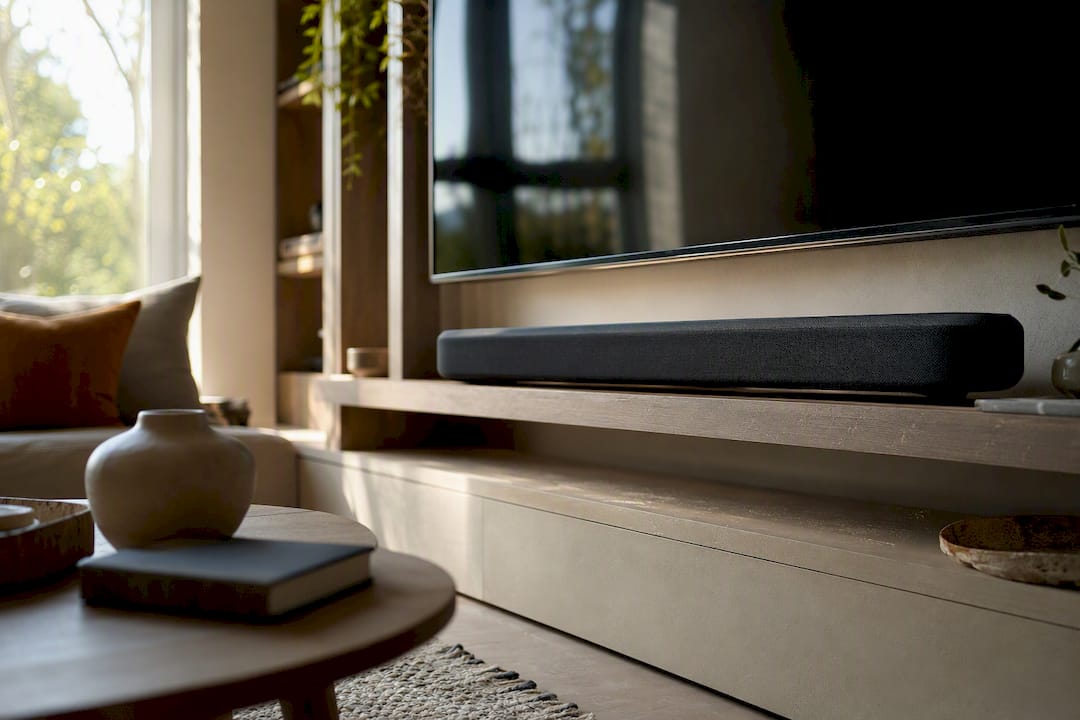
The conventional advice treats mounting height as the main event and clearance as an afterthought. Flip that. Get the bar out where it can breathe first, then worry about whether it's an inch too high or too low. A few inches of height error is forgivable. A cabinet door closed in front of the drivers is not.
If you're planning a media wall from scratch, this is the moment to build the clearance in rather than retrofit it later. Anyone who's tried to hack ventilation into an already-built cabinet knows it's never as clean as designing the right mounting height and depth from day one.
Build a Media Wall That Keeps Your Soundbar Sounding Right
Themediawallstore designs its kits with soundbar clearance built in from the start, so you're not fighting a cabinet depth or a slat panel that blocks the drivers after the fact. Every kit ships pre-cut and pre-labeled with hidden cable channels, so wiring never crosses in front of the bar, and floating console designs put the front edge exactly where manufacturers recommend placing it.

The acoustic slat panels are spaced to avoid boxing in upward-firing drivers, and the whole system installs in a weekend without a contractor. If you're planning a media wall around a soundbar, start by browsing the DIY media wall kits built for exactly this kind of setup, or check the acoustic slat wall panel options if you already have a wall you're trying to fix.
Sources
- Why you need a soundbar and where to put it - Dolby
- Why your soundbar placement matters more than the soundbar itself - HowToGeek
- Speaker placement and positioning | Bose Smart Soundbar
- How to Mount a Soundbar Under a TV - MantelMount
- Soundbar Mount Finder: Which Bracket Fits Your Bar | Express Mounting
FAQ
Where Is the Best Place to Position a Soundbar?
Directly below the TV, centered, and as close to seated ear height as your mount allows, with nothing blocking the drivers on top or sides.
Should a Soundbar Go in Front of or Behind the TV?
In front, on an open shelf or wall bracket, never tucked behind or inside an enclosed cabinet where sound gets trapped and muffled.
Is a Soundbar Better Above or Below the TV?
Below is the standard recommendation from Bose and Dolby alike, since it keeps the bar at a more natural height for dialogue and gives upward-firing drivers a clear shot at the ceiling.
Does a Soundbar Need to Be Centered Under the TV?
Yes. Off-center placement skews dialogue timing across the room, and centering keeps the stereo image and Atmos effects consistent for everyone on the couch.
How Much Space Should Be Above a Soundbar for Atmos Effects?
Plan for 4 to 6 inches of clear space above the bar and a flat ceiling between roughly 7.5 and 12 feet for the height channels to reflect properly.