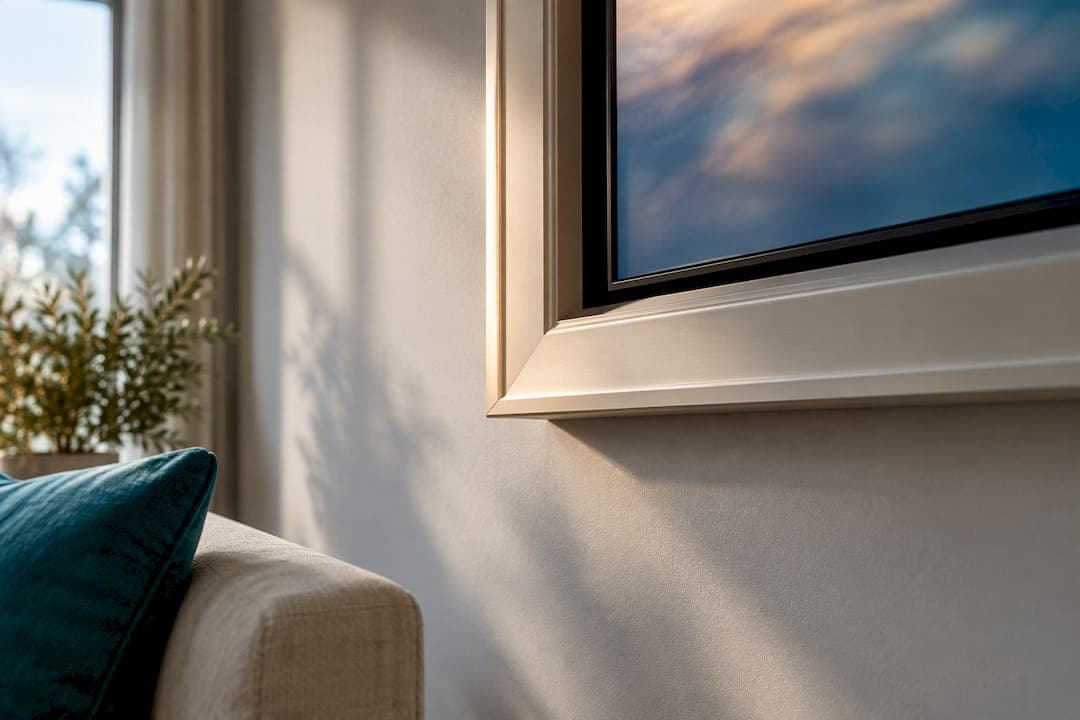
The fastest routes to a framed TV wall are a painted faux frame or a snap-on bezel for a weekend fix under $150, a slat wall or gallery layout for a mid-range project between $150 and $800, and a pre-cut media wall kit or built-in for anyone who wants a finished, luxury look above $800. Which one fits depends on how much time, tools, and wall you're willing to commit.
TL;DR:
- A faux painted border or snap-on bezel can achieve a framed look in just a weekend for under $150, suitable for DIY beginners.
- Medium-cost options like slat walls or gallery arrangements offer more design variety, with installation times ranging from one to two days.
- Using pre-cut media wall kits simplifies complex measurements and finish matching, enabling a complete media wall in a single weekend without a contractor.
- Proper proportion and lighting are crucial; frames should be neither too wide nor too narrow, and a shadow line enhances realism.
- Hiding cords and mounting flush against the wall requires recessed outlets or in-wall power kits, especially for a seamless, art-like appearance.
Table of Contents
- 1. Twelve framed TV wall ideas to match your room and budget
- 2. Turning any idea into a weekend project
- 3. Turning a regular TV into an art-style framed display
- 4. Mounting and hiding cables without cutting into drywall
- 5. Why pre-cut kits get you a finished wall in a weekend
- 6. What the framed TV wall trend gets wrong
- 7. See the kits and get a design started
- 8. Design galleries and how-to resources worth bookmarking
- Sources
- FAQ
1. Twelve framed TV wall ideas to match your room and budget
Design roundups keep pointing to the same handful of treatments that make a TV read as decor instead of an afterthought: molding, slat walls, built-ins, paint, and gallery arrangements show up again and again because they work with almost any room. Here are twelve ways to apply that idea, ranked roughly by effort.
- Painted faux frame: paint a rectangular border in a contrasting matte shade directly on the wall around the TV. Budget tier is affordable, skill level is beginner, and it works well above a low media console.
- Snap-on magnetic bezel: a lightweight frame that clips or magnets onto the TV edge. Budget is affordable, skill is beginner, and it suits a single feature TV in a living room.
- Gallery wall of frames: surround the TV with a mix of empty and filled picture frames at matching depth. Budget runs a moderate range, skill is beginner to intermediate, and it works above a sofa or fireplace.
- Picture-frame molding: apply MDF or primed trim in a rectangle or grid pattern around the screen. Budget is moderate, skill is intermediate, and it fits formal living rooms or dens.
- Vertical slat wall with LED backlighting: ribbed wood panels with a hidden light channel behind the TV. Budget is higher mid-range, skill is intermediate, and it's a strong fit for an accent wall behind a low media console.
- Inset niche with floating shelves: a recessed-look panel treatment with shelves flanking the screen. Budget is higher mid-range, skill is intermediate, and it works in open-plan living rooms.
- Built-in cabinetry: full media wall with cabinets, shelving, and a centered TV bay. Budget is premium, skill is advanced or pro-installed, and it anchors a main living space.
- Marble or tile surround: stone-look tile framing the screen, often paired with an electric fireplace below. Budget is substantial, skill is intermediate to advanced, and it suits a fireplace wall.
- Oversized art backdrop: one large canvas or print behind the mounted TV instead of a frame. Budget is moderate, skill is beginner, and it works in bedrooms or smaller living rooms.
- Framed mirror accents: pairing the TV with matching mirrors on either side to balance the wall. Budget is moderate, skill is beginner, and it fits narrow walls that need visual width.
- Renter-friendly foam-board frame: lightweight foam board cut to size and painted or wrapped, mounted with removable adhesive. Budget is low, skill is beginner, and it's ideal for apartments.
- Cover panels or curtains: a sliding panel or curtain track that conceals the screen when off. Budget is moderate, skill is intermediate, and it works well in bedrooms or home offices.
2. Turning any idea into a weekend project
Before you cut anything, measure. Leave at least 2 to 3 inches of clearance between the TV edge and the inner frame line so the screen doesn't look cramped, and keep the outer frame width proportional to the screen, roughly a third of the TV's width on each side works for most rooms. Mount the TV center at eye level when seated, typically 42 to 48 inches from the floor to the screen's center.
- Renters: foam board, spray adhesive, and painter's tape, total cost usually under $50.
- Painted frames: primed MDF or pine molding, wood filler, a miter saw or box and painter's tape for clean paint lines.
- Slat walls: pre-finished slat panels or acoustic slat wall panels, construction adhesive, and an LED strip kit for backlighting.
- Tools and time: a basic molding frame takes a weekend with a miter saw, level, and stud finder; a slat wall with lighting takes a full weekend plus an evening for wiring.
Use matte paint rather than gloss around the screen to cut glare, and if you're adding a mat board or fabric inset, a faux linen texture reads more like framed art than a plain painted border. Keep the frame proportion modest. A frame that's too wide competes with the screen instead of setting it off.
Pro Tip: Paint the inside edge of any faux frame a shade darker than the wall. It creates a shadow line that makes the frame look built rather than painted on.
For color direction, our guide to accent wall paint ideas covers shades that flatter a mounted screen without competing with it.
3. Turning a regular TV into an art-style framed display
You don't need a dedicated art TV to get the gallery effect. A snap-on bezel or a foam-board mat around the screen edge does most of the visual work, especially when paired with a matte screen protector to cut glare.
- Snap-on bezels attach with adhesive strips or a magnetic frame that clips to the TV's existing edge.
- A foam-board mat, cut with a beveled inner edge and painted or fabric-wrapped, mimics a museum mat around the screen.
- For the art-mode illusion to hold up, Samsung's own support guidance recommends a warm color tone and lower brightness, since a too-bright, too-blue display breaks the printed-art effect instantly.
- Disabling aggressive auto-brightness helps keep the image steady under changing room light.
A dedicated Frame Pro TV can cost noticeably more than a bezel retrofit, and reviewers note it often still needs extra bezels or a recessed outlet to look fully flush against the wall, according to a 2026 review of the Samsung Frame Pro. If your existing TV is otherwise fine, a bezel and a calibration pass will get you most of the way there for a fraction of the price. Buying a purpose-built art TV only makes sense if you also want the thinner profile and matte finish that comes with it.
4. Mounting and hiding cables without cutting into drywall
A frame only looks intentional if the mount is flush and the cords disappear. The same review that covers the Frame Pro's mounting quirks also flags recessed outlets or an approved in-wall power kit as the cleanest fix for cord clutter, rather than running a cord down the wall face.
- Locate studs and choose a mount rated for your TV's weight before drilling anything.
- Use an in-wall power kit or recessed outlet for permanent installs, since it keeps cords out of sight without a raw wire running through drywall.
- If you're renting, route cords behind a console or use paintable surface raceways instead of cutting into the wall.
- Leave clearance around any cable box or streaming device so it doesn't overheat behind a closed panel.
- Call an electrician or installer for in-wall power work, heavy TVs, or mounting above eye level. That's not a DIY job to guess at.
Pro Tip: A raceway painted to match your wall color disappears almost as well as an in-wall kit, at a fraction of the cost and no electrical work involved.
Our full walkthrough on hiding wires without cutting walls covers renter-safe options in more detail.

5. Why pre-cut kits get you a finished wall in a weekend
Pre-cut, pre-labeled media wall kits solve the part of this project that trips up most DIYers: measuring, cutting, and matching finishes across panels. Every piece arrives sized and marked, wire channels are already built in, and the finish is consistent panel to panel, so there's no guessing where a cut went wrong.
That's the gap kits are built to close: premium materials and pre-engineered panels that install without a contractor, at a fraction of what a custom-built media wall typically costs, with clear instructions and support to back up a DIY install. A homeowner turning a plain living room wall into a slat-panel accent with a centered TV and floating shelves can realistically finish the whole thing in a weekend with one helper.
A kit is worth choosing when you know the finish you want but don't have the time, tools, or confidence to cut and fit panels yourself.
6. What the framed TV wall trend gets wrong
Most advice on this topic treats a framed TV wall as an all-or-nothing choice: either a $50 foam-board hack or a full custom build with a contractor. That framing overstates the gap. A slat wall with integrated lighting or a picture-frame molding treatment sits comfortably in between, and it's where most homeowners actually land once they price things out.

The bigger mistake is skipping proportion. A frame or bezel that's too wide, or a slat pattern that ignores the TV's centerline, looks more like an afterthought than the plain wall it replaced. Get the measurements right before you touch paint or panels. That single step matters more than which material you choose.
If you're picking a direction, prioritize lighting and finish consistency over the frame style itself. A well-lit, evenly finished wall reads as intentional even with a simple painted border, while a mismatched finish undercuts even an expensive built-in.
— Jake
7. See the kits and get a design started
If you like the slat wall or built-in look but don't want to cut a single board yourself, The Media Wall Store's Media Wall Kits are pre-cut and pre-labeled for a weekend install, with design packages and White-Glove Installation available for homeowners in the San Francisco Bay Area who'd rather hand off the whole project.
- Browse Media Wall Kits to see finishes and panel styles.
- Start with a Single Concept Design if you want a layout before you buy.
- Compare design packages, including the 3 Concepts + Revision Design Package and Full Design & Quote.
Browse the kits or request a design quote to see what a finished wall would look like in your space.
8. Design galleries and how-to resources worth bookmarking
- 2026 TV wall trends: textured panels and LED backlighting.
- Media wall ideas guide: budget tiers and styles.
- Decor ideas for TV walls: shelving and styling tips.
Sources
- Samsung Frame Pro (2026) review: A better, brighter take on the art TV concept - Yahoo/Tech
- Samsung support: Art Mode settings guidance
- 25 Living Room TV Wall Ideas for 2026 Designed to Make the TV Disappear When It’s Off - The Coolist
FAQ
How do I make a Frame TV look good on the wall?
Keep the surrounding wall simple, use a warm color tone and lower brightness in art mode so displayed images read as printed art rather than a screen, and add a bezel or mat that matches your room's trim color. Even lighting around the TV, not glare, does most of the work.
What are the downsides of a Frame TV or art-style setup?
Dedicated art TVs and their bezels add cost, and reviews of the Samsung Frame Pro note they can still be tricky to mount flush without a recessed outlet. A snap-on bezel on a regular TV gets you close to the same look for less.
Does a Frame TV need a special wall mount?
A flush, art-like finish generally calls for a low-profile or no-gap mount and, ideally, an in-wall power solution so cords don't show. A standard tilting mount will work, but it won't sit as flat against the wall.
Can I turn a regular TV into a Frame TV?
Yes. A snap-on bezel or a foam-board mat around the edge, combined with warm color tone and lower brightness settings, gets a standard TV close to the art-TV look for a fraction of the cost of a dedicated model.
What's the cheapest way to frame a TV this weekend?
A painted faux frame or a foam-board mat, both doable for under $150 and finishable in a single weekend, are the fastest options. Renters should stick to foam board and removable adhesive rather than paint or molding.