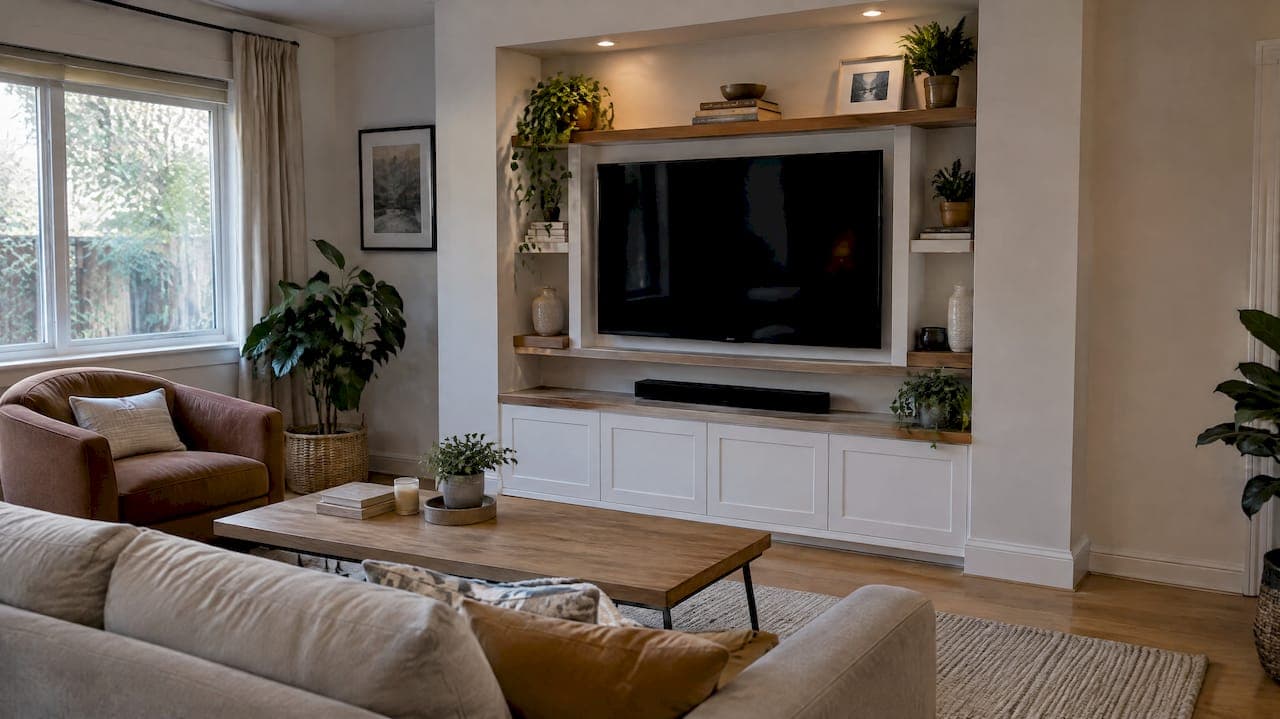
For most living rooms, a framed niche with concealed wiring and layered lighting gives the best mix of style and safety, though a full built-in media wall or a minimalist slat wall both work well depending on your space and budget. Whichever direction you choose, treat anchoring, ventilation, and hidden cable routing as non-negotiable steps, then layer in lighting and storage to finish the look.
TL;DR:
- Center the screen midpoint at seated eye level, usually 42 to 48 inches high, and keep viewing distance at 1.5 to 2.5 times its diagonal.
- Anchor TVs to wall studs with rated hardware, secure supporting furniture with a restraint, and leave 2 to 4 inches around screens for ventilation.
- Make the niche at least 1.5 times the TV’s width, use closed cabinets for equipment and cords, and open shelves for display objects.
- Use warm lighting around 2700K, put screen backlighting and ambient shelf lights on separate switches, and center the soundbar at or just below screen height.
- Hire a professional for work involving fire rated walls, structural framing, or gas lines; cutting fire rated walls for wiring may require listed protective materials.
Table of Contents
- 1. Ten TV Wall Niche Ideas You Can Copy This Weekend
- 2. How Do You Make a TV Niche Feel Intentional?
- 3. What Safety Steps Matter Most When Mounting a TV in a Niche?
- 4. Which Lighting and Sound Setup Works Best for a TV Niche?
- 5. What Finishing Touches Make the Niche Look Professionally Done?
- 6. Who's Behind These Media Wall Ideas
- 7. A Few Honest Thoughts on Designing Around a Screen
- 8. Bring Any of These Niche Ideas to Life Without the Guesswork
- FAQ
- Sources
1. Ten TV Wall Niche Ideas You Can Copy This Weekend
Each idea below includes what it is, who it fits, a material suggestion, and one tip to execute it well. Pick one direction rather than mixing several, since a focused niche reads as intentional while a cluttered mix of styles reads as unfinished.
- Floating panel niche: a single recessed or applied panel frames the TV against a contrasting wall color, works for renters and owners alike, and looks best in a matte charcoal or walnut veneer. Keep the panel 4 to 6 inches wider than the TV on each side so the screen reads as centered rather than cramped.
- Wood-slat accent wall: vertical slats run floor to ceiling or stop at a shadow box around the screen, suits mid-century and Scandinavian rooms, and reads richest in natural oak or a smoked walnut finish. Our weekend wood slat TV wall guide covers wiring and safe mounting for this exact layout.
- Built-in cabinetry media wall: full-height cabinetry flanks the screen with closed storage below, fits larger living rooms where gear needs to disappear, and holds up best in painted MDF or a low-sheen laminate. Leave at least 3 inches of clearance behind the TV mount for airflow.
- Fireplace and TV combination: an electric fireplace sits below or beside the screen inside the same niche, suits homes without a wood-burning unit, and pairs well with a linear insert and a stone or tile surround. Check manufacturer heat clearance specs before fixing the TV height.
- Recessed shelving with hidden wiring: open shelves sit inside a recessed cavity with a channel cut behind the drywall for cables, fits collectors who want books or decor visible, and works in painted drywall or a thin wood veneer. Run conduit before drywall goes up if you are building from scratch.
- Gallery framing around the screen: small art pieces or frames surround the TV so it blends into a larger art wall, suits traditional and eclectic rooms, and looks sharpest with matching frame finishes in brass or black. Keep frame spacing even using a paper template before hanging anything.
- Textured plaster or veneer backdrop: a lime-wash plaster or thin stone veneer gives the niche depth without pattern, fits modern farmhouse and organic-modern spaces, and holds texture best in a warm putty tone. Test a sample swatch under your actual room lighting before committing to the full wall.
- Multifunctional niche with desk or bar: the TV niche extends into a small desk, bar cart nook, or reading corner, suits studio apartments and multipurpose rooms, and works well in a two-tone finish that visually separates zones. Keep the TV zone matte and the functional zone glossier to signal the shift.
- Minimalist slat wall with concealed storage: slats conceal a push-to-open cabinet behind them, fits anyone who wants storage without visible hardware, and looks cleanest in a single-tone finish that matches the slats to the cabinet face. More layout examples for 2026 appear in our media wall ideas gallery.
- Layered niche with LED backlight channel: a shallow LED channel runs around the inside edge of the niche, suits anyone chasing a cinematic look, and reads best with a soft white or warm diffuser strip rather than exposed bulbs. More premium layout inspiration lives in our luxury TV wall design examples.
Pro Tip: Pick one texture, one storage style, and one lighting accent before you shop for materials. Three decisions are easier to execute well than ten.
2. How Do You Make a TV Niche Feel Intentional?
Good proportion and restraint separate a niche that looks designed from one that looks like an afterthought.
- Height and distance: center the screen so the midpoint sits roughly at seated eye level, usually 42 to 48 inches off the floor, and keep viewing distance at roughly 1.5 to 2.5 times the screen's diagonal size.
- Scale versus wall width: the niche or feature area should span at least 1.5 times the TV's width so the screen doesn't dominate a narrow wall.
- Rule of three: combine three primary elements, such as a slat panel, the screen, and a floating shelf, so the eye has a clear hierarchy instead of competing focal points.
- Closed versus open storage: choose closed cabinetry when you have multiple AV components or cords to hide, and open shelving when you want the niche to double as display space.
- Wire check: route cables through an in-wall channel or cord cover, label each cable at both ends, and leave slack for future equipment swaps.
3. What Safety Steps Matter Most When Mounting a TV in a Niche?
Tip-over injuries remain a real risk with wall-mounted and furniture-set TVs, which is why the CPSC's Anchor It! campaign recommends mounting flat-screen TVs to the wall or anchoring them securely to furniture rather than leaving them freestanding.
- Anchor the TV to wall studs using rated mounting hardware, not just drywall anchors, whenever the niche allows a stud-mounted bracket.
- Use an anti-tip kit on any furniture or stand inside the niche that holds a TV, even a mounted one, as a backup measure.
- Leave at least 2 to 4 inches of clearance around the TV for ventilation, and more if the niche sits above an electric fireplace insert.
- If you're building into a fire-rated wall (common in multi-unit buildings or shared walls), consult Portland's fire-rated wall code guide or your local equivalent, since cutting into that assembly for outlets or recessed lighting typically requires UL-listed protective materials around electrical boxes.
An anti-tip kit typically installs in under 20 minutes and costs less than $20, making it one of the cheapest safety upgrades available for a media wall project.
4. Which Lighting and Sound Setup Works Best for a TV Niche?
LED backlighting behind the screen reduces eye strain and gives the niche depth after dark, while a separate ambient zone (a shelf light or cove strip) keeps the room usable when the TV is off.
- Choose a warm color temperature, around 2700K, for cozy living rooms rather than a cooler white that can feel clinical next to a dark screen.
- Check the CRI and CCT listed on the DOE's LED color characteristics factsheet before buying strips, since color rendition varies between LED products even at the same wattage.
- Mount a soundbar at or just below screen height, centered, with a few inches of clearance from the TV for sound dispersion.
- Add a dimmer or smart switch so you can drop ambient light for movie mode without touching the backlight channel.
For a deeper look at minimalist layouts built around 2700K lighting and hidden cable runs, see this guide to warm minimalist TV walls.
Pro Tip: Put the backlight and the ambient shelf light on separate switches so you can tune the mood independently of the screen.

5. What Finishing Touches Make the Niche Look Professionally Done?
A shadow gap or a strip of trim around the TV visually "frames" the screen the way a picture frame does, and a matte paint finish behind it cuts glare far better than satin or gloss.
- Keep artwork or decor objects near the niche modest in scale so nothing competes with the screen for attention.
- Store remotes, game consoles, and cables in closed storage rather than on open shelves next to the TV.
- Stick to a limited palette, generally two to three colors, so the eye reads the niche as calm rather than busy.
- Add one accent light, like a small sconce or picture light, instead of multiple competing light sources.
Small upgrades like these are covered in more detail in our ten stylish TV wall upgrades post.
6. Who's Behind These Media Wall Ideas
We offer DIY media wall kits that arrive pre-cut and pre-labeled, so homeowners can build a stylish media wall without hiring a contractor. Our kits deliver a high-end look at a fraction of custom-build pricing, and orders come with expert support and risk-free returns. Jake writes on design and installation for our blog, drawing on patterns we see across customer projects.

7. A Few Honest Thoughts on Designing Around a Screen
The niches that age well pick one treatment, a slat wall, a plaster texture, a fireplace pairing, and commit to it rather than chasing three trends at once. Cohesion beats cleverness. DIY the surface work; call a professional for anything touching a fire-rated wall, structural framing, or gas lines.
— Jake
8. Bring Any of These Niche Ideas to Life Without the Guesswork
Whichever direction you picked above, floating panels, a slat wall, or a fireplace build, our pre-cut kits are built to match it. Panels arrive labeled for your exact layout, with integrated LED lighting and hidden wire channels already planned into the design, so there's no guessing where cables go.
- Floating panel and slat wall ideas map directly to our media wall kits.
- Fireplace integrations pair with our electric fireplace accessories.
- Want a second opinion on layout first? Start with a Single Concept Design or Full Design & Quote.
Homeowners who'd rather skip the tools entirely can add a White-Glove Installation service, and every kit ships with expert support plus a risk-free return window if it's not the right fit.
FAQ
Are wall niches dated?
Wall niches aren't dated as a concept; what dates a niche is an overly ornate or heavily arched design from decades past. A clean-lined, flush niche with modern materials like slats or floating panels reads current in 2026 and beyond.
How do you make a TV wall more interesting?
Add texture through wood slats, plaster, or veneer, then layer in LED backlighting to give the wall depth after dark. Mixing one bold material with simple lines, rather than several competing finishes, keeps the wall interesting without looking busy.
What are the TV stand design trends for 2026?
Floating cabinetry, slat-front storage, and fireplace-integrated stands are leading the current trend toward media walls that hide AV components behind clean surfaces. Warm wood tones and matte black hardware are also common finish choices this cycle.
What looks good on a wall above a TV?
A single piece of art, a floating shelf with a few curated objects, or a continuation of the same slat or plaster texture used around the TV all work well. Avoid crowding the space above the screen with multiple small items, since that pulls focus away from the TV itself.
Sources
- Cpsc
- LED color characteristics factsheet | DOE
- Fire-rated walls and projections (Portland code guide)