
For most homeowners and small retail or office buyers, a prefinished MDF slat panel in a painted white or acoustic finish is the right call, and a pre-cut DIY kit is the fastest way to get there. It balances looks, ease of installation, and enough weight capacity for shelves, TVs, and hooks. Measure your wall, pick a finish, and choose a kit sized to your studs before you order anything.
TL;DR:
- MDF melamine slat wall panels are the most affordable option for interior uses, but they chip easily at exposed edges without trim protection.
- PVC slat wall panels resist moisture and chemicals, making them ideal for garages, basements, and high-impact utility areas.
- Groove spacing affects both the appearance and flexibility, with 3-inch spacing offering more mounting points and 6-inch giving a bolder, fewer-line look.
- For heavy-duty retail or commercial installations, aluminum or metal inserts can increase load capacity up to 100 pounds per line or 300 pounds per square foot with proper reinforcement.
- Pre-cut media wall kits simplify installation, reduce waste, and deliver a high-end look at a fraction of custom build costs, especially when ordered with appropriate material and size for the space.
Table of Contents
- What Are White Slat Wall Panels?
- Which Material Holds Up Best: MDF, PVC, or Veneer?
- What Sizes and Slat Spacing Should You Order?
- How Do You Install and Mount TVs on Slat Panels?
- How Much Weight Can a Slat Wall Panel Hold?
- Do You Need Edge Trim on White Slat Wall Panels?
- Where Can You Buy Slat Wall Panels and What Do They Cost?
- How Do Slat Walls Change a Room's Look and Sound?
- How Do You Clean and Maintain a Slat Wall?
- How The Media Wall Store Makes DIY Slat Walls Practical
- What Load Standards Apply to Commercial Slat Wall Installs?
- What Warranty and Durability Should You Expect for Commercial Use?
- Is Slat Wall Paneling Fire Rated for Commercial Buildings?
- The Editorial Take: Why Overbuilding Your First Slat Wall Is a Mistake
- Skip the Guesswork With a Precut Media Wall Kit
- Sources
- FAQ
What Are White Slat Wall Panels?
White slat wall panels are grooved wall coverings, usually made from MDF, PVC, or veneered wood, installed in horizontal or vertical runs to create a paneled, textured look. Retailers use them for hanging fixtures. Homeowners use them for accent walls, media walls, and closets. The grooves themselves, spaced at standard intervals, are what let hooks, brackets, and inserts click into place without extra hardware.
Three product families cover almost every use case:
- Acoustic painted slat panels pair a solid or engineered wood face with a felt or fabric backing, built for living rooms and bedrooms where sound absorption matters as much as looks.
- MDF or melamine slatwall is the workhorse option: a matte white or wood-grain melamine surface over an MDF core, common in retail, closets, and home offices.
- PVC molded slatwall skips wood entirely, molding the grooves into solid plastic, which makes it the default choice for garages, basements, and anywhere moisture is a factor.
Finish choice matters almost as much as material. Matte painted MDF gives you the cleanest, most modern white look and hides fingerprints better than gloss. Veneer brings real wood grain under a clear coat, which reads more expensive but scratches more easily. Melamine is the budget-friendly middle ground, tough enough for retail traffic but flatter in appearance. Felt-backed acoustic panels add texture and sound control but cost more per square foot.
Living rooms and media walls lean toward acoustic or veneer finishes. Retail floors do well with melamine because it survives constant handling. Garages and utility spaces should skip wood-based panels altogether and go straight to PVC.
Which Material Holds Up Best: MDF, PVC, or Veneer?
PVC wins on moisture resistance, MDF wins on look-per-dollar, and veneer wins on visual warmth, so the right pick depends on where the panel is going, not which one is "best" overall.
MDF with a melamine or painted finish is the most common choice for interior accent walls and media walls because it delivers a flat, consistent white surface at a reasonable cost. The tradeoff is the core material itself: MDF is compressed wood fiber, and its edges chip or swell if they're left exposed to water or heavy impact. A standard MDF slat panel setup handles everyday use fine, but it is not a garage or bathroom material.
PVC-molded slatwall solves that problem outright. It's waterproof, resists chemical exposure, and shrugs off the kind of abuse a garage or car detail bay dishes out. Heavy-duty molded PVC systems built for garage storage advertise load capacities as high as 300 lbs per square foot when paired with their own install strips, and the panels are recyclable. That's a different performance tier than decorative interior slatwall, and it comes with a heavier, more industrial look that doesn't always suit a living room.
Veneer and painted acoustic slats sit at the premium end. You're paying for real wood grain or a felt-backed acoustic layer, and the visual payoff shows in natural light. The general industry guidance holds up in practice: pick PVC for moisture and chemical exposure, and MDF or veneered acoustic slats for interior aesthetics.
- MDF melamine: matte finish, cost-effective, weak at exposed edges without trim.
- PVC: waterproof, chemical-resistant, best for garages and utility rooms.
- Veneer/acoustic: premium look and sound absorption, more delicate finish.
- Metal inserts and trims: worth adding wherever edges are exposed or load is a concern.
Pro Tip: If you're mixing zones, like a mudroom that transitions into a garage, don't force one material to do both jobs. Run MDF or veneer where people see it daily and switch to PVC once you cross into wet or high-impact territory.
What Sizes and Slat Spacing Should You Order?
Standard slatwall panels ship in 4 by 8 foot sheets, with 4 by 4 foot half-sheets increasingly common because they're easier for one person to carry and cheaper to freight. Full 4 by 8 sheets run around 90 pounds, while 4 by 4 panels come in closer to 45 pounds, a difference that matters if you're installing solo or hauling panels up a stairwell.
Groove spacing comes in two standards, and the choice changes both the look and the flexibility of your finished wall.
- 3 inch spacing gives you more mounting points per square foot, which means more flexibility for hooks, shelves, and brackets later. It also reads as a finer, more detailed texture on the wall.
- 6 inch spacing creates a bolder, shiplap-style look with fewer visible lines, which many homeowners prefer for media walls and accent walls where the panel itself is the visual statement.
Both spacing options are considered standard across the retail slatwall market, so availability isn't usually the deciding factor. Fit is.
To calculate coverage, measure your wall's total square footage, then subtract windows, doors, and any outlets you're not paneling around. If your wall has an odd width, decide up front whether you'd rather run fewer full sheets (fewer seams, harder to carry) or more half sheets (easier handling, more seams to align). There's no wrong answer here, just a tradeoff between installation ease and a cleaner seam count.
How Do You Install and Mount TVs on Slat Panels?
Installation comes down to three methods: adhesive, screws into studs, or install strips, and most manufacturers support all three depending on the panel and wall type.
- Prep the wall first. Find and mark every stud, snap a level line for your first panel, and add blocking behind any spot where you plan to mount a TV or heavy shelf. Skipping this step is the single most common reason DIY slat walls end up crooked or under-supported.
- Choose your fastening method. Construction adhesive works well over drywall for lightweight decorative panels. Screws driven through aluminum inserts give you the strongest hold and are the right call anywhere you'll hang real weight. Install strips speed up the process and are common in retail-style installs where panels need to come down and go back up.
- Cut carefully. A table saw with a fine-tooth blade gives the cleanest cut on MDF and melamine panels; a circular saw with a guide works fine for site cuts. Score the finish side first with a utility knife on melamine panels to avoid chipping the surface.
- Mount TVs and shelves onto studs or blocking, not into the panel alone. A slat panel's grooves aren't rated to carry a 55-inch television by themselves. Run your mount hardware through the panel and into a stud, or into blocking installed during step one, and use aluminum inserts where the panel manufacturer offers them. Our own step-by-step guide to mounting a TV on a slat wall walks through the exact hardware sequence.
- Call in an electrician if you're relocating outlets or running new low-voltage lines behind the panel for a media wall setup. Cutting into a wall you don't fully understand the wiring of is the one place DIY confidence should yield to a professional.
Pro Tip: Dry-fit your first two panels before applying any adhesive or driving a single screw. Slatwall grooves need to line up perfectly across seams, and there's no fixing a misaligned groove line once glue sets.
For the full walkthrough on tools, sequencing, and finishing touches, our DIY wall panel installation guide covers the process panel by panel.
How Much Weight Can a Slat Wall Panel Hold?
Without reinforcement, a standard MDF slat panel line holds around 30 pounds per line, which is plenty for hooks, small shelves, and light decor. Add aluminum inserts into the grooves, and that same line jumps to as much as 100 pounds, enough for floating shelves, mounted TVs, or retail merchandising fixtures. Exact numbers vary by manufacturer, so treat these as working estimates rather than a universal spec.
Weight capacity in numbers: roughly 30 lbs per slat line unreinforced, up to 100 lbs per line with aluminum inserts, and up to 75 lbs per square foot on some PVC retail systems.
Aluminum or metal inserts do two things at once: they distribute weight across the groove instead of concentrating it on the MDF core, and they give screws something solid to bite into instead of chipping through wood fiber. Install strips serve a similar function for lighter loads, letting fixtures hook in without any screwing at all.
- Hooks and small brackets: fine on standard grooves without inserts.
- Floating shelves and shelving brackets: use inserts or mount into studs behind the panel. Hangrails and garment bars: check manufacturer weight ratings before loading them with heavy coats or retail stock. TVs and mirrors: always anchor into studs or blocking, insert or no insert.
Do You Need Edge Trim on White Slat Wall Panels?
Yes, and it's not optional if you want the panel to last. Exposed MDF or veneer edges are the first thing to fail in high-traffic or humid spots, and edge trim is the cheapest insurance against that. Aluminum L-cap trims and corner profiles cap raw edges, protect against chipping, and give the whole installation a finished, intentional look instead of a raw-cut edge.
- L-caps wrap the outer edge of a panel run, ideal anywhere a slat wall ends before a corner or transitions into drywall.
- J-trims cradle the edge from the front, common where panels meet flooring or a ceiling line.
- Color-matched or powder-coated aluminum trims are worth the upgrade over plain trim when the wall is a visual focal point, since a mismatched trim color is one of the fastest ways to make a DIY install look unfinished.
Moisture protection is mostly about keeping water away from the panel's edges in the first place. Leave a small gap where slatwall meets flooring, use a paintable sealant along any cut edge before installation, and never install MDF or veneer panels in direct splash zones. Designers commonly install trims specifically where panels meet floors or wet areas, and installers who deal with commercial spaces regularly point to the same failure pattern: exposed MDF cores are usually the first thing to go in high-traffic or damp locations, which is exactly what trim is designed to prevent.
Where Can You Buy Slat Wall Panels and What Do They Cost?
Standard 4 by 8 foot MDF melamine slat panels sit at the affordable end of the category, while veneer and acoustic panels with felt backing cost noticeably more per square foot given the added materials and finishing work.
Shipping is the part most first-time buyers underestimate. Full-size panels usually travel as freight shipments on a pallet, which means you're dealing with scheduled delivery windows rather than a package on your doorstep. Ask sellers directly about lift-gate service if you don't have a loading dock or forklift, since without it you may be stuck unloading a pallet curbside by hand.
Before ordering, run through this checklist with any seller:
- Are aluminum or metal inserts sold separately, and are they compatible with this specific panel groove?
- What's the current lead time from order to delivery?
- Can you order a sample panel or swatch before committing to a full wall's worth?
- What's the return policy if a panel arrives damaged in freight?
- Do they provide installation videos or written instructions specific to their product line?
A seller who answers all five without hesitation is one worth ordering from.
How Do Slat Walls Change a Room's Look and Sound?
The visual impact of a slat wall depends almost entirely on how much of the wall you cover and which direction the slats run. A full feature wall behind a TV or bed reads as a deliberate design statement. Partial cladding, run halfway up a wall or framed as a single panel, reads more like a subtle architectural detail. Horizontal slats widen a room visually; vertical slats draw the eye upward and make ceilings feel taller.
Acoustic performance is where slat walls earn their keep beyond looks. Panels built with felt or acoustic backing behind the slats absorb sound rather than reflecting it, cutting down on the echo that hard, flat walls create in living rooms and home offices. That's a real functional upgrade for anyone dealing with a room that feels loud or "hard" acoustically, not just a design flourish.
- Home media walls and living rooms: acoustic-backed panels or veneer, run as a full feature wall.
- Retail boutiques and showrooms: matte melamine finishes that read clean under bright lighting.
- Garages and storage areas: heavy-duty PVC, chosen for durability over aesthetics.
- Offices: acoustic backing to cut down on ambient noise in open floor plans.
How Do You Clean and Maintain a Slat Wall?
Cleaning routines follow the finish. Painted and veneer panels need a soft cloth and a mild, non-abrasive cleaner, since anything harsher can dull the finish or strip a clear coat over time. PVC panels are more forgiving and can handle a wet wipe-down with most household cleaners without issue.
Minor chips in MDF panels are fixable with wood filler and a matching touch-up paint, applied in thin layers and sanded flush before a final coat. Veneer scratches are trickier and usually call for a color-matched touch-up pen rather than filler. As general upkeep, keep abrasive scrubbers away from any painted or veneered surface, and be mindful that some wood veneers can shift in tone with prolonged direct sunlight exposure.
How The Media Wall Store Makes DIY Slat Walls Practical
Reading a materials chart and cutting your first panel are two very different challenges, and that gap is where most DIY slat wall projects stall out. The Media Wall Store built its kits specifically to close that gap, delivering luxury media wall components designed for homeowners without a contractor on speed dial.
Kits arrive pre-cut and pre-labeled, which turns a project that traditionally requires custom fabrication and a lengthy install timeline into something a homeowner can finish over a weekend. That single change, precision-cut panels that already know where they go, removes most of the guesswork that causes chipped edges and misaligned grooves in a first-time install.
The pricing gap matters just as much as the time savings. The Media Wall Store's acoustic slat panel line is positioned to deliver the high-end look of a custom-built media wall at a price point well below what a bespoke contractor build typically runs, which is what makes a genuinely luxury result accessible to a homeowner working a normal budget. That's the whole premise: the natural oak and walnut acoustic panel options show the same design intent as a custom install, just packaged for a Saturday afternoon instead of a six-week build.
What Load Standards Apply to Commercial Slat Wall Installs?
Commercial slat wall installations, think retail fixtures, office partitions, or showroom displays, don't operate under a single universal load code the way structural framing does. Instead, weight ratings come from the manufacturer's own testing, and it's the buyer's job to match the rated panel to the actual load before installation.
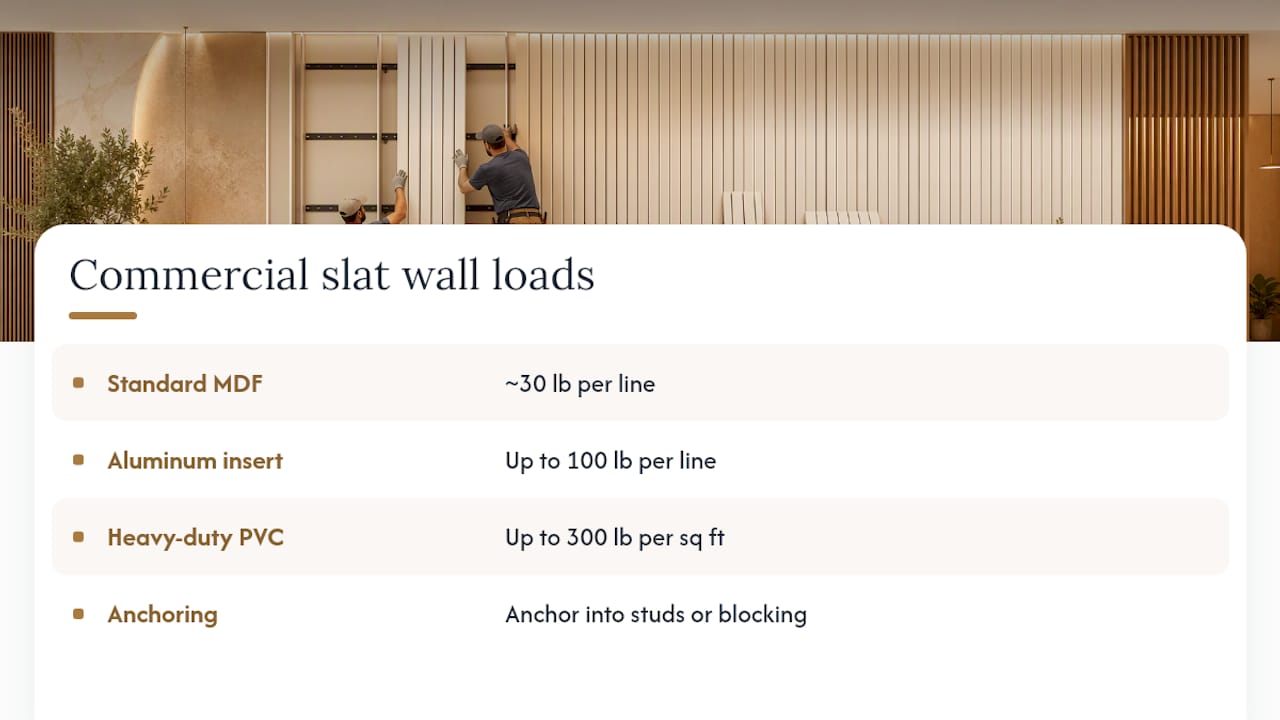
The practical standard in the industry is per-line or per-square-foot capacity, tested by the manufacturer and published on the product spec sheet. As noted earlier, standard MDF grooves without reinforcement handle around 30 pounds per line, aluminum-inserted grooves handle up to 100 pounds per line, and dedicated heavy-duty PVC garage systems can be rated as high as 300 pounds per square foot with their proprietary install strips. A commercial buyer outfitting a retail floor with merchandising hooks and shelving should treat those manufacturer numbers as the ceiling, not a rough guideline, since retail fixtures often carry rotating, unpredictable loads that residential accent walls never see.
Building codes generally address slat wall systems the way they address any interior finish or non-structural fixture: through general life-safety and structural anchoring requirements rather than a slatwall-specific standard. That means the real compliance question for a commercial installer isn't "is this panel rated for commercial use," but "is this specific load, in this specific location, anchored into the building's actual structure." Any fixture carrying meaningful weight, particularly in high-traffic retail, should tie back into studs or structural blocking, not the panel's groove alone.
What Warranty and Durability Should You Expect for Commercial Use?
Commercial installations take a harder beating than a residential accent wall. Retail slat panels get bumped by carts, scraped by merchandise, and cleaned far more often, which means the durability question isn't just "will it hold weight" but "will it still look good after a year of daily handling."
Material choice drives most of the durability outcome here. PVC systems marketed for heavy-duty and garage use tend to carry the longest practical service life in high-abrasion commercial settings because the material itself doesn't chip or swell the way MDF cores do at the edges. That durability advantage is part of why heavy-duty molded PVC systems are positioned with long warranty terms and marketed as recyclable, waterproof products built for repeated commercial-grade abuse rather than a single residential install.
MDF and veneer panels can absolutely hold up in commercial settings too, but their durability depends heavily on whether edge trim was installed correctly at the outset. A trimmed, sealed MDF panel in a boutique retail space can last years; an untrimmed one in the same space will show chipped corners within months. Warranty terms for MDF and veneer product lines vary by manufacturer, so a commercial buyer should always confirm coverage specifics, particularly whether the warranty covers edge damage or only manufacturing defects, before ordering panels for a space with daily foot traffic.
Is Slat Wall Paneling Fire Rated for Commercial Buildings?
Fire resistance and code compliance depend on the specific building, occupancy type, and local jurisdiction, which makes this one area where a commercial buyer should not rely on a general guide. Commercial building codes typically classify interior wall finishes by flame spread and smoke development ratings, and requirements shift based on the building's occupancy classification, whether it's retail, office, or assembly space, and how much of the wall surface the paneling covers.
MDF and wood veneer panels are combustible materials by nature, and any commercial installation covering a meaningful percentage of wall surface should be checked against the local fire code before installation, not after. PVC panels behave differently under fire conditions than wood-based products, and neither material family should be assumed automatically compliant without checking the specific product's fire rating documentation from the manufacturer.
The practical move for any commercial buyer is straightforward: request fire rating documentation directly from the panel manufacturer before purchase, and confirm with your local building department or a licensed contractor that the specific product and coverage amount meets your jurisdiction's requirements for your building's occupancy type. This isn't a place to guess or extrapolate from a residential install. A slat wall that's perfectly fine behind a home television may not clear code in a retail space with different occupancy and egress requirements. Treat fire compliance as a document you collect before the order ships, not a detail to sort out during inspection.
The Editorial Take: Why Overbuilding Your First Slat Wall Is a Mistake
The conventional advice on slat walls treats every project like it needs commercial-grade everything: maximum weight rating, premium veneer, full aluminum insert coverage on every groove. That's overkill for most homeowners, and it's the reason DIY projects balloon in cost and complexity before a single panel goes up.
The research actually supports a simpler read: match the material to the room, use inserts only where real weight is going, and spend your trim budget on the edges people will actually see and touch. A painted MDF panel with proper edge trim in a living room will outperform an over-specified, over-budget install that never gets finished because it felt too complicated to start.
What gets underrated is the value of a pre-cut kit for a first attempt. Cutting your own panels sounds like it saves money, but a chipped edge or a misaligned groove costs more in wasted material than most kits cost to begin with. Start with a defined kit, learn the install on a forgiving project, and reserve the fully custom cut-your-own approach for round two, once you know exactly what you're doing.
— Jake
Skip the Guesswork With a Precut Media Wall Kit
Everything covered above, material choice, groove spacing, weight capacity, edge trim, adds up to a lot of decisions before a single screw goes in. Themediawallstore removes most of that decision fatigue by shipping media wall kits that are already precut, pre-labeled, and matched to a specific finish, so you're assembling a designed wall instead of engineering one from scratch.

If you want a second set of eyes before you commit, start with the Single Concept Design service for a flat one-time fee, or go straight to the Full Design & Quote package if you already know the look you want and just need it priced out. Homeowners in the San Francisco Bay Area who'd rather skip the DIY weekend entirely can add White-Glove Installation once a kit is selected. Either way, the starting point is the same: measure your wall, browse the media wall kits, and request a quote before you order a single panel.
Sources
- Dakota Slatwall technical/installation notes (PDF) — Dakota Panel
- Matte White Slatwall Panel | Displayarama
FAQ
What Is the Most Affordable Slat Wall Option?
Standard MDF melamine slatwall panels are the most budget-friendly option among the main material types, since they skip the added cost of veneer finishing or acoustic felt backing. PVC panels can cost more upfront but often save money long-term in moisture-prone spaces by avoiding replacement costs.
Are Slat Walls Still Trendy in 2026?
Yes. Acoustic and painted white slat walls remain one of the most requested accent wall styles for media rooms and living spaces, largely because they add texture and sound absorption without the cost of a full custom build. Retail and office use has grown alongside the residential trend, since the same felt-backed acoustic panels that quiet a living room also work well in open-plan offices.
What Are White Wall Panels With Grooves Called?
They're generally called slat wall panels or slatwall, though you'll also see the terms "slat wood panels" or "acoustic slat panels" used for the felt-backed, sound-absorbing versions. All three terms describe the same core product: a grooved panel surface, typically MDF, PVC, or veneer, installed as an accent wall or fixture-mounting surface.
What's a Cheaper Alternative to Full Slat Wall Panels?
Individual slat wood boards installed with spacing, rather than a pre-grooved panel sheet, can cost less in material but take significantly longer to install and align by hand. A more time-efficient middle ground is a pre-cut kit, like the media wall kits from Themediawallstore, which bundle precut panels at a price well below a custom contractor build while still saving the labor of individual board installation.