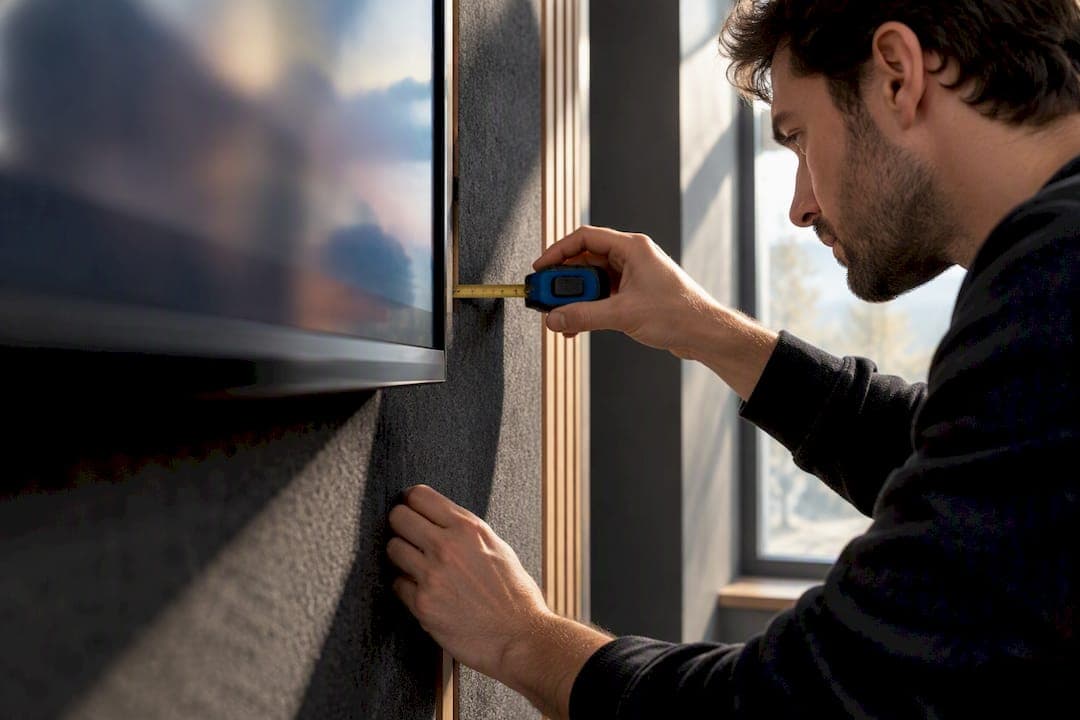
Here, acoustic treatment behind TV means building a finished media wall backdrop, not adding sound-absorbing panels. The fix is a pre-cut, pre-labeled media wall kit sized to your television, checked against three things before you buy: your wall's weight capacity, the manufacturer's clearance requirements, and, if you have a fireplace, its vent spacing. Get those three right, and the rest of the project is mostly assembly.
TL;DR:
- Ensure your wall supports four times the weight of the TV and has proper blocking, especially if the wall is masonry or steel stud, to prevent failure.
- Maintain at least one inch of clearance between the TV and fireplace vents, with recess depths limited to six inches to allow heat dissipation and prevent damage.
- Confirm that the media wall kit fits your TV's VESA pattern, weight, and depth, and check for included features like cable channels and LED lighting before purchase.
- Plan wiring carefully using in-wall rated cables and secure power sources behind the wall to ensure a clean appearance and safety compliance.
- Opt for professional installation if your wall has complex framing, masonry, or unclear structural conditions, especially when dealing with venting or electrical work.
Table of Contents
- What to check before you buy a media wall kit
- Ventilation, heat, and fireplace safety for recessed or built media walls
- Mounting and structural requirements for studs and fasteners
- Wiring, power, and hidden cable management inside a media wall
- Materials, finishes, and features that create a finished TV backdrop
- DIY installation overview for a pre-cut, pre-labeled kit
- AV integration for soundbars and hidden speakers
- Why luxury DIY kits are a pragmatic middle ground
- How The Media Wall Store can help you finish the wall
- Sources
- FAQ
What to check before you buy a media wall kit
Start with your television's own specs, not the kit's marketing photos. Measure the VESA mounting pattern, screen size, panel depth, and the height that puts the screen center at a comfortable viewing line, then compare those numbers against the kit's opening dimensions.
Wall structure matters just as much as fit. Confirm stud spacing and whether you have blocking in place, since Sony's mounting guidance recommends the wall support four times the television's weight before you commit to a mount.
From there, look at what the kit actually includes and what your install will demand:
- Check for built-in cable channels, LED wiring paths, and floating cabinet hardware included in the kit.
- Confirm the recess depth leaves room for ventilation and future service access.
- Decide early whether new outlets or unusual wall material means calling an electrician or professional installer.
- Compare panel finishes now, since swapping them after installation is far harder than choosing well upfront.
A kit that matches your TV on paper can still fail if the wall behind it cannot take the load or breathe properly.
Ventilation, heat, and fireplace safety for recessed or built media walls
Televisions generate heat, and boxing one into a tight recess without airflow shortens its life. Manufacturer guidance commonly cited by Sony calls for roughly 4 inches (10 centimeters) of clearance on each side of a wall-mounted set, a figure worth treating as a baseline rather than a suggestion.

At least 1 inch of clearance is required between a recessed TV and any fireplace vent, according to fireplace installation and TV-recess guidance, which also caps some recess depths at 6 inches to let heat escape. That single inch is the difference between a safe install and a slow heat buildup behind drywall.
A few practices reduce that risk further:
- Build a double-wall or chase with non-combustible inner surfaces, following air barrier guidance for walls behind fireplaces.
- Leave a sealed air-release path rather than fully enclosing the cavity.
- Skip recessing the TV entirely if you cannot confirm the vent path or wall temperature.
Our guide on mounting a TV above a fireplace walks through measuring heat before you cut into drywall.
Mounting and structural requirements for studs and fasteners
The mount is the single point holding your television to the wall, so it deserves more scrutiny than most buyers give it.
- Choose a mount rated for your TV's size and weight, ideally listed by an independent lab such as UL, CSA, or ETL.
- Anchor into studs or solid blocking rather than drywall alone. Framing typically runs on 16 or 24 inch centers, and thicker drywall or unusual framing may need added backing.
- Apply the four times weight guideline from Sony's mounting FAQ as a quick sanity check on whether your wall can carry the load long term.
- Call a professional installer if the wall is masonry, steel stud, or otherwise unknown fill, since guessing at hidden framing is how mounts fail years later.
Pro Tip: Tap the wall in a grid pattern before drilling. A dull thud usually means a stud; a hollow knock means you're between them.
Wiring, power, and hidden cable management inside a media wall
A clean media wall depends on wiring planned before the panels go up, not fished through afterward.
- Use in-wall rated HDMI and speaker cable, and install a proper in-wall power kit or outlet behind the TV where local code allows it.
- Near fireplaces, secure and insulate wiring without blocking the heat-release path, following the fireplace manufacturer's own wiring instructions.
- For recessed niches, route cable entry from the top or sides so wiring stays clear of vent pipes, a tactic recommended in fireplace TV-recess documentation.
- Bring in a licensed electrician for new outlets or concealed runs that touch local code, rather than improvising.
Our post on safety rules for recessed electric fireplaces covers wiring clearances specific to that setup.
Materials, finishes, and features that create a finished TV backdrop
The visual backdrop is where a media wall earns its "luxury" label, and the material choice affects both looks and heat tolerance. Slat panels bring texture and shadow lines, veneered panels read as furniture-grade wood, and painted MDF finishes give the cleanest, most modern look.
- Slat panels, like the Acoustic Slat Wall Panel in Red Walnut, add depth as a visual finish rather than sound absorption.
- Floating cabinets with magnetic grills hide speakers while keeping a removable panel for service.
- Integrated LED lighting adds a high-end feel but needs its own power run and low-heat fixtures placed away from the TV recess.
Pro Tip: Order finish samples before committing. Panel color often reads differently under living-room lighting than it does on a product photo.
DIY installation overview for a pre-cut, pre-labeled kit
A well-designed kit turns a weekend project into a sequence rather than a puzzle.
- Measure first: confirm VESA pattern, stud locations, and clearance requirements before you open a single box.
- Attach mounting backing to studs or blocking, secure the TV mount, then dry-fit panels and hardware without glue or fasteners.
- Install panels in their labeled order, route cables through the built-in channels, fit floating cabinets, and finish with trim and LED wiring.
- Run a final check: confirm airflow around the TV and that every fastener is snug into structural backing.
If any step raises a question about wall structure or electrical work, stop and call a professional rather than pushing through. Our DIY guide to fireplace media walls breaks down where that line usually falls.
AV integration for soundbars and hidden speakers
A media wall should sound as good as it looks, which means planning speaker placement before the panels go on.
- Mount soundbars just below or above the screen; recessed shelves can narrow dispersion if they sit too close to the driver.
- Conceal speakers behind magnetic grills or in recessed bays, keeping the actual acoustic opening unobstructed.
- Run power and speaker cable to any hidden amplifier or powered speaker with enough slack for future service.
- Bring in an AV professional for room correction or high-end speaker placement once the build gets past a simple soundbar.
Why luxury DIY kits are a pragmatic middle ground
A pre-cut, pre-labeled kit gives you a predictable install window and a finish that looks custom without a custom price tag or timeline. Many buyers have been supported through that process, with expert support and risk-free returns available if a kit does not fit. Complex walls, fireplace venting, or unclear framing are the moments to step up to custom design and installation instead of a standard kit.
— Jake
How The Media Wall Store can help you finish the wall
Once you know your TV size, wall structure, and clearance needs, the next step is picking a kit that matches. Kits arrive pre-cut and pre-labeled, with hidden wire management, optional LED lighting, and floating cabinetry already engineered to fit together, which is what keeps a weekend install a weekend install.
- Browse the full shop for kits, panels, and accessories in one place.
- Explore Media Wall Kits to compare finishes, sizes, and fireplace-ready options.
- See example pieces like the Acoustic Slat Wall Panel and the 71” Floating TV Console for a sense of scale and finish.
If your wall raises questions a standard kit cannot answer, a Full Design & Quote starts at $299 and gives you a project plan before you buy anything.
Sources
Before you buy or drill, these documents cover the load-bearing and heat-safety questions this guide is built on.
- TV wall mount FAQ | Sony USA
- Flare fireplaces — TV mounting and recess guidance (installation manual / TV recess specs)
- Walls behind fireplaces — Building America Solution Center (BASC/PNNL)
FAQ
What does "acoustic treatment behind TV" mean for a media wall?
In this context, it refers to a decorative media wall kit that finishes the wall behind your television, not sound-absorbing acoustic panels. The goal is a clean visual backdrop with proper mounting and clearance, built from pre-cut panels, cabinetry, and lighting.
How much wall clearance does a mounted TV need?
Manufacturer guidance commonly cited by Sony recommends about 4 inches (10 centimeters) of clearance on each side to allow airflow and prevent overheating. Recessed installs need extra planning since the niche itself can trap heat if it is too tight.
How close can a TV be to a fireplace vent?
Fireplace installation guidance sets a minimum of 1 inch of clearance between a recessed TV and any vent pipe. Some guidance also limits recess depth to around 6 inches so heat can dissipate rather than build up behind the panel.
Do I need a professional to install a media wall kit?
Many pre-cut kits are designed for confident DIYers, but a professional is worth hiring when the wall is masonry, steel stud, or has unclear framing. White-Glove Installation is sometimes offered for buyers who want the design and build handled for them.
What wall strength do I need to mount a TV?
A common structural guideline from Sony is that the wall and mount should support four times the television's weight. Anchoring into studs or solid blocking, rather than drywall alone, is what makes that margin realistic.