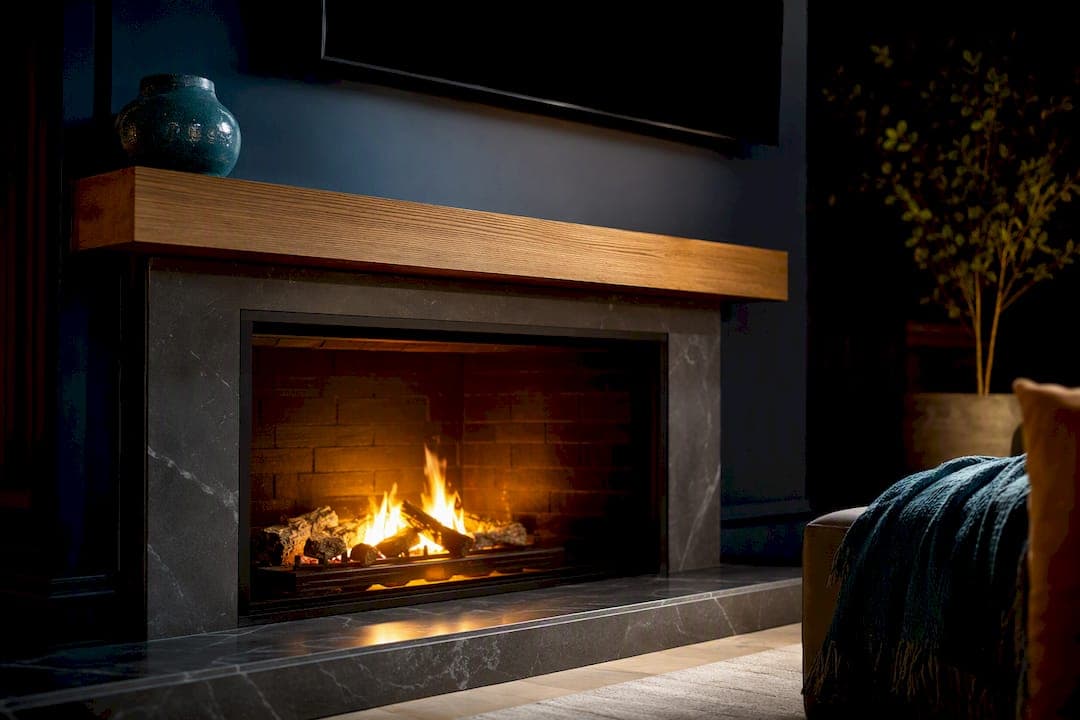
Mounting a TV above a fireplace is safe only when the wall surface at the TV's location stays below the set's rated ambient operating limit, often around 104°F (40°C), and the installation respects the fireplace manufacturer's own clearance rules. Electric fireplaces make this easy in most cases. Wood-burning and many gas units make it harder, sometimes forcing a deeper mantel or a different spot for the screen entirely. Test your wall before you commit to a mount.
TL;DR:
- The wall temperature where a TV is mounted above a fireplace must stay below 104°F (40°C) to prevent gradual heat damage to backlights, panels, and capacitors.
- Electric fireplaces produce less upward wall heat than gas or wood-burning units, making them safer choices for TV placement above a fireplace.
- Testing the wall temperature with a thermometer during a full burn cycle ensures the spot is safe, with a warm wall feeling being a helpful tactile indicator.
- Proper mantel depth, heat shields, ventilated alcoves, and relocating electronics can help mitigate heat risks if the wall runs warm but remains below safety thresholds.
- Installing the TV into a pre-designed, heat- and cable-smart media wall kit reduces guesswork and ensures ventilation and clearance requirements are met from the start.
Table of Contents
- How Heat Damages TVs: Operating Limits and Failure Modes
- Clearance Guidance by Fireplace Type
- How to Test Your Wall Before You Mount
- Heat-Mitigation Options That Actually Work
- Mounting and Cable-Routing Rules That Prevent Bigger Problems
- How to Decide, and What to Ask an Installer
- Signs Your TV Is Already Suffering Heat Damage
- Choosing a TV Built for Life Above a Fireplace
- Why an Integrated Media Wall Beats a Retrofit
- Get a Fireplace-Ready Media Wall Without the Retrofit Guesswork
- Sources
- FAQ
How Heat Damages TVs: Operating Limits and Failure Modes
TV makers do not guess at heat tolerance. They publish it. Philips, for one, lists an upper ambient operating temperature around 104°F (40°C) on its 5000-series LED sets, and that number is a design boundary, not a suggestion. Push past it consistently and the set doesn't fail dramatically. It fails slowly.
Backlights degrade faster in sustained heat, which shows up as dimming or uneven brightness a year or two before you'd expect it. Color panels can drift, capacitors in the power supply age faster than they should, and plastic bezels near the bottom edge (where warm air naturally collects) sometimes discolor or warp. None of this is covered by warranty once a manufacturer determines heat exposure caused it.
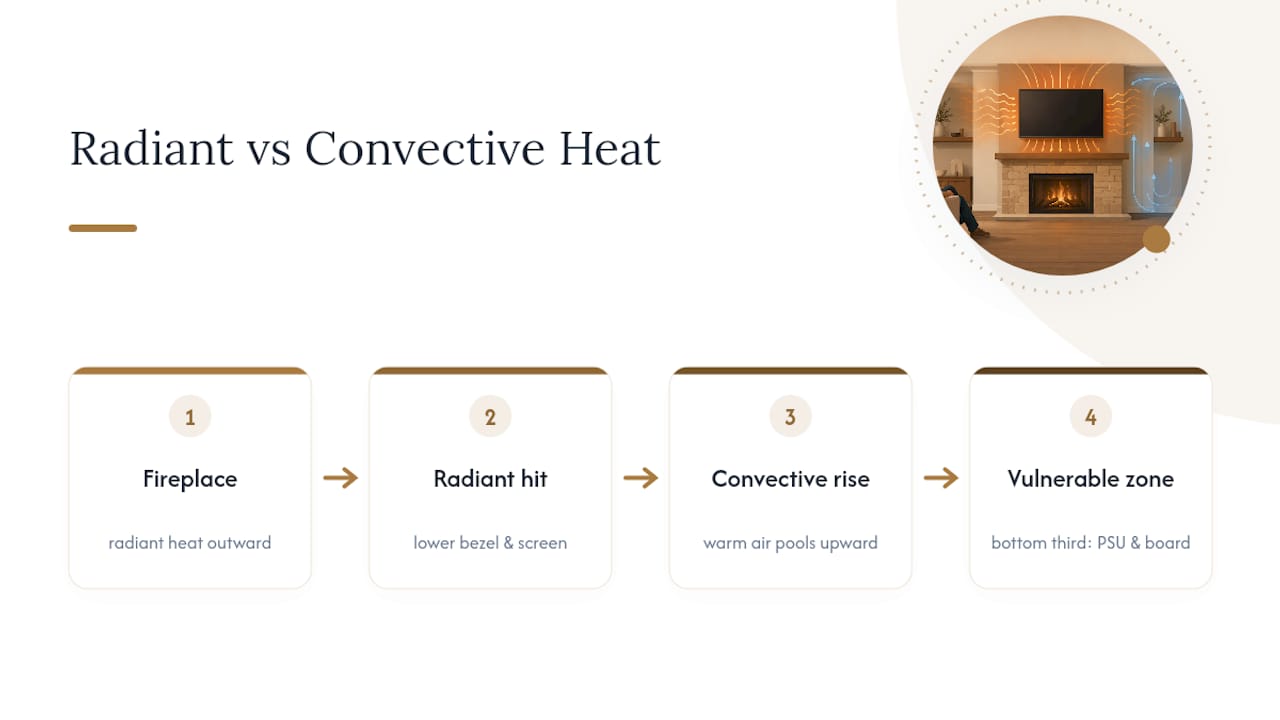
Radiant heat and convective heat do different damage. Radiant heat, the kind that travels in a straight line from an open flame, hits whatever surface faces it directly, usually the TV's lower bezel and screen. Convective heat rises as warm air currents, pooling near the ceiling or, in this case, right where a wall-mounted TV's electronics live. That's why the bottom third of the TV, where the power supply and main board usually sit, is the most vulnerable zone in almost every over-fireplace installation.
Clearance Guidance by Fireplace Type
Not all fireplaces put out the same heat, and the type installed changes the entire clearance conversation. Electric fireplaces typically produce much less upward wall heat than combustion units, which is why they're the default recommendation for anyone building a TV wall from scratch.
- Wood-burning fireplaces generate the highest radiant heat and produce soot that can drift upward onto electronics. Most installers recommend the deepest mantels here, or skipping the over-mantel TV placement altogether.
- Gas fireplaces vary widely by model. A sealed, glass-fronted gas unit directs less heat into the room than an open-front design, but clearance requirements are set by the specific manufacturer, not a general rule.
- Pellet stoves cycle heat in bursts tied to the blower cycle, so a quick check when the unit first ignites won't tell you much. Test during a full, typical burn cycle.
- Electric fireplaces run coolest at the wall and are usually the safest match for a TV mounted directly above, which is part of why so many modern media wall designs pair the two.
Whatever type you have, the manufacturer's manual for that specific model overrides any general guidance, including this article's.
How to Test Your Wall Before You Mount
You don't need a contractor to find out whether your wall is safe. You need a thermometer and thirty minutes.
- Run the fireplace normally for 20 to 30 minutes to reach steady-state heat, not just the initial spike.
- Tape a thermometer to the wall at the exact spot where the TV's back panel would sit, or use an infrared thermometer gun aimed at that same point.
- Record the reading at the 20 minute mark and again at 30 minutes to confirm it has leveled off rather than still climbing.
- Compare the number to your TV's published ambient limit. If it's staying comfortably under 104°F (40°C), you're likely in safe territory. If it's climbing past that or still rising at 30 minutes, stop and reconsider.
- Do a hand check too. The wall should feel barely warm to the touch, never hot.
This kind of field test is standard advice from builders who deal with this exact placement problem regularly, and it's echoed in guidance from Fine Homebuilding on arranging fireplaces and televisions in the same wall.
Pro Tip: Test on the coldest day you plan to use the fireplace heavily. A unit running at full output in January tells you far more than a mild autumn burn.
If your readings come back too hot, you have options: a deeper mantel, a heat shield, recessing the TV into a ventilated alcove, or simply mounting the TV somewhere else in the room. None of those are failures. They're just what the wall told you.
Heat-Mitigation Options That Actually Work
Assuming your wall runs a little warm but not dangerously so, a handful of design fixes can close the gap.
- Mantel depth matters more than most homeowners expect. A common starting rule is a noncombustible mantel positioned at least 12 inches above the firebox opening, with the TV's bottom edge another 4 to 6 inches above the mantel. Deeper mantels physically block more radiant heat from reaching the screen.
- Heat shields and hoods installed correctly can lower mantel-face temperatures by roughly 30°F in professionally matched setups, though they're often not enough on their own against an open wood fire running hot.
- Recessed alcoves create a protected pocket for the TV, but only work if you build in real airflow. A sealed recess with no venting just traps heat behind the screen instead of keeping it out.
- Component relocation keeps your streaming box, receiver, and cable box off the hot wall entirely. Store them in a ventilated nearby cabinet and control them with an IR extender or app based remote instead of running them right behind a warm TV.
Pro Tip: A mantel that looks deep enough from across the room often isn't. Measure it, don't eyeball it, before you decide the wall qualifies as low-risk.
Mantel choice also affects the whole room's proportions, which is a separate design question worth thinking through before you commit to a depth. Our guide to mantel decisions covers that trade-off in more detail.
Mounting and Cable-Routing Rules That Prevent Bigger Problems
Heat isn't the only risk in this installation. Bad wiring and weak mounts cause just as many callbacks.
- Mount into wall studs or masonry anchors rated for the TV's full weight. Drywall anchors alone are not sufficient for anything larger than a small monitor.
- Install a listed in-wall power kit, or have a licensed electrician add a recessed outlet behind the TV. Never run an extension cord through a wall cavity to reach power.
- Route HDMI and Ethernet using in-wall-rated low-voltage cable, and keep every cable path clear of the firebox and chimney chase entirely.
- Whenever possible, house streaming devices and cable boxes in a ventilated cabinet nearby rather than tucking them behind the TV where heat and dust both accumulate.
Two separate cable paths, one for power and one for signal, is standard practice among installers who do this work daily. Mixing the two, or improvising with household extension cords, is one of the most common mistakes homeowners make on this exact project.
How to Decide, and What to Ask an Installer
Once your wall passes the temperature test, the remaining decision is mostly ergonomic. Aim for a viewing angle under 15 degrees of upward tilt from your normal seating position. If the fireplace forces the TV higher than that, a tilting mount helps correct the angle without moving the whole installation. Our guide to mounting height walks through the math if you want exact numbers for your room.
If you're bringing in a professional, ask direct questions:
- Can you show me measured surface temperatures for a wall like mine?
- What clearance does this specific fireplace model require, according to its manual?
- How will you route power and low-voltage cables so nothing crosses the firebox?
If the answers feel vague, or if your wall simply runs too hot no matter what shielding you add, side-by-side placement, a flush media console, or swapping to an electric fireplace insert are all legitimate alternatives to forcing a TV above heat it can't tolerate.
Signs Your TV Is Already Suffering Heat Damage
If you've already got a TV mounted above a fireplace, a few warning signs are worth checking for now rather than waiting for a full failure.
Look at the picture first. Uneven brightness across the screen, a warm color cast that wasn't there when the TV was new, or dark patches near the bottom edge often point to backlight stress from sustained heat exposure. These symptoms tend to develop gradually, which is exactly why they're easy to dismiss as normal aging.
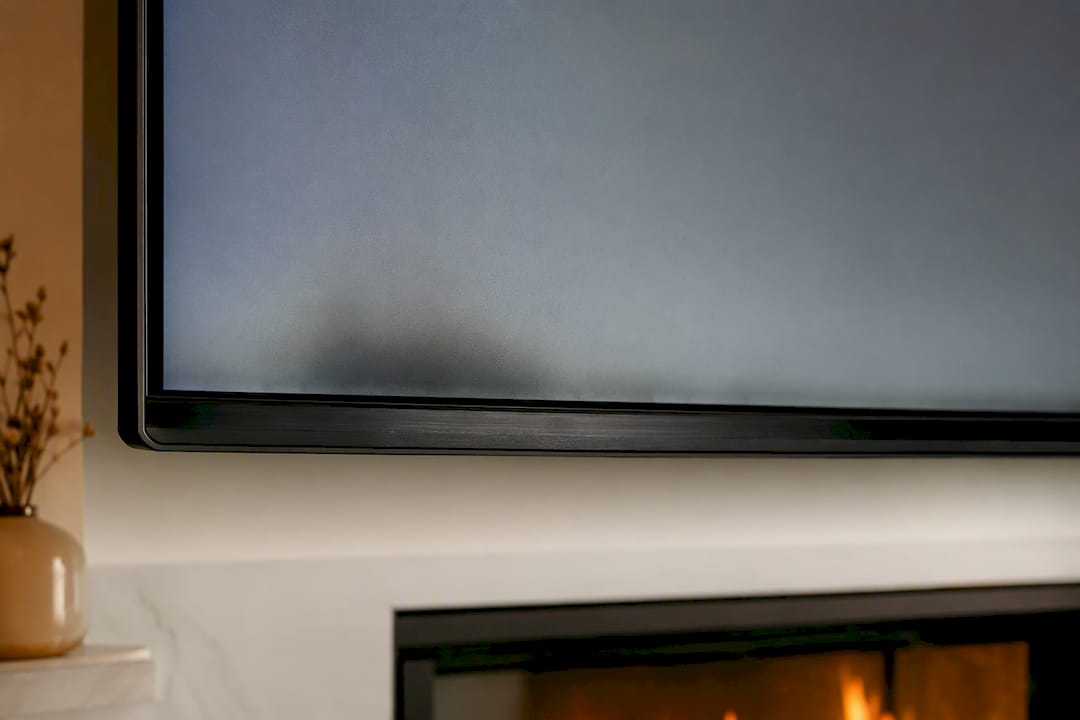
Check the physical hardware too. Warping or discoloration on the plastic bezel, especially along the bottom edge closest to the mantel, is a fairly reliable sign the TV has been running hotter than it should. A faint plastic or burning smell, however mild, is not something to ignore. Unexpected shutdowns or restarts, particularly during or right after the fireplace has been running, suggest the internal thermal protection is kicking in to prevent worse damage.
If your TV has ever felt noticeably warm to the touch on its back panel after a few hours of fireplace use, that's not normal, and it's worth pulling it down for the wall temperature test described earlier in this guide. Catching heat stress early, before a backlight fully fails or a board shorts out, is the difference between a minor placement fix and buying a replacement TV years ahead of schedule.
Choosing a TV Built for Life Above a Fireplace
Not every television handles this placement equally well, and a little research before you buy saves you the mitigation headache entirely. Look for sets with a published ambient operating range that gives you real margin above your tested wall temperature, not just a number that barely clears it.
OLED panels tend to run warmer internally than LED/LCD sets and can be more sensitive to additional ambient heat, so if your wall test comes back on the warmer side, an LED model with a higher-rated tolerance is often the safer bet. Sets with rear ventilation slots rather than a fully sealed back panel also dissipate heat more effectively in a mounted position, since airflow behind the panel makes a real difference over years of use.
Bottom-heavy heat exposure is the main risk in this placement, so pay attention to where a given model's ports, power supply, and vents actually sit. A design that clusters heat-sensitive components toward the top of the panel, farther from the mantel, has a practical advantage over one that puts them right at the bottom edge closest to the fire.
Why an Integrated Media Wall Beats a Retrofit
Retrofitting heat mitigation onto an existing wall is guesswork stacked on guesswork. Themediawallstore designs kits around the fireplace from the start, planning ventilation, cable paths, and electric fireplace compatibility before a single panel is cut. That sequencing is the real advantage. When the wiring plan and the heat plan are built together, you're not drilling into a finished wall later to fix a problem a pre-built layout would have avoided. A kit that assumes an electric insert from day one also sidesteps most of the clearance debate this entire article walks through.
— Jake
Get a Fireplace-Ready Media Wall Without the Retrofit Guesswork
Everything covered above, mantel depth, cable routing, ventilation, gets designed in from the start with a Themediawallstore kit instead of patched in after the fact. Our panels arrive pre-cut and pre-labeled with hidden wire management and layouts built around electric fireplace inserts, so you're not improvising a heat shield around a wall that was never planned for a TV.
If you already know your fireplace type, browse the electric fireplace TV stand collection for a combined unit that solves clearance and design in one piece. Prefer to build your own layout around an existing wall? Start with the full media wall kit shop and filter by fireplace-compatible designs. Either way, the next step is the same: pick a kit, check the fireplace compatibility notes on the product page, and reach out for a design consultation if you want a second set of eyes before you order.
Sources
Before you drill, mount, or reroute power, check your TV's spec sheet for its ambient temperature limit and your fireplace's installation manual for its specific clearance requirements. Local electrical code always takes precedence over general guidance, including everything in this guide.
- Mounting a TV above a fireplace: placement, safety, and design tips
- Should You Put a TV Above a Fireplace? (What’s Safe — And What’s Not) - Direct Fireplaces
- Arranging a fireplace and a television - Fine Homebuilding
- TV-Over-Fireplace Cable Management: 7 Pro-Level Ways to Hide Wires – Mantels Direct
FAQ
How close can a TV be near a fireplace?
There's no single universal distance. It depends on your fireplace type and the manufacturer's clearance rules, but a common starting guideline puts the mantel at least 12 inches above the firebox and the TV another 4 to 6 inches above that.
Does heat from the fireplace affect the TV?
Yes, sustained heat exposure above a TV's rated ambient limit, often around 104°F (40°C), accelerates backlight aging, can cause color shift, and may void the manufacturer's warranty.
How do you deflect heat from a fireplace away from a TV?
Deeper noncombustible mantels, rigid heat shields or hoods, and ventilated recessed alcoves are the main options, though shields alone often aren't enough against a hot open wood fire.
How far should a TV be from a wood-burning stove?
Wood-burning units produce the highest radiant heat of any fireplace type, so they typically need the deepest mantels and widest clearances, and in some cases the TV is better placed elsewhere in the room entirely.
Is it safer to mount a TV above an electric fireplace?
Generally yes. Electric fireplaces produce far less upward wall heat than wood or gas units, which is why many media wall designs, including Themediawallstore's electric fireplace options, build the TV placement around an electric insert from the start.