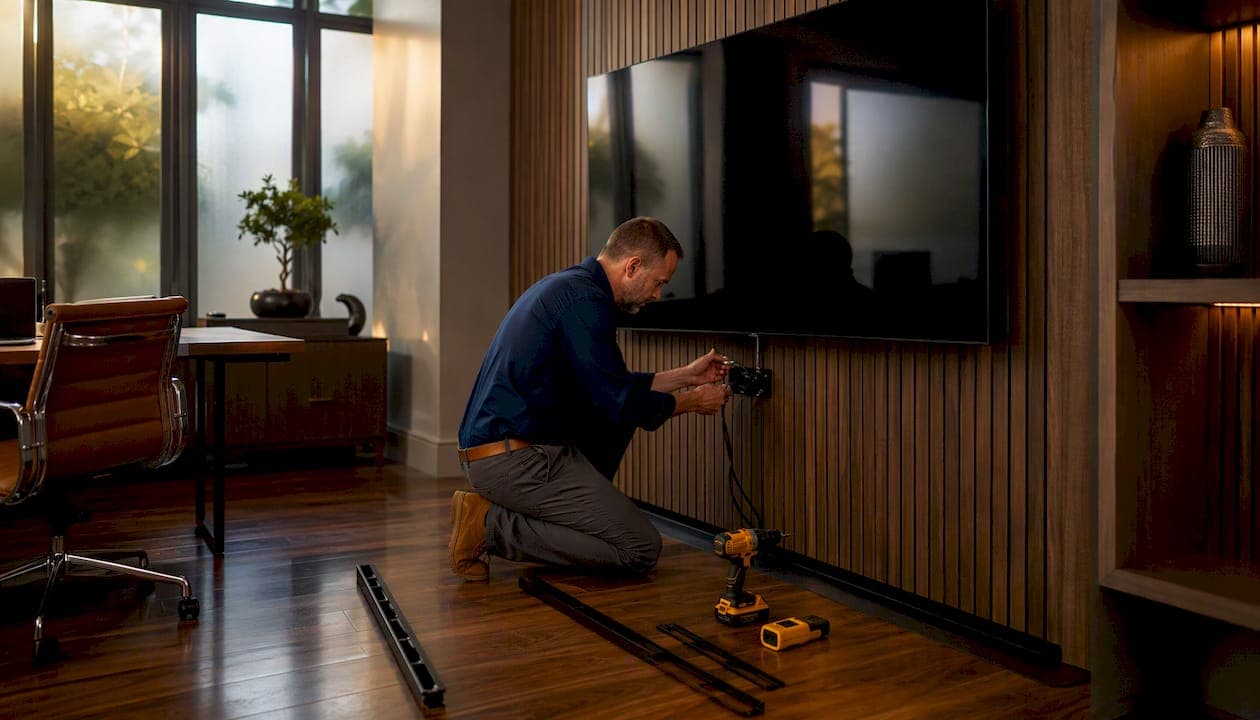
For a permanent, high-end media wall finish, an in-wall rated power-and-cable kit is the best TV wire management kit you can buy. It hides every cord inside the wall cavity, leaves zero visible hardware, and when it carries a cETLus or UL listing, it meets the safety standard that matters most. If cutting drywall isn't an option, a paintable on-wall raceway is the right alternative. It mounts to the surface, accepts latex paint, and looks far cleaner than a dangling cable.
Best for permanent luxury finish: in-wall rated power-and-cable kit (cETLus or UL listed) Best for renters or no-cut installs: paintable PVC raceway, UL-94 V0 flame-resistant and paintable to match your wall When to hire an electrician: any time the install requires a new outlet, altering existing house wiring, or your local code is unclear
Trust signals to verify before you buy:
- cETLus or UL listing on any kit you plan to run inside a wall cavity
- UL-94 V0 flame-resistance rating on raceway PVC
- Manufacturer-provided installation guide with tool list and safety notes
Table of Contents
- Which TV wire management kit type is right for you?
- Safety, certifications, and when you need an electrician
- How to choose the right wire concealment kit
- What installation actually looks like for each solution type
- What separates a quality kit from a cheap one
- Why Themediawallstore's kits deliver a finish raceways can't match
- Key Takeaways
- The case for going integrated from the start
- Themediawallstore makes the integrated approach accessible
- Useful sources
- FAQ
Which TV wire management kit type is right for you?
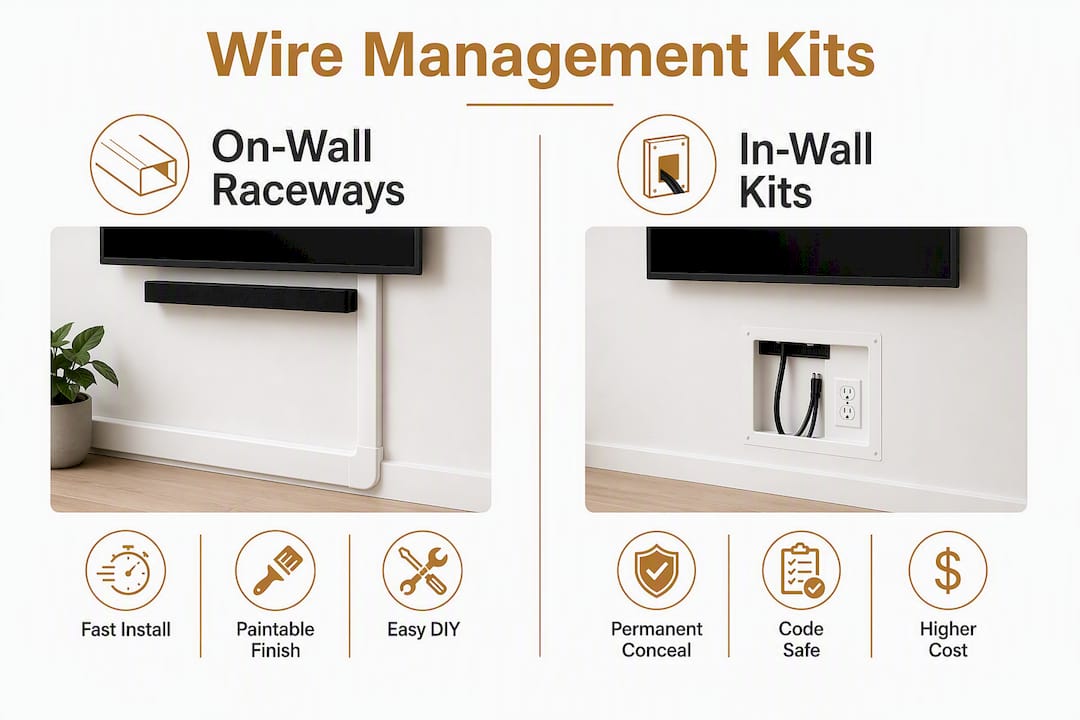
| Solution type | Best for | Aesthetic finish | DIY difficulty | Safety / in-wall rating | Typical cost | Re-entry |
|---|---|---|---|---|---|---|
| On-wall paintable raceway | Renters, no-cut installs | Paintable to match wall | Easy | UL-94 V0 surface only | a range of low prices | High |
| In-wall power-and-cable kit | Permanent installs, luxury finish | Flush wall plates | Moderate | cETLus / UL required | a range of moderate prices | Moderate |
| Recessed cable plate | Clean pass-through, no power | Near-flush | Moderate | Low-voltage only | a range of low prices | High |
| Full integrated media wall kit | Complete luxury build | Premium, custom finish | Weekend project | Integrated, pre-planned | a range of higher prices | Designed in |
On-wall paintable raceways are the fastest path to a tidy wall. They accept latex paint and include corner pieces and couplings for routing along baseboards or door frames. The trade-off is visibility: even a well-painted raceway presents a slight surface bump.
In-wall kits from brands like Legrand Wiremold are sold as plug-and-play solutions that include a pre-wired harness, grommets, a hole saw, and a 6-foot in-wall rated power cord. The result is a completely flush wall with no visible cord.
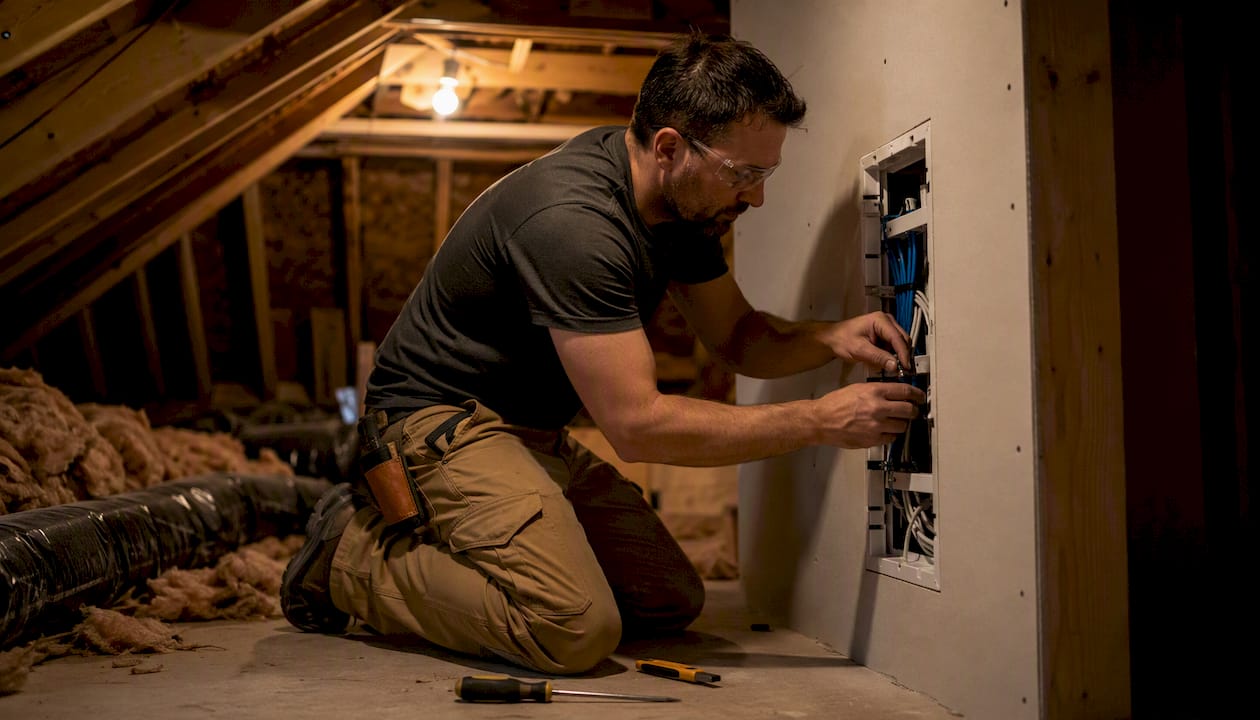
Recessed cable plates handle low-voltage cables only. No power runs through them, so they carry no in-wall electrical rating requirement. Good for HDMI and speaker wire; not a power solution.
Full integrated media wall kits from Themediawallstore sit in a category of their own. Wire management is built into the panel system, not bolted on afterward. That's the difference between a luxury finish and a DIY patch job.
Safety, certifications, and when you need an electrician
Choose only a cETLus-listed or UL-listed kit for any cable or cord running inside a wall cavity. Running a standard extension cord or non-rated power cable inside drywall is a fire hazard and likely violates your local building code. Manufacturer guidance is explicit on this point: "no electrician needed" marketing applies only when the kit uses an existing outlet and does not alter permanent house wiring.
Certifications to verify before purchase:
- cETLus or UL listing on any in-wall power component
- UL-94 V0 flame-resistance on raceway PVC
- RoHS compliance on kits with electronics (USB modules, power input panels)
Common hazards to avoid:
- Non-rated cords run inside wall cavities
- Adhesive-only mounting on textured or recently painted surfaces (adhesive fails; the raceway falls)
- Power components installed without adequate ventilation
Pro Tip: Call a licensed electrician if the install requires adding a new outlet, relocating an existing one, or touching any part of your home's permanent wiring. A $150 electrician visit is far cheaper than a drywall repair after a code violation.
For a full walkthrough of code-aware in-wall installation, Themediawallstore's safe DIY in-wall guide covers the key checkpoints before you cut.
How to choose the right wire concealment kit
Prioritize safety rating first, then re-entry design, paintability, and mount compatibility. Everything else is secondary.
Pre-purchase checklist:
- Wall construction: confirm stud locations and check for insulation before choosing a kit. Insulated walls need fish tape, which many basic kits don't include.
- TV mounting type: fixed mounts need less cable slack than full-motion arms. Full-motion mounts need a larger entry point or a flexible conduit.
- Future upgrade needs: will you add a soundbar, gaming console, or streaming device later? Choose a kit with a re-entry-friendly design.
- Finish and paintability: on-wall raceways that accept latex paint blend in well; in-wall kits use wall plates that match standard outlet covers.
- Included accessories: look for grommets, a hole saw, fish tape, corner pieces, and couplings. A kit missing these adds cost and a hardware store trip.
- Warranty and support: a kit with no listed warranty or no customer support contact is a red flag.
Red flags to walk away from:
- No in-wall rating when you plan to route inside the wall
- Missing installation instructions or incomplete parts list
- Adhesive-only raceways marketed for textured walls
- No warranty information anywhere on the product page
What installation actually looks like for each solution type
On-wall raceway (30–90 minutes)
- Measure the cable path from TV to outlet.
- Clean the wall surface thoroughly. Adhesive fails on dust or fresh paint.
- Cut raceway sections to length, snap in cables, press to wall.
- Add corner pieces at bends; use finish screws alongside adhesive on textured surfaces.
- Paint to match once adhesive has cured.
Tools: tape measure, utility knife, level, paint supplies.
In-wall kit (1–4 hours)
- Locate studs with a stud finder. Mark the planned hole positions.
- Cut upper and lower wall openings with the included hole saw.
- Fish the in-wall rated power cord and low-voltage cables through the cavity using fish tape.
- Connect the power module at the lower plate; route cables to the TV at the upper plate.
- Secure wall plates, dress cables, and test before mounting the TV.
Tools: stud finder, hole saw, fish tape, drywall saw, level, screwdriver.
The advertised "under 30 minutes" install time rarely holds once you account for stud checks and insulation. Budget 2–4 hours for a first install.
Common obstacles and quick fixes:
- Stud in the planned path: shift the hole 2–3 inches and re-measure before cutting. Moving the hole before you cut takes 5 minutes; patching drywall takes a weekend.
- Insulation blocking the cable pull: insulated walls need fish tape and sometimes a longer, stiffer rod to push through fiberglass or foam.
- Adhesive failure on textured paint: supplement with small finish screws every 12–18 inches.
What separates a quality kit from a cheap one
Hinge durability, material rating, and access design are the three characteristics that determine whether a wire concealment kit still works well two years from now. Higher-quality extruded hinges allow repeated re-entry without cracking, which matters every time you add a device or swap an HDMI cable.
Pro Tip: Before buying a hinged raceway, open and close the lid ten times in the store or check reviewer photos for cracked hinge points. A raceway that cracks on the third re-entry is not a re-entry-friendly design.
What to look for in a quality kit:
- UL-94 V0 rated PVC on any raceway. This is the flame-resistance standard that separates safe surface cable management from a fire risk.
- Extruded hinge construction rather than a snap-fit lid. Extruded hinges flex; snap-fit lids crack.
- Paintable surface that accepts latex without bubbling or peeling.
- Included accessories: corners, couplings, and end caps. A kit without these forces improvised cuts at every bend.
Hinged lid paintable raceways manufactured from flame-resistant PVC typically include the full accessory set. Cheaper kits ship raceway lengths only and leave the routing details to you.
Why Themediawallstore's kits deliver a finish raceways can't match
A paintable raceway hides wires. Themediawallstore's luxury DIY media wall kits hide wires and build the entire wall around them. Wire management is integrated into the panel system from the start, not added as an afterthought.
The practical difference: with a standalone raceway, you're managing cables on top of a finished wall; for truly integrated solutions, consider home organization systems that incorporate custom cabinetry and built-in media walls. With a Themediawallstore kit, the cable channels are part of the structure itself. Pre-cut, pre-labeled panels mean no guesswork on routing, and the integrated design supports a premium finish that a surface raceway simply can't replicate.
What the kits include and support:
- Pre-cut and pre-labeled panels with built-in wire channels
- Integrated LED lighting options and multiple finish choices
- Options for electric fireplaces and floating cabinetry
- Detailed how-to guides and support for weekend DIY installation
- Over 1,000 satisfied customers and risk-free returns
- White-glove custom installation available in the San Francisco Bay Area
For homeowners who want the home theater wall aesthetic without hiring a contractor, the integrated approach is the cleaner path. The accessories page covers finishing touches including trim, lighting, and cable covers.
Key Takeaways
An in-wall rated kit (cETLus or UL listed) is the only safe choice for permanent concealment inside a wall cavity; on-wall paintable raceways are the right call when cutting drywall isn't an option.
| Point | Details |
|---|---|
| In-wall rating is non-negotiable | Only cETLus or UL-listed kits are safe and code-compliant for inside-wall power runs. |
| Raceway quality varies widely | Extruded hinges and UL-94 V0 PVC separate durable raceways from ones that crack on re-entry. |
| Budget extra installation time | Stud checks and insulation routinely push in-wall installs to 2–4 hours, not the advertised 30 minutes. |
| Hire an electrician for new outlets | Any install that adds or moves an outlet requires a licensed electrician, regardless of kit marketing. |
| Themediawallstore integrates wire management | Pre-cut luxury media wall kits include built-in cable channels for a finish raceways can't replicate. |
The case for going integrated from the start
Most homeowners approach wire management as a finishing step. They mount the TV, then look at the cables, then buy a raceway. That order produces a result that looks managed, not designed.
The kits that hold up best over time are the ones where wire routing was planned before the first panel went up. That's not a knock on raceways. A quality UL-94 V0 paintable raceway, properly installed with finish screws and two coats of latex paint, looks genuinely clean. But it's still a surface solution on top of a wall, and every time you add a device, you're reopening a channel that was never designed for repeated access.
For a permanent install, the better sequence is: choose your media wall system, plan the cable routes inside the structure, then finish. That's the logic behind integrated kits, and it's why the result looks different. The wire management isn't visible because it was never on the surface to begin with.
One practical rule: always locate studs before you mark hole positions, not after. Relocating a pencil mark takes seconds. Patching a miscut hole in drywall takes a weekend and shows under paint.
Themediawallstore makes the integrated approach accessible
If you want a luxury media wall finish without a contractor's timeline or price, Themediawallstore's pre-cut DIY media wall kits are built for exactly that. Wire management is integrated into the panel system, panels arrive pre-labeled, and the kits are designed for a weekend install.
The Luxe Marble Glow Media Wall Kit is a strong starting point for homeowners who want a premium finish with built-in cable channels. For a fully custom build in the San Francisco Bay Area, white-glove installation is available. Browse the full media wall kit shop or request a design consultation to find the configuration that fits your space.
Useful sources
- Legrand Wiremold Flat Screen TV Cord and Cable Power Kit: check the cETLus listing and in-wall rating before purchasing any power kit.
- Legrand Wiremold In-Wall TV Power and Cable Grommet Kit (The Home Depot): review the included tool list and insulation notes before you buy.
- Mount-It! On-Wall TV Cable Concealer Kit: reference for UL-94 V0 paintable raceway specs and included accessories.
- Kable Kontrol Hinged Lid Cable Raceway: use to verify flame-resistance rating and hinge construction before purchasing a surface raceway.
- Themediawallstore How-to: Hide TV wires in wall (safe DIY guide): read before cutting any drywall; covers code checkpoints and tool requirements.
- Themediawallstore How-to: Hide wires without cutting walls: the go-to reference for renters and anyone choosing a surface raceway approach.
FAQ
What is the safest TV wire management kit for inside a wall?
Any kit you run inside a wall cavity must carry a cETLus or UL listing. Non-rated cords inside drywall are a fire hazard and may violate local building codes.
How long does a TV wire management kit take to install?
On-wall raceways typically take 30–90 minutes. In-wall kits run 1–4 hours once you account for stud checks, measuring, and insulation. The advertised "under 30 minutes" rarely holds in practice.
Can I paint over a cable raceway to match my wall?
Yes. Quality paintable raceways made from UL-94 V0 PVC accept standard latex paint. Clean the surface first and let the adhesive cure fully before painting.
Do I need an electrician to install a TV wire management kit?
Not for a standard in-wall kit that uses an existing outlet. You do need a licensed electrician if the install requires adding a new outlet, relocating one, or altering any permanent house wiring.
What makes Themediawallstore's kits different from a basic raceway?
Themediawallstore's luxury DIY media wall kits integrate wire management into the panel structure itself, so cables are concealed inside the build rather than on the surface. The result is a custom-looking finish that a surface raceway cannot replicate.