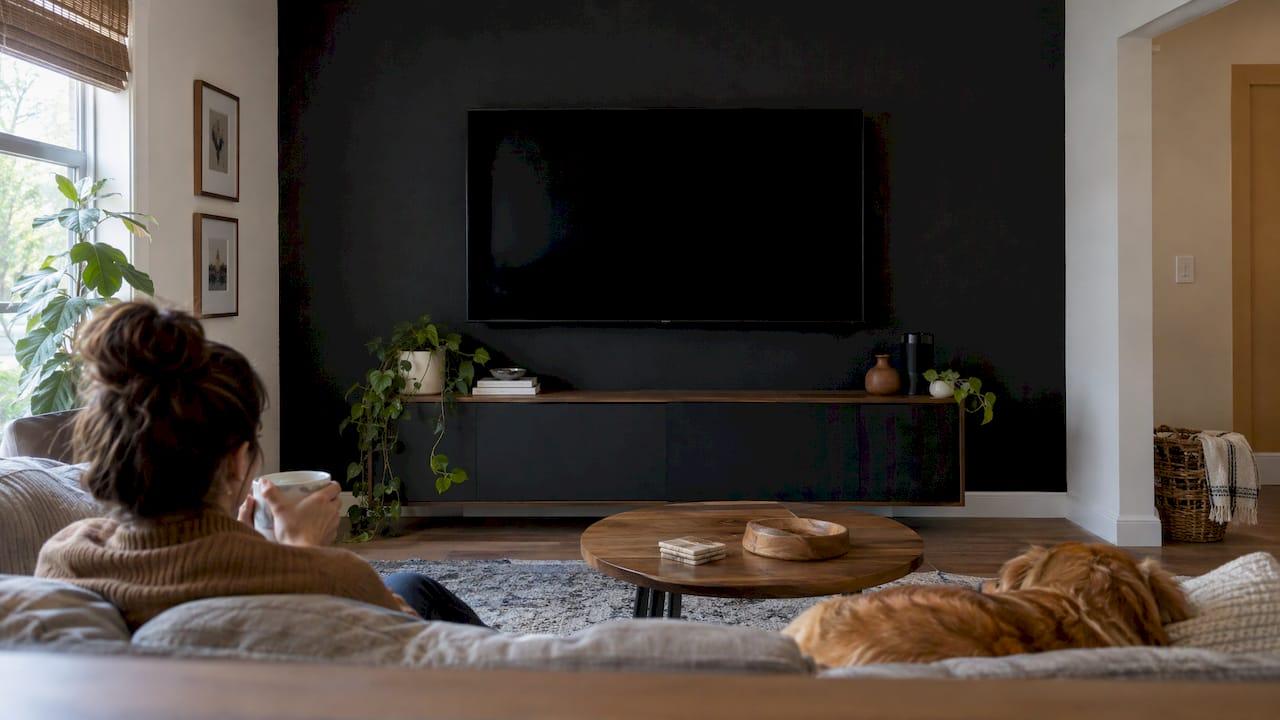
A matte black TV wall works when the wall is treated as a designed surface, not just a dark paint color: a low-sheen finish, warm layered light, a wood or slat texture and cables you never see. You can get there with paint alone, or faster and with more depth with a pre-cut kit. We build and sell the kit route, and the steps below work for either.
TL;DR
- Matte or flat black behind the TV hides fingerprints and dust and lets the screen blend into the wall when it is off.
- Choose a flat or matte finish, not gloss, so lamps and windows don't create hotspots on the wall.
- Prep decides the result: dark paint shows every ridge, patch and spackle edge.
- Warm bulbs (about 2700K), wood tones and a little metal keep black from feeling like a cave.
- Center the screen at seated eye level and plan cable concealment before anything goes on the wall.
Table of Contents
- Why a matte black wall suits a TV
- Choosing the black and the finish
- How to paint the wall matte black
- Add texture so black has depth
- Keep it warm: lighting, wood and metal
- Plan the layout before you paint or build
- Paint or kit: how to decide
- Not sure what to build? Start with a design
- Our view on black TV walls
- FAQ
- Sources
Why a matte black wall suits a TV
A black or near-black wall behind a television helps the TV blend into the wall when it is off, because a dark backdrop matches many TV bezels and the screen reads less like a separate box. The same guide notes that black also hides fingerprints, scuffs and dust better than white or pastel walls, which matters in a living room with kids.
The finish matters as much as the color. Glossy paint reflects lamps and windows, which shows up as bright spots during movie night. Flat paint has no sheen at all, and matte is nearly as shine-free, with excellent hide and depth of color and slightly more durability. For a wall behind a screen, one of those two is the right call.
Black also absorbs light, so where you put lamps and LED strips does more work here than on a pale wall. That is a design opportunity: lighting becomes the decoration.
Choosing the black and the finish
Not every black is the same. Some lean blue, some brown, some are true neutral. Tricorn Black from Sherwin-Williams is described as a true black that modernizes a space, and it is a common pick for accent walls. Whatever you choose, brush out a sample about 2 feet square on the actual wall and look at it in the morning, at midday and at night with your normal lamps on. A black that looks neutral in the store can look green or purple beside your trim.
Here is how the two low-sheen options compare:
| Finish | What it does | Best for |
|---|---|---|
| Flat | The least reflective; hides small surface variation | Walls with minor texture, rooms with strong window light |
| Matte | A soft, low sheen, slightly more durable | Living rooms that get wiped down or bumped |
| Eggshell | A little more glow, easier to wash | Hallways and playrooms, less ideal directly behind the screen |
| Gloss | Mirror-like reflections | Not recommended behind a TV |
Two upkeep notes. Scrubbing a flat or matte black too hard can polish a shiny patch into an otherwise low-sheen wall, so follow the paint maker's cleaning instructions and use a soft damp cloth. And flatter finishes generally touch up more readily than glossier ones, though if the wall has a big repair, repainting the whole wall is often more predictable than patching.
How to paint the wall matte black
This is the routine for a painted TV wall. Budget a weekend: one day to prep and prime, one to paint and let it cure.
- Clear and clean. Take the TV and mount down, move furniture away and wipe the wall. Farrow & Ball's guidance is that surfaces should be sound, clean, dry and free of dust, grease and loose material. Grease from a nearby kitchen is the usual culprit.
- Fill and sand. This is where black goes wrong. Dark paint can cast subtle shadows along ridges, dried spackle edges and unprimed drywall patches. Fill every old screw hole and dent, sand smooth, and wipe the dust away.
- Prime fully. A full, solid coat of primer helps the topcoat stick, absorb evenly and develop rich depth of color. Don't thin the primer: over-diluting reduces opacity and can leave the finish uneven.
- Tape and cut in. Mask the ceiling line, baseboard and side walls. Paint a 3-inch band along edges first, then roll the field while the edges are still wet so you avoid visible lap lines.
- Roll two coats. Use a quality roller cover, work in vertical sections from top to bottom, and wait the full recoat time on the can. Rushing the second coat is how you get streaks that only show in raking light.
- Cure before you mount. Give the paint time to harden before you hang a bracket or lean furniture against it. Check the can for the manufacturer's cure time.
One guide to black TV walls estimates DIY paint at roughly $50 to $150 for a single wall. Prices vary by paint line and wall size, so treat it as a ballpark.
A tip for paint-only walls: a flat black can look a little flat on its own. That is why most good black TV walls add texture, which is the next step.
Add texture so black has depth
A single flat plane of black can feel heavy. Designers add rhythm: vertical slats, shiplap, fluted or paneled sections, or a floating shelf casting a shadow line. The point is that dark surfaces show texture through shadow, so even a modest relief looks expensive.

A pre-cut kit is the shortest path to that look. Our kits come with pre-cut, pre-labeled panels, a modular system, hidden wire management, integrated LED lighting, floating cabinetry and slat accent panels, and a choice of finishes, so you assemble rather than measure and cut. They are designed to go up in a weekend without a contractor. If you like the idea of warm slats against black, the Acoustic Slat Wall Panel in Red Walnut is the kind of piece that gives a black wall its texture and warmth in one move.
If you want the black to be furniture rather than paint, the 71" Floating TV Console in Black Wood Grain gives you a black-toned base with a visible grain, which reads richer than flat paint alone. For small hardware details, our matte black, brass and chrome hardware finishes let you match handles and fittings to the wall.
For more paint and accent ideas that pair with a dark wall, see our guide to accent wall paint ideas for living room media walls.
Keep it warm: lighting, wood and metal
The common complaint about black walls is that they feel like a cave. The fix is not a lighter wall. It is better light and warmer materials.
Layer the lighting. Overhead lighting alone can flatten a dark palette. Guidance for dark interiors is to layer light and use warm bulbs around 2700K, and to keep bulb temperatures consistent: mixing cool and warm bulbs can make the room look accidental. The same source suggests a CRI (color rendering index, a measure of how true colors look under a bulb) of around 90 or higher so wood grain and fabrics don't look muddy. Good layers behind a TV wall are a floor lamp to one side, a picture light or two, and a backlit LED strip. Our media wall lighting range covers LED and ambient options, and the Oslo Lux LED floating shelf has lighting built in, so there is no separate strip to wire.

Pair it with wood. Warm tones such as white oak, walnut and mahogany sit well against matte black, as do brushed brass or warm bronze accents. A floating wood shelf like the Oslo Classic adds a warm horizontal line, and floating shelves for media walls let you style a few objects against the dark backdrop.
Frame it with something lighter. Painting the side walls a soft neutral and keeping the black to the TV wall alone follows the simplest version of the idea: one coat of matte black behind the television, with the rest of the room lighter for balance. Crisp off-white or soft cream trim around the black makes the edges look intentional.
Add a fireplace if you want a focal point. A linear electric fireplace gives the black wall a glowing center. Browse electric fireplaces for media walls, or look at the Breckenridge 70" floating fireplace TV stand.
Plan the layout before you paint or build
The wall can be beautiful and still be wrong if the TV is too high or the cables dangle. Settle these first.
TV height. Mount the TV so the center of the screen sits at seated eye level, about 42 inches from the floor for a standard sofa. A bigger TV is taller, so its bottom edge ends up lower. Sit on your sofa and have someone hold a piece of painter's tape where the center should be before you drill.
Position in the room. Place the TV wall perpendicular to the main window where you can, so daylight doesn't hit the screen head-on, and keep walkways clear. A dark wall opposite a big window will pick up reflections in the daytime.
Cables first. Plan the route before panels or paint go up. Surface trunking can be hidden behind panels, or cables chased into the wall if it is accessible. Cutting into walls carries its own risks, since you don't know what runs behind drywall, so if you are unsure, use a surface route. Our guide on how to hide wires from a mounted TV without cutting walls shows how to do it cleanly, and the kit's hidden wire management is built for the same job.
Storage and heat. Streaming boxes and cable boxes need airflow. Our post on media wall storage ideas that don't trap heat covers spacing, and hiding a cable box without blocking remotes covers the remote-signal side.
Mount it safely. A TV bracket must fasten into studs or solid backing behind the wall, never into the paint, a decorative panel or drywall alone. Use the bracket maker's stated weight rating and its instructions, and ask a qualified installer if you are not sure what is behind the wall. Our white-glove installation is available if you would rather have it done for you.
Paint or kit: how to decide
| Paint only | Pre-cut kit | |
|---|---|---|
| Look | Clean, minimal | Textured, layered, built-in |
| Cable concealment | Add-on raceway | Designed in with hidden wire management |
| Lighting | Added separately | Integrated LED lighting available |
| Time | A weekend of prep and painting | Designed for a weekend install |
| Skill | Patience and a steady hand | Pre-cut, pre-labeled panels |
Paint alone is the lowest-cost start. If you want slats, shelves and lighting in the same finish, the kit covers all of it in one coordinated system, and it is the version that looks custom.
Not sure what to build? Start with a design
If you can't picture the finished wall, we offer design services before you buy anything else: a Single Concept Design for $99, a 3 Concepts + Revision Design Package for $199, or a Full Design & Quote for $299. You see a plan sized to your wall and TV first. If you want the build handled for you, white-glove installation is available in the SF Bay Area, and nationwide we ship kits with risk-free returns. You can also see how it works for custom installs and DIY kits.

For everything else that goes on or around the wall, from shelves to smart tech, browse our accessories.
Our view on black TV walls
We have watched a lot of people stand in front of a blank wall with a can of black paint and a plan that stops at the color. Black is the easy part. What makes it look like a designer room is everything around it: the shadow lines from slats, a floating console that lets the wall breathe, light you control, and cables that simply aren't there.
That is why we built our kits the way we did. Pre-cut, pre-labeled panels mean the geometry is right before you start. Hidden wire management means the wall stays clean. Integrated LED lighting means the black glows instead of swallowing the room. And the finish options mean you can warm it with walnut or cool it with chrome.
If you are a first-time homeowner or a busy parent, you don't need to pay custom-build prices to get this look. A weekend and the right kit get you there.
Jake
FAQ
Is matte or flat black better behind a TV?
Both work. Flat is the least reflective, and matte has a soft low sheen with a bit more durability. Pick flat if the wall has small imperfections or strong window light, and matte if the wall will get touched and wiped. Avoid gloss, which reflects lamps and windows.
Will a black wall make my room too dark?
Not if you plan the light. Use warm bulbs around 2700K, layer a floor lamp, picture lights or an LED strip, and add warm wood and a little metal. Keeping the side walls lighter also keeps the room balanced.
How much does a DIY matte black TV wall cost?
One 2026 guide estimates $50 to $150 for DIY paint and $300 to $900 for DIY slat or shiplap paneling. Our kits are priced by configuration on our shop pages, and our design packages start at $99.
Can I hide the cables on a black TV wall?
Yes. Plan the route before any panels go up, and use a paintable raceway or hidden channels behind panels. Our kits include hidden wire management so cords stay out of sight.
Sources
- Black TV Wall Ideas That Make Any Screen Disappear
- How to Choose a Paint Finish, Benjamin Moore
- How to Choose the Best Black Paint Colors for Bold Rooms, BHG
- Matte Black vs Flat Black: Sheen Differences
- Painting the TV wall: choose the color, finish and preparation
- Farrow & Ball Product Advice Sheet
- Ultimate Checklist for Matte Black Paint for Walls
- Dark Academia Living Room Design Guide
- How High to Mount a TV: Height Chart
- How to Arrange a Small Living Room Around a TV
- How to Build a Media Wall: Step-by-Step Guide