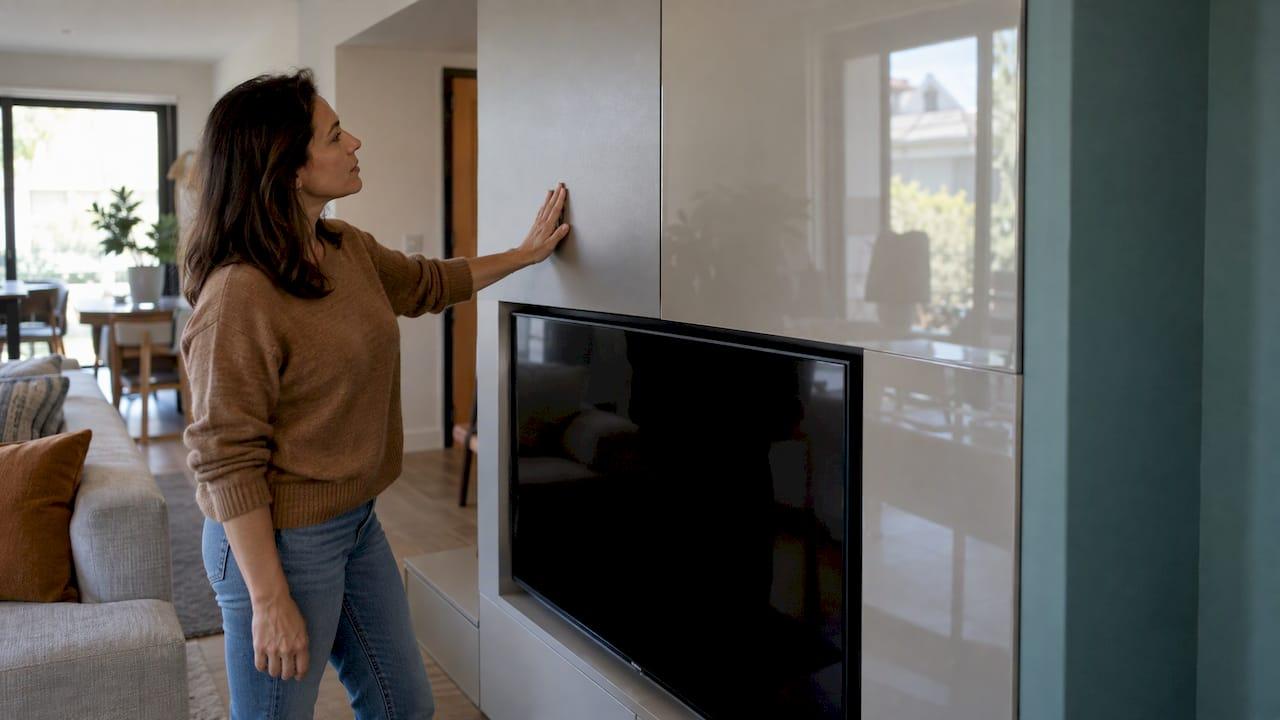
For the wall around a TV, matte panels are the safer pick in a room with windows or lamps, and gloss belongs where you control the light. A matte finish scatters light, so the wall stays calm next to the screen and shows fewer fingerprints. A gloss finish bounces light back like a mirror. It looks dramatic in a dim theater-style room, but it can throw window light and lamp glare across the screen. Our kits come in multiple finishes, so you can match the surface to your room instead of guessing.
Most of what you read online about "matte vs gloss" is about monitors and TV screens. That research turns out to be useful for your wall too, because the physics is the same: a rough surface scatters light and a smooth one reflects it. This guide translates it into decisions for a living room, den or family room.
TL;DR
- Matte scatters light and hides fingerprints, dust and small marks. It is the practical choice for bright rooms, rooms with big windows and homes with kids.
- Gloss reflects light directly. It adds depth and a high-end look in a room where you control the lighting, and it works best beside the TV rather than directly behind it.
- The screen itself matters as much as the wall: testing shows a glossy TV screen keeps deeper blacks in a lit room, while a matte screen copes better with direct glare.
- A hybrid wall (matte behind the screen, a richer finish on accents such as shelves and slats) gets most of the benefit of both.
- Check your room at the hours you actually watch TV before you commit to a finish.
Table of Contents
- What matte and gloss actually mean
- Why the finish matters more on a media wall
- How each finish behaves in real rooms
- The screen matters too: what the research shows
- Look and feel: what each finish does to a room
- Fingerprints, dust and everyday upkeep
- Choosing by your situation
- The hybrid approach most rooms end up with
- A simple test before you order
- Our view on matte vs gloss
- Get the finish right from the start
- FAQ
- Sources
What matte and gloss actually mean
Gloss is a smooth, shiny surface. Light hits it and bounces off in a clean, predictable direction, which is why you can see a window or a lamp reflected in it. Matte has a microscopically rough surface that breaks light up and sends it in many directions, so you see a soft, even look and no sharp reflections.
The same idea is how display makers describe their screens. XDA Developers explains that glossy displays use a smooth glass or reflective polymer surface, while matte displays use a plastic layer with microscopic grooves that scatter light away from the display. Wall finishes work the same way, only at room scale.
There is also a middle ground, often called satin, semi-gloss or low-sheen. It reflects a little, diffuses a little, and suits people who want some richness without a mirror effect. Think of the choice as a dial, not a switch.

Why the finish matters more on a media wall
A bedroom wall only has to look good. A media wall has a screen in the middle of it, and a screen is the most reflection-sensitive object in your house. Anything shiny around it can end up in your picture, and anything bright on a wall opposite it can too.
There are two separate reflection problems to keep in mind:
- Reflections on the screen. Light from windows, lamps and recessed lights bounces off glossy surfaces on the wall and the opposite wall, and some of it reaches the TV.
- Reflections on the wall itself. Panels with a high sheen show the light fixtures, windows and furniture across from them, which can look like visual clutter when you are trying to watch a movie.
A matte wall largely removes the second problem and reduces the first. That is why many people who love the look of gloss still choose matte directly behind and below the screen.
How each finish behaves in real rooms
Bright rooms with windows
If your TV wall faces a window, or the window sits beside it, daylight will find every shiny surface. Testing by display analysts at TFTCentral concluded that matte coatings suit well-lit rooms in the daytime, while glossy suits darker rooms and nighttime viewing where you can control the lights. That is about screens, but the lesson carries to the wall: the brighter and less controllable your room, the more a matte finish earns its place.
KTC, a display maker, gives rough lighting bands for choosing a screen coating. In spaces above about 500 lux (roughly a sunlit room), matte is generally necessary for basic usability, and in a true dark room of 0 to 50 lux glossy wins. Lux is simply a measure of how much light lands on a surface. Your phone's light meter app can give you a ballpark.
Dim, controlled rooms
If you watch in a den or basement with blackout curtains and dimmable lights, gloss is a strong option. In a dark room, Tom's Guide reports no discernible difference between glossy and matte OLED screens. Without ambient light there is nothing to reflect, so a glossy wall panel can bring in depth and sparkle with no downside during movie time. Just remember the room also has to work with the lights on.
Mixed-use family rooms
Most living rooms are neither cave nor greenhouse. They are bright in the morning, lamp-lit in the evening and full of people in between. For this middle case, a matte or low-sheen finish behind the TV and gloss or high-contrast finishes as accents is the most forgiving combination.
The screen matters too: what the research shows
Your TV's own surface interacts with the wall around it, so it helps to know what you are working with.
TFTCentral's controlled test found that glossy OLED panels had about 3.5 times better perceived black depth than matte anti-glare panels when a light source sat in front of the screen but off to the side. The reason: a matte coating also diffuses ambient light across the whole screen, which lifts the darkest areas. Later TFTCentral work found that matte coatings had the lowest level of reflections when a bright light was shone directly at the panel, while glossy panels showed significantly more.
In plain terms:
- A glossy TV looks richer in a room with soft, controlled light.
- A matte TV is easier to live with when light comes straight at it.
- Either way, a wall that adds extra reflections or bright glare makes things harder.
Tom's Guide's advice for an OLED TV in a room with a fair amount of ambient light is to choose a glossy screen for deeper blacks, but to go with a glare-free matte design if the TV sits right next to a window or opposite a strong light source. The same logic works for the wall: keep reflective surfaces out of the line between your light sources and your eyes.
Why the sightline test beats the finish name
TFTCentral also points out that glossy reflections can be significant if a light source is behind the viewer. So where you sit matters as much as the finish. Before you decide, sit in your usual spot and look at the wall and screen in daylight, then at night with your lamps on. Note every bright thing you can see reflected. Windows, light-colored walls and ceiling fixtures are the usual culprits.
Look and feel: what each finish does to a room
| Matte | Gloss | |
|---|---|---|
| Light behavior | Scatters light, soft and even | Reflects light, mirror-like |
| Best room | Bright, windowed, mixed-use | Dim, controlled, theater-style |
| Glare near the TV | Minimal | Can be strong if light sources face it |
| Fingerprints and smudges | Far less visible | Show up quickly |
| Visual feel | Calm, modern, understated | Dramatic, polished, high contrast |
| Best position | Directly behind and around the screen | Side panels, shelves, accents |
One more practical point from the display world applies to walls: a matte surface can look flatter. As PCMonitors.info notes, matte treatment reduces perceived contrast and vibrancy slightly, while glossy leaves the image richer and more vivid. On a wall, that translates to a quieter, more muted effect for matte and more depth and punch for gloss. Neither is better. They create different moods, so decide what you want your room to feel like.
Fingerprints, dust and everyday upkeep
If you have kids, pets or a habit of leaning on the wall while you plug in a console, upkeep is a real part of the choice.
As a general rule, smooth shiny surfaces show smudges and dust more, while matte surfaces hide them. Ars Technica reports that glossy screens using reflective glass or polymers attract more fingerprints and dust than matte ones. BenQ's guide for everyday use similarly says matte resists fingerprints and smudges better. The same thing happens on a wall, because a sharp reflection makes every mark stand out.
Some practical habits that help with either finish:
- Use a soft, dry microfiber cloth for routine dusting.
- Test any cleaner on a hidden spot first. Our guide on wall panel cleaning and the hidden spot test walks through how to do it so you do not dull or mark the finish.
- Wipe with the grain or in light, even strokes rather than scrubbing one area, which can polish a matte surface into a shiny patch.
If you would rather budget for help with deep cleaning, a breakdown of wall cleaning costs per square foot shows what a professional wash typically runs and when it is worth it.
Choosing by your situation
Busy parents and rooms with kids
Pick matte or a low-sheen finish on the wall zones within reach of small hands. Fingerprints barely register, and a quick dusting keeps it looking new. Keep gloss for high, out-of-reach accents if you want some shine.
First-time homeowners on a budget
You will likely live with this wall for years, so choose the finish that tolerates the widest range of lighting. That is matte. It also gives you the most freedom to change lamps, curtains and furniture later without suddenly seeing new reflections.
Design lovers chasing a high-end look
You can get a luxe result without gloss everywhere. Rich textures, slat accent panels, built-in LED lighting and metal hardware add depth while the main surface stays matte. If you want a mirror-like moment, put it where it will not face a window, such as on a side section or a feature niche. Our hardware finishes in brass, chrome and matte black show how metal accents can add the shine while the wall stays calm.
DIY enthusiasts
Finish affects installation more than you might expect. Glossy surfaces show every flaw, including uneven seams, filler marks and fingerprints left during handling. Matte surfaces are more forgiving. If you are doing the build yourself, seams are a real concern for either finish, and our guide to hiding TV wall panel seams covers filling and revealing them cleanly.
Rooms that double as home offices
If the media wall is also where you work on a laptop or monitor, favor matte. Chris Hoffman at PCWorld found that in challenging lighting, matte displays are easier to read with less glare and eye fatigue, while glossy ones look vivid in ideal conditions such as a dark room.
The hybrid approach most rooms end up with
You do not have to choose one finish for the whole wall. A layered design usually looks better and behaves better:
- Matte or low-sheen around the TV. This is the area most exposed to your light sources and your eyes.
- Texture on the sides. Slat panels and wood or stone looks add depth without mirror-like reflections.
- Shine as an accent. Metal hardware, a lit floating shelf or a glossy detail lets light play across the wall without bouncing straight at the viewer.
- Lighting that works with the finish. Integrated LED lighting that washes the wall softly looks good on matte surfaces, and avoiding bare spotlights aimed at shiny areas keeps glare down.
If you want to see how these combinations look together, our guides to panel interior design and decorative wall panels are full of layouts and finish pairings.
A simple test before you order
Because the right finish depends on your light, a short routine saves guesswork:
- Map your light. Note windows, lamps and ceiling fixtures facing the TV wall.
- Check at two times. Look at the wall at midday and in the evening with your usual lamps on.
- Sit where you sit. The angle between you, the light and the wall decides what you see. Move to your couch, not a spot in the middle of the room.
- Score the glare. If you can see a bright window or lamp reflected on the wall near the TV, use matte there.
- Pick your accents last. Once the main surface is chosen, add gloss and metallic touches where they will not face a light source.
TFTCentral's summary of the topic is worth remembering: there is no best coating overall, and the viewing environment, light position and personal preference decide. That is as true of a wall as of a screen.
Our view on matte vs gloss
We build media walls for people who want a high-end result without a contractor's price, and the finish question comes up more than almost any other.
Our advice is to treat the wall as a frame for the screen. The screen is the star, so the surface directly around it should stay calm. That is why we lean toward matte and low-sheen finishes behind the TV, and then bring in richness through texture, slat panels, integrated LED lighting and floating cabinetry.
Our kits are pre-cut and pre-labeled, with hidden wire management, so the build is straightforward over a weekend. You can choose from multiple finishes and features to suit your room, and the modular system lets you combine a quiet main surface with accents that add the luxury feel.
If you are unsure, start with the lighting in your room, not the sample swatch. Then choose the finish that lets your TV look its best at the hours you really watch it.
Jake
Get the finish right from the start
If you want a second pair of eyes on your room, our design services start at $99 for a Single Concept Design, $199 for the 3 Concepts + Revision Design Package, and $299 for Full Design & Quote. They are listed in our shop. If you prefer to build it yourself, browse our finishes and media wall kits, or see how it works from order to installation. In the SF Bay Area we also offer white-glove installation.

Our kits ship nationwide with expert support and risk-free returns.
FAQ
Is gloss or matte better behind a TV?
Matte is the safer choice directly behind and around the screen, particularly when the room has windows or lamps that can reflect. Gloss works best on side sections and accents away from your sightline. In a room you can fully darken, either finish can work.
Is glossy better for an OLED TV?
Often, if your room is controlled. TFTCentral measured glossy OLED panels with about 3.5 times better perceived black depth than matte ones in its test. Tom's Guide recommends a glossy screen for rooms with a fair amount of ambient light, and a glare-free matte screen if the TV sits next to a window or opposite a strong light.
Which finish hides fingerprints better?
Matte. Its scattered surface makes smudges, dust and small marks far less visible, which is why it suits family rooms. A glossy surface shows marks quickly and needs more frequent wiping.
Can I mix matte and gloss on one media wall?
Yes, and it is often the best look. Keep the surface around the TV matte or low-sheen, then use gloss or metallic finishes on shelves, trim and hardware. This adds depth and keeps the screen free of distracting reflections.
Sources
- Matte vs glossy displays: How to decide and why it matters (XDA Developers)
- The OLED Black Depth Lie: When Panel Type and Coating Matters (TFTCentral)
- Glossy vs Matte: OLED Panel Coatings Compared (TFTCentral)
- Matte vs glossy OLED TV screens (Tom's Guide)
- Glossy vs Matte OLED Monitors: Which Coating Wins? (KTC)
- Matte vs Glossy Monitors (PCMonitors.info)
- First glossy gaming monitors promise enhanced colors, more reflections (Ars Technica)
- Glossy vs. Matte Monitors: Which Is Better for You? (BenQ)
- I stopped chasing OLED laptops for one reason: Glare (PCWorld)