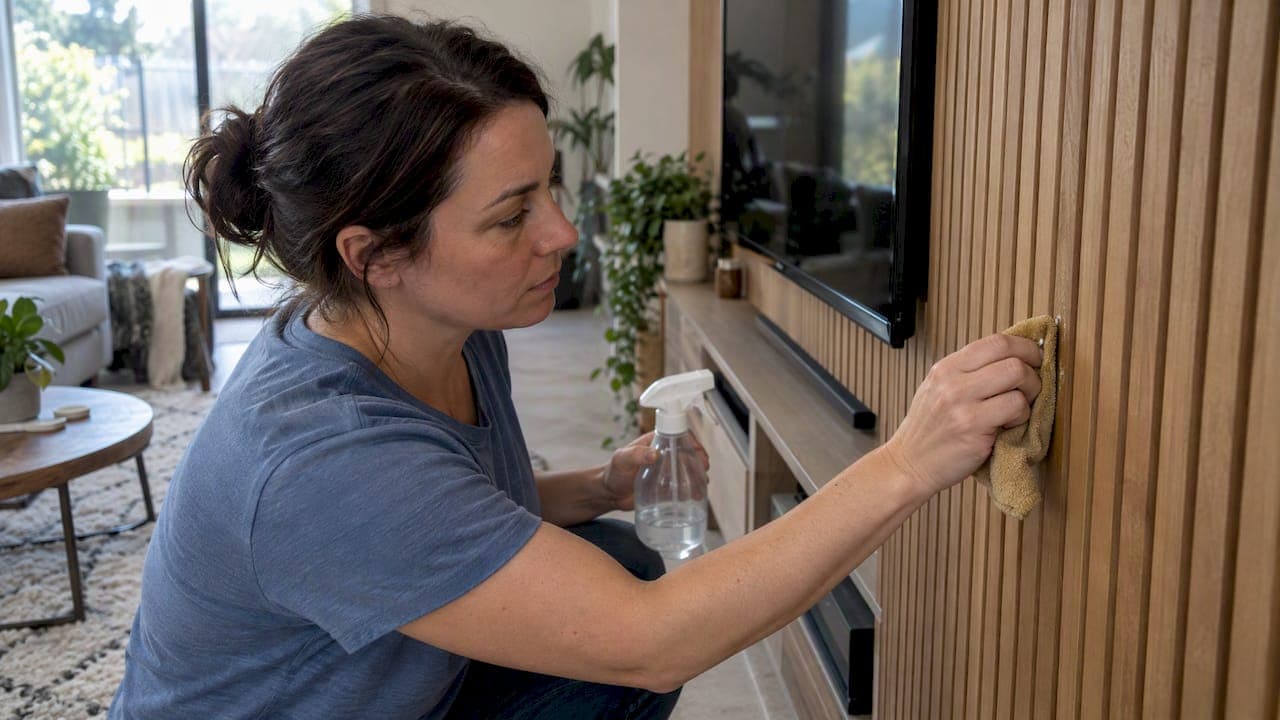
Start by spot-testing a hidden corner, then wipe most wall panels with a mild dish soap solution and a soft microfiber cloth, working bottom to top and drying right away. Skip abrasive pads, and keep oil-based products off unfinished wood. Material-specific methods follow below, because the right cleaner depends on what your panels are made of.
TL;DR:
- Sealed PVC, laminate, and finished wood tolerate damp wiping, while unfinished wood, veneer edges, and panels with fabric faces can absorb moisture or delaminate.
- Use cleaner only after a hidden test area dries; for finished wood, dilute Murphy Oil Soap at 1/4 cup per gallon, never on raw wood.
- Rinse cleaned surfaces with plain water and dry promptly; if a mark remains after two gentle passes, use a stain specific method rather than scrubbing.
- Treat stains selectively: use diluted dish soap for grease, test isopropyl alcohol before dabbing ink, and reserve mild vinegar for nonporous surfaces, not unfinished wood.
- Vacuum acoustic panels and blot spots without soaking; call a professional for deep wood stains, widespread mildew, or finishes that have already dulled.
Table of Contents
- How do you identify your wall panel material?
- What should you do before you clean?
- How do you clean wall panels step by step?
- Which cleaning method is safe for each panel material?
- How do you remove grease, marker, water rings and mold?
- What habits keep wall panels cleaner longer?
- Which cleaners and tools are worth buying?
- What does real media wall experience teach about cleaning?
- Which low-maintenance media wall options do we offer?
- FAQ
- Sources
How do you identify your wall panel material?
Cleaning goes wrong most often when the panel is not what the owner assumed. A few visible clues usually settle it, and any manufacturer label or installation packet you still have settles it faster.
- PVC or laminate: Smooth, uniform surface, often with a slight sheen, and clean snap-in seams or trim. Nonporous.
- Finished wood: Visible grain under a glossy or satin coating. Water beads on the surface. Sealed, so it behaves like a nonporous surface for light cleaning.
- Unfinished wood: Dry, matte grain with no coating, and a drop of water darkens it quickly. Porous.
- Painted or veneered panels: Flat color, or a thin wood layer over a core, with edges that may show a seam. Paint is fairly sealed, but veneer can lift if soaked.
- Acoustic or fabric-faced panels: Textured fabric, felt or slatted faces over a backing. Porous, and sensitive to moisture and adhesives.
Why does this matter? Nonporous surfaces tolerate damp wiping, while porous ones absorb liquid and can swell, stain or lose their backing. If you are unsure which type you have, our decorative wall panels homeowner guide walks through how the common materials differ.
What should you do before you clean?
Preparation helps reduce the risk of damage. Plastic panel specifications make the same point: follow the manufacturer's written instructions for cleaning, including any solvents they name.
- Spot-test: Pick a hidden spot, such as behind a door or near the baseboard. Apply your cleaner, wait a few minutes, wipe, and let it dry. Note any dulling, color transfer or tackiness before moving on.
- Gather tools: Microfiber cloths, a soft sponge, a bucket, a soft-bristle brush, and a vacuum with a soft brush attachment.
- Check dilution: Use the label's ratio rather than guessing. For example, Murphy Oil Soap's own guidance is 1/4 cup per gallon of water for general cleaning, and it applies to finished wood only.
- Ventilate: Open a window when you use stronger cleaners or bleach, and wear gloves. Never saturate unfinished wood.
Pro Tip: Photograph your spot-test area before and after it dries. Sheen changes are easy to miss in the moment and obvious side by side.
How do you clean wall panels step by step?
This routine suits everyday dust and light dirt on most panels. It works because you remove loose grit first, so you are never grinding it into the finish.
- Dust or vacuum the panels with a soft brush attachment, top to bottom, to lift loose grit.
- Mix a few drops of mild dish soap into a bucket of warm water.
- Spot-test the mixture in a hidden area and let it dry fully.
- Wring a microfiber cloth until it is barely damp. It should never drip.
- Clean from the bottom of the wall upward in overlapping circular motions. The American Cleaning Institute recommends this bottom-up approach so dirty runoff does not streak areas you have already cleaned.
- Wipe with a second cloth dampened with plain water, then dry with a clean, dry microfiber cloth.
Use light pressure. If a mark does not lift after two gentle passes, stop. More scrubbing is how finishes get dulled, so move on to the stain fixes below instead.
Which cleaning method is safe for each panel material?
The general routine is a starting point. Each material has a limit you should know before you reach for a stronger product.
- PVC, laminate and plastic: Mild detergent or a PVC-specific cleaner works well. Avoid solvents that can haze or strip the surface unless the manufacturer names them. Rinse and dry.
- Unfinished wood: Skip liquid oil soaps and heavy conditioners, because raw wood absorbs them. Stick to dry dusting, a vacuum brush and minimal moisture. For deep stains, talk to a refinishing professional.
- Painted or veneered panels: Use a nonabrasive all-purpose cleaner and a barely damp cloth. Strong solvents can strip paint, and too much water can lift veneer edges. This is also why a gentle approach to painted trim pays off: One Day Doors & Closets explains nonabrasive door cleaning and how sheen affects what you can use.
- Acoustic and fabric-faced panels: Vacuum or dust first. For spots, follow the manufacturer's care notes, blot rather than rub, and never soak them. Water and harsh cleaners can damage the backing or adhesive.
The cleaning guidance in one line: the American Cleaning Institute advises testing washability in an inconspicuous area and choosing a nonabrasive all-purpose cleaner or a wood cleaner, which applies to nearly every panel type above.
How do you remove grease, marker, water rings and mold?
Match the fix to the stain, and spot-test every one of these first.
- Grease: Blot, then wipe with diluted dish soap and warm water. Rinse with a damp cloth and dry.
- Marker or ink: Dab isopropyl alcohol on a hidden spot first. If the finish holds, use it sparingly on the mark and rinse.
- Water rings and hard-water spots: On nonporous panels, try a mild vinegar solution. Keep vinegar off unfinished wood and natural finishes.
- Mold and mildew: For mold or mildew, follow the panel manufacturer's care instructions or contact a professional. For fabric or acoustic panels, follow the manufacturer's guidance or call a professional.
Pro Tip: Work on a stain while it is fresh. A dried stain needs stronger products, and stronger products are what damage finishes.
What habits keep wall panels cleaner longer?
Prevention takes less effort than any stain removal. A few small habits do most of the work.
- Dust regularly: A quick pass with a microfiber cloth or vacuum brush every couple of weeks stops buildup before it bonds to the surface.
- Skip conditioning oils on raw wood: Cleaners with heavy conditioners can leave a tacky film. Murphy's safety guidance notes such films attract dust and grime and force more aggressive cleaning later.
- Control humidity: In bathrooms and kitchens, run a fan and wipe up moisture quickly to head off mold and warping.
- Know when to call a pro: Deep stains on wood, widespread mildew, or a finish that has already dulled are jobs for a professional cleaner or refinisher.
If a scratch rather than a stain is your problem, our panel scratch repair test shows what is worth fixing at a normal viewing distance.
Which cleaners and tools are worth buying?
You do not need a cabinet full of products. A few categories cover nearly every panel.
- Mild dish soap or a nonabrasive all-purpose cleaner: Your default for general cleaning.
- Water-based wood cleaner: For finished wood only, diluted per the label, such as the 1/4 cup per gallon general-cleaning guidance on Murphy Oil Soap.
- PVC or laminate cleaner: For stubborn soil on nonporous panels, following the product label.
- Tools: Microfiber cloths, soft sponges, soft-bristle brushes, and a vacuum with a soft brush or upholstery attachment.
- A professional: Worth it for large areas, heavy mildew or finish restoration.
What does real media wall experience teach about cleaning?
Our editorial stance is simple: most panel damage comes from the cleaner, not the dirt. A strong all-purpose spray can haze a prefinished surface. The fix is nearly always the same: a barely damp microfiber cloth, mild soap, and patience. We also write homeowner guides for the panels we sell, including our step-by-step installation guide, which is worth keeping handy because the install packet is where care instructions live. Cleaning gets easier when you treat the finish as the thing you are protecting.
— Jake
Which low-maintenance media wall options do we offer?
Our pre-cut and pre-labeled panels arrive ready to assemble. If you would rather skip the work, we also offer white-glove installation. Here is what to look at:
- Media wall kits and white-glove installation for a ready-to-assemble, easy-care wall
- Acoustic slat wall panels for texture and sound control
- Design packages, from a Single Concept Design at $99 to a Full Design & Quote at $299
- Lighting, fireplaces and hardware finishes to finish the wall

See how our kits work on our how-it-works page, then browse our media wall kits to start planning a wall that is simple to keep clean.
FAQ
What is the best way to clean paneled walls?
Dust first, then wipe with a barely damp microfiber cloth and mild dish soap, working from the bottom up. Spot-test a hidden area before you start and dry the surface right away.
Is Murphy's oil soap good for wood paneling?
Yes, on finished wood paneling, diluted per the label. It is not meant for unfinished wood---Natural-Scent---Ammonia-free--Bleach-free--Phosphate-free---Brown---1-Each__CPC61035074.aspx?bvstate=pg:6/ct:r), which absorbs liquid and can be damaged.
How much does it cost to get your walls cleaned?
Pricing varies by market and wall size. One local cleaning company, Pure Homes Cleaning, publishes its wall cleaning rates, which is a useful reference point before you request quotes.
What are some easy-to-clean wall panels?
Sealed, nonporous panels such as PVC and laminate are the simplest, since a damp cloth and mild soap handle most dirt.
Sources
- Cleaning Hard Surfaces | The American Cleaning Institute (ACI)
- 06 64 00 fl Plastic paneling (012914)
- Murphyoilsoap