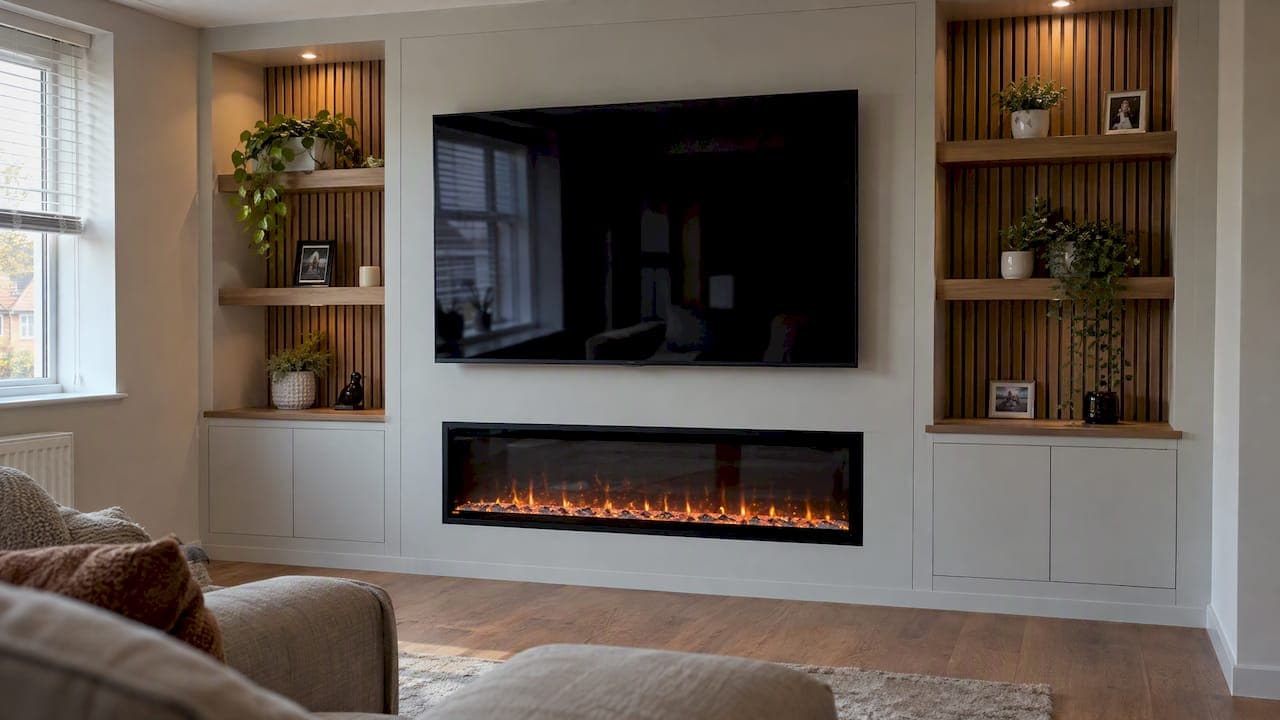
A media wall kit costs far less than a custom build, but the kit is only one line in the budget. Your total depends on wall size, whether you add an electric fireplace, how you handle lighting and wiring, and who does the finishing. A professionally installed media wall can run $2,500 to $6,000 according to one homebuilder's DIY guide, and that is the number a kit is trying to beat.
Below, we break the budget into parts you can price yourself, show where DIY saves money and where it doesn't, and give you a worksheet to build your own estimate before you order anything.
TL;DR
- A kit replaces the biggest custom-build cost: design time, carpentry labor and long lead times. Panels arrive pre-cut and pre-labeled, so a weekend install is realistic for many homeowners.
- Budget separately for the TV, an electric fireplace, lighting, paint or finish, and any electrical work. These often add up to more than the panels.
- Professional installation of a custom media wall is commonly quoted at $2,500 to $6,000, and our own San Francisco cost guide shows Bay Area projects reaching much higher.
- Finishing (taping, mudding, sanding, paint) is where DIY builds most often fall short. Pre-finished panels avoid most of it.
- Pick your TV and fireplace models before you build, because the openings must fit them.
Table of Contents
- What a media wall kit actually includes
- Typical media wall costs by build type
- Where the money goes in a kit project
- DIY versus professional: where you save and where you don't
- A worksheet to build your own estimate
- The fireplace clearance rule that affects your budget
- Does a media wall add value to your home?
- Our perspective: why we built kits instead of selling custom walls only
- Plan before you buy: our design packages
- FAQ
- Sources
What a media wall kit actually includes
A kit is a set of pre-engineered parts designed to go together without a contractor. Ours are pre-cut and pre-labeled, so you match the labels to the instructions rather than measure and saw. Depending on the configuration, a kit can include panels, slat accent panels, floating cabinetry, integrated LED lighting, hidden wire management and a recess for an electric fireplace, in a choice of finishes.
What a kit does not include is your own gear. The TV, soundbar, fireplace insert (if the kit isn't paired with one), outlets and any in-wall power are separate. That's the first lesson of media wall budgeting: the sticker price of the wall and the cost of the finished room are two different numbers.
We don't publish a single kit price, because kits vary by width, layout and finish. You can browse current options on our DIY media wall kit shop and see what each configuration includes before you add anything else.
Typical media wall costs by build type
Most price guides sort projects the same way: by how much structure and how many features you add. Here is the shape of the market in the US, using sources we checked.
| Build type | What you get | Typical cost range |
|---|---|---|
| Flat-pack or pre-cut kit, DIY | Panels, hardware and instructions; you supply the TV and finishing | Varies by kit; see the shop |
| Professionally installed custom wall | Framed, drywalled, painted and wired by a crew | $2,500 to $6,000 |
| Custom wall in the San Francisco Bay Area | Higher local labor and material costs | $3,000 to $17,000 |
The spread inside each row is wide for a reason. A plain slat wall behind a wall-mounted TV is a very different project from a floor-to-ceiling build with cabinets, a recessed fireplace and lighting on every shelf.
Treat any single number you see online as a midpoint of a wide range, not a quote. Cost guides are written for general audiences. Your wall, your region and your finish choices decide where you land.
Where the money goes in a kit project
When you add up a kit-based build, the costs usually fall into six buckets. Price each one before you commit.
1. The kit itself
The kit sets your size, layout and finish. Wider walls need more panels. Adding floating cabinetry or a built-in shelf layout increases the parts count. Premium finishes cost more than basic ones. If you're unsure which configuration fits your wall, a design package (below) is a cheap way to settle it before you order.
2. The fireplace
An electric fireplace is often the single biggest add-on after the wall itself. Linear inserts, built-in units and fireplace TV stands sit at very different price points, and the unit you choose determines the opening size. We resell a range through our electric fireplaces for media walls category, and we also have a guide to choosing an electric fireplace for a TV wall.
If you want an all-in-one piece rather than a built-in, look at something like our 70" distressed white electric fireplace TV stand with linear insert and walnut shelf.
3. Lighting
Integrated LED lighting is a big part of why a media wall looks expensive. Strip lighting behind panels, shelf lighting and ambient washes cost little compared with the visual effect. Browse media wall lighting to see the options and plan where the power runs.
4. Electrical and wire management
Concealing cables is the part of a media wall that most people underestimate. A kit with hidden wire management makes the routing easy, but the power source still has to exist. If you need a new outlet behind the TV or a dedicated circuit for the fireplace, that's a licensed electrician's job in most places, and it's a real line item. Electrical work should be grounded and often needs specific circuits, according to installers cited in one DIY guide. Check your local code and ask an electrician before you cut into walls.
5. Finishing and hardware
Paint, stain, handles and brackets are small individually and add up together. Our hardware finishes come in brass, chrome and matte black, which lets you match existing fixtures without a custom order.
6. Labor, if you hire it
If you don't want to do the whole job, you can hire out part of it. We offer white-glove installation in the San Francisco Bay Area; see White-Glove Installation for details. Pricing isn't published, so you'll need to request a quote.
DIY versus professional: where you save and where you don't
The usual advice is that a DIY build saves a large share of the cost, because labor is the biggest part of a professional quote. That's true, but it depends on how much of the work you can actually do well.
One builder's guide frames the project as two phases: structure and finish. Beginners tend to do fine with structure and then underestimate the finishing: taping, mudding and sanding drywall until it looks seamless under evening lamplight. The same guide notes that many successful DIYers frame the wall themselves and hire a pro for the drywall finishing.
That's the gap kits are built to close. With pre-cut, pre-labeled panels there's no framing to measure and no joint compound to sand. You are assembling, not building from scratch. That doesn't make it effortless: you still need to find studs, level the pieces and handle power. But the failure points of a from-scratch build, wavy drywall and mismatched cuts, are largely designed out.
Our take on who should do what:
- Do it yourself if you're comfortable with a drill, a level and a stud finder, and you have a free weekend. Our DIY media wall guide walks through the process.
- Split the job if you want a kit but not the electrical or the finish work. Hire an electrician for power and do the assembly yourself.
- Hire the whole thing out if the wall is complex, if you're in the Bay Area and want a custom design, or if you simply don't have the time.
For a side-by-side look at the trade-offs, read our kit versus custom buying guide.
A worksheet to build your own estimate
Before you order, fill in each line. Leave a line at zero only if you already own the item.
- Wall size. Measure width and height of the wall, and note any corners. A corner layout is possible with precut parts; see our corner media wall guide.
- Kit or design package. Pick the kit configuration, or start with a design package.
- TV. Confirm the model and its dimensions and mount type.
- Fireplace. Choose the model first. Framing to generic measurements often produces openings that don't fit modern units, and fixing a finished, painted wall is slow and error-prone.
- Lighting and smart controls. Add LED strips and any smart tech you want.
- Electrical. Get a quote from a licensed electrician for any new outlet or circuit.
- Finish and hardware. Choose paint or stain and handles.
- Contingency. Add a cushion for the things you didn't think of. Many people use around ten percent; that's a rule of thumb, not a figure from a study.
Total the lines, then compare with a custom quote for the same wall. That comparison is the honest test of whether a kit saves you money.
The fireplace clearance rule that affects your budget
If your plan has a TV above an electric fireplace, heat management shapes both the design and the cost. Many electric fireplaces specify a gap above the unit, often 3 to 8 inches, and the space above should stay under 100°F to protect the TV's internal components, according to a fireplace manufacturer. The same source says to follow the specific unit's manual rather than generic rules, and we agree.
This matters for cost because clearances decide the wall height you need, whether you add a mantel or shelf as a heat deflector, and whether the TV sits higher than you'd like. Read our four safety rules for recessed electric fireplaces before you finalize the layout. If your fireplace needs a new circuit, ask a licensed electrician; don't guess.
Does a media wall add value to your home?
Don't count on a dollar-for-dollar return. A media wall typically doesn't produce a guaranteed increase in appraised value, because valuations rest on comparable sales. It can help marketability, though, because it makes a room look finished.
Quality matters here. The same source says that well-integrated built-ins are seen as more valuable than basic flat-pack kits that show warping or poor installation. That's an argument for choosing solid materials and taking your time on the install, not for spending the most.
Our perspective: why we built kits instead of selling custom walls only
We started from a simple observation. Most homeowners who want a media wall don't object to the look of a custom build. They object to the quote, and to the weeks of waiting for a carpenter. So we made the look portable: premium materials, curated styles and pre-engineered panels that go up in a weekend without a contractor.

We also think cost conversations are too often dishonest in one direction or the other. Custom builders tend to show you the beautiful finished photo and the big number. Cheap flat-pack sellers show you a small number and leave out the TV, fireplace, wiring and finish. Neither tells you what the finished room costs. That's why we'd rather you build the worksheet above, and why we sell design packages at published prices: you can settle your plan before you buy a single panel.
Our advice for a first-time builder is to spend where it shows and where it's hard to fix later. Spend on the fireplace and the finish. Save on the framing, which a kit handles for you. And never skip the electrical check.
— Jake
Plan before you buy: our design packages
If you're not sure which layout fits your wall, start with a design. We offer a Single Concept Design for $99, a 3 Concepts + Revision Design Package for $199, and a Full Design & Quote for $299, each as a one-off fee. You can see them on our shop page, and our How It Works page explains the steps for DIY kits and custom installs. We also offer risk-free returns and expert support if you get stuck during assembly.
FAQ
How much does a media wall kit cost?
It depends on the width, layout, finish and extras such as cabinetry and lighting. We don't publish one flat price, so check the configurations in our kit shop. Then add the TV, fireplace, electrical work and finishing to get the full project cost.
Is a kit cheaper than a custom media wall?
Usually, yes, because a kit removes design time and carpentry labor. Professionally installed custom walls are commonly quoted at $2,500 to $6,000, and more in high-cost areas. Compare like for like: the same wall size, fireplace and finish.
Can I install a media wall kit myself in a weekend?
Many homeowners can, with basic tools and a helper. Our kits are pre-cut and pre-labeled so you don't cut or frame from scratch. Electrical work is the exception: hire a licensed electrician if you need new outlets or circuits.
Does a media wall add value to a house?
Not as a guaranteed dollar amount. Appraisals rely on comparable sales, but a well-built wall can make a home more appealing to buyers. Poor installation can have the opposite effect.
Sources
- DIY Media Wall Build Guide: Costs, Steps, Pitfalls
- Does a Media Wall Add Value to Your Home?
- Safely Mount a TV Above an Electric Fireplace
- DIY fireplace wall with TV