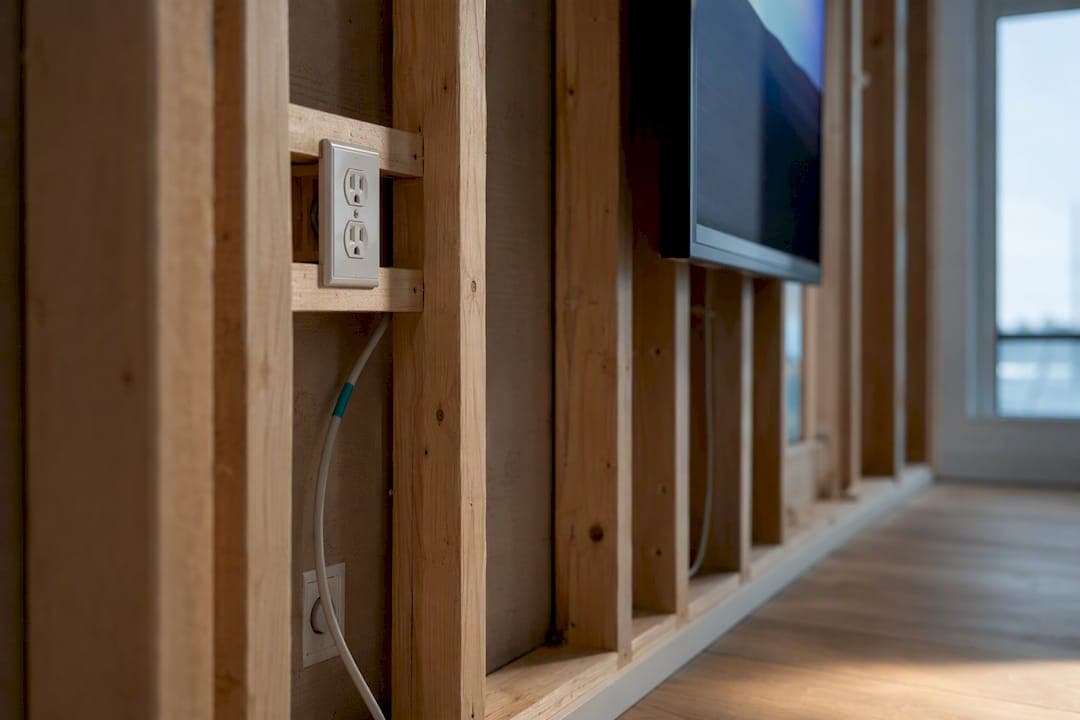
Running your TV's factory power cord through the wall is illegal under NEC 400.12, full stop. The two code-compliant fixes are a UL/ETL-listed in-wall power relocation kit, which taps an existing outlet and usually skips the permit process, or a new recessed outlet wired with real branch wiring, which requires a permit and inspection. Which one you pick depends on how permanent you want the setup, what your local building department requires, and how clean you want the wall to look when you're done.
TL;DR:
- Using a flexible power cord through the wall is illegal and can lead to fire risks, so a UL/ETL-listed in-wall kit or a new recessed outlet is necessary.
- In-wall kits connect to existing outlets and usually skip permits, but require confirming circuit load capacity and using certified products, not generic pass-through cords.
- Recessed outlets involve new wiring, permits, and inspections, making them more permanent and resale-friendly options, especially for long-term installations.
- NEC 400.12 prohibits concealing factory power cords inside walls; NEC 210.12 requires AFCI protection for new receptacles in most living areas.
- Proper placement and planning of outlets are crucial, with ideal location being in the same stud bay as the mount to allow slack, avoid heat zones, and facilitate future maintenance.
Table of Contents
- How Outlet Behind TV Code Requirements Compare Across Methods
- What Permit Rules and NEC Articles Actually Trigger an Inspection
- Wire Gauge, Breaker Sizing, and Box Fill Rules That Matter
- Where to Place the Outlet Behind a Wall-Mounted TV
- Who's Allowed to Do the Work and How Permits Actually Move
- Final Checklist Before You Close the Wall
- Planning Outlet Count for a Full Media Wall, Not Just One TV
- A Homeowner's Take on Kits vs. Recessed Outlets
- Get the Outlet Placement Right Before You Buy the Wall
- Where to Check the Official Rules
- Sources
- FAQ
How Outlet Behind TV Code Requirements Compare Across Methods
Homeowners usually land on one of three approaches when they're planning power for a wall-mounted TV, and only two of them are legal.
In-wall power relocation kits are the fastest route to a clean look. These kits, sold under brands like PowerBridge and similar UL/ETL-listed systems, include a recessed receptacle that sits behind the TV and a lower power inlet that plugs into your existing wall outlet. In-wall rated cable connects the two inside a listed assembly, so the flexible cord problem never comes up. Because most kits don't touch your home's branch circuit wiring, they're often treated as a repair rather than new electrical work, which is why they frequently skip the permit process entirely. The catch: you still need to confirm the existing circuit can handle the added load, and you must use a listed product, not a generic pass-through kit bought off a discount site.
New recessed outlets mean real branch wiring, run from your panel or an extended circuit to a new box behind the TV. This is the more permanent, more finished-looking option, and it's the one that turns your project into an actual electrical job. You'll need correctly sized conductors, AFCI protection where code requires it, a permit, and a rough-in and final inspection. It costs more and takes longer, but there's no cord dangling behind an access panel, and it holds up better at resale.
What's prohibited, always: feeding the TV's own power cord, an extension cord, or any non-listed flexible cord through a hole in the drywall. This is the single most common DIY mistake, and it's a straightforward violation of NEC 400.12, which bars concealing flexible cords inside wall cavities. It's also a real fire risk, since factory TV cords aren't rated for the heat buildup or physical stress of being sandwiched inside insulation and drywall.
A few things tend to decide which legal path makes sense:
- Renters and condo owners generally can't cut into walls for new wiring, making a kit the only realistic option.
- Above-fireplace installs invite closer inspector scrutiny and added heat considerations, covered below.
- If you want zero visible hardware and plan to stay in the home long term, a recessed outlet with proper wiring is the stronger long-term investment.
- If you're testing out a wall-mount location before committing, a kit avoids cutting into drywall you might patch again later.
What Permit Rules and NEC Articles Actually Trigger an Inspection
Two NEC sections do most of the work here, and knowing them saves you from an expensive redo.
NEC 400.12 is the rule that kills the "just fish the cord through" approach. It prohibits flexible cords, including the cord that came with your TV, from being run inside wall cavities, floors, or ceilings. A listed in-wall kit gets around this because the cord segment inside the wall is part of a UL or ETL-listed assembly built specifically for that use, not a bare extension cord shoved through a hole.
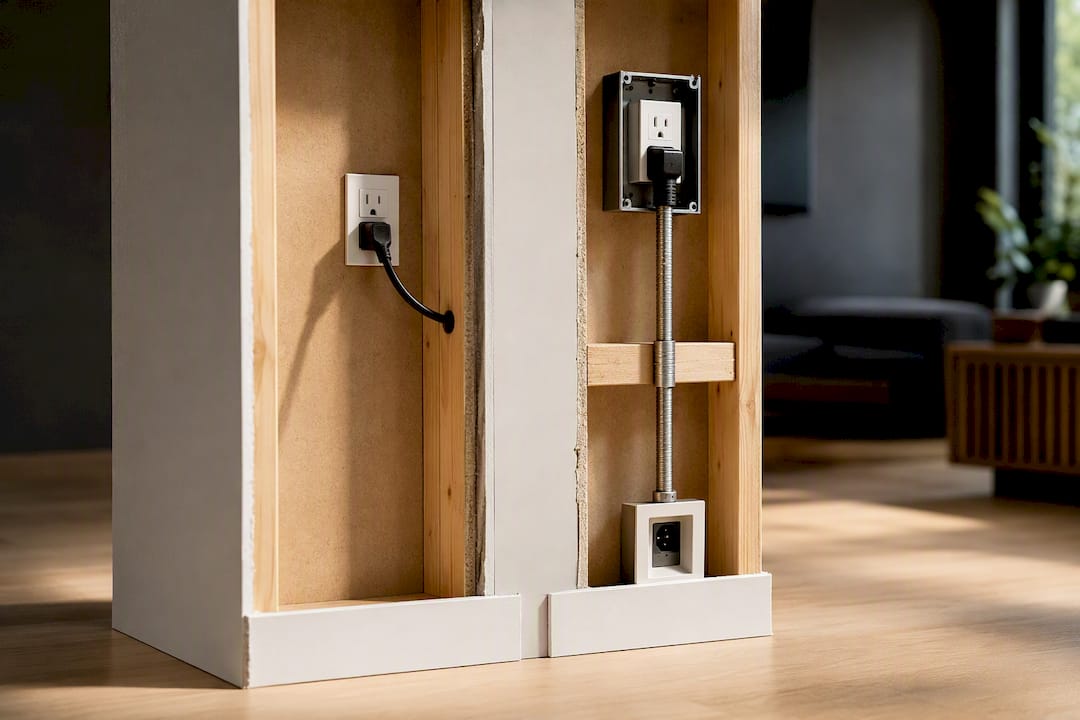
NEC 210.12 covers arc-fault circuit interrupter (AFCI) protection. If you're adding a new 15A or 20A receptacle in most living areas, AFCI protection generally applies to that new branch-circuit wiring. Inspectors check for this specifically, and it's one of the most common reasons a rough-in fails on the first pass.
Whether you need a permit at all comes down to what you're actually doing:
- Installing a listed in-wall power kit that taps an existing outlet: usually no permit required, since no new circuit is created.
- Adding a new recessed outlet with new branch wiring: almost always requires a permit and inspection in U.S. jurisdictions, because you're adding a new circuit or relocating a box.
- Relocating an existing outlet to a new stud bay: typically requires a permit for the same reason.
- Any work tied into the electrical panel: permit required, virtually everywhere.
One wrinkle worth knowing: local code adoption lags the national NEC cycle. Some jurisdictions are still enforcing the 2020 or 2023 edition while others move to 2026, and AFCI and GFCI coverage can expand with each new edition. Check with your local building department before assuming your neighbor's five-year-old install reflects current rules.
When an inspector shows up, they're looking at specific things: whether the box is securely mounted to a stud or approved bracket, whether box fill calculations were respected, whether nail plates protect cable running close to the stud face, whether the device is properly grounded, and whether AFCI or GFCI protection is present where required.
Wire Gauge, Breaker Sizing, and Box Fill Rules That Matter
Get the conductor size wrong and you've built a fire hazard, not a shortcut.
Match your wire gauge to the breaker protecting the circuit, not the other way around. Use 14-gauge (14/2) wire for a 15-amp circuit and 12-gauge (12/2) wire for a 20-amp circuit, based on standard ampacity charts. Before you run a single foot of cable, check the breaker at the panel. Don't assume; verify.
- Confirm the breaker amperage first, then select 14/2 for 15A or 12/2 for 20A accordingly.
- Check whether AFCI protection is required for the new receptacle; this may mean an AFCI breaker or a combination AFCI/GFCI device depending on your setup.
- Calculate box fill before mounting, accounting for every conductor, device, and clamp inside the box, and use a tamper-resistant receptacle as most codes now require in living spaces.
- Install nail plates anywhere cable runs within 1 1/4 inches of the stud's front face, protecting it from a stray drywall screw later.
- Keep low-voltage cable rated CL2 or CL3 for in-wall use, and physically separate it from line-voltage wiring, either in its own chase or with adequate spacing inside the wall cavity.
If you hit an older outlet box with no grounding conductor, the accepted retrofit is a GFCI-protected receptacle labeled "No Equipment Ground," not a bootleg ground or a cheat adapter. That's a documented workaround from DIY electrical forums, and it holds up until a full panel or wiring upgrade happens.
Pro Tip: Box fill and missing nail plates are two of the most common reasons a rough-in inspection fails on the first try. Budget extra depth in your box before you mount it, and don't skip the nail plate just because "it's probably fine."
Where to Place the Outlet Behind a Wall-Mounted TV
Getting placement right the first time saves you from fishing cable through drywall twice.
Center the recessed outlet in the same stud bay where your TV mount will sit, ideally a few inches above where the mount bracket's lower edge will land, so the cord has slack without dangling into view. If you're installing both a power outlet and a low-voltage pass-through, keep the upper receptacle and lower inlet in the same stud bay. It makes fishing cable between the two dramatically easier and keeps everything hidden behind the TV's footprint.
Above-fireplace installations need extra care. Cutting into a wall above a fireplace can break required fireblocking, which has to be restored per IRC R302.11 before you close the wall back up. Heat clearance around the box also matters more here than in a standard install, and inspectors tend to look harder at fireplace-adjacent electrical work.
A few more placement details that save headaches later:
- Leave a small service loop in the cable so future maintenance doesn't require refishing the entire run.
- Position the outlet so it won't sit directly behind a wall-mount arm or bracket once the TV is installed.
- Avoid blocking any ventilation path behind the TV, especially if you're also hiding a cable box or streaming device in the same cavity.
- Plan the opening size with a slightly larger TV in mind, since most households upsize their next television.
Who's Allowed to Do the Work and How Permits Actually Move
Most U.S. jurisdictions let a homesteaded owner-occupant pull a permit and do their own electrical work on a single-family home they live in. Rentals, condos, and multi-unit buildings almost always require a licensed electrician, no exceptions. Before you touch a wall, call your local building department or check its online permit portal, since the specific NEC edition your city has adopted changes some of the details above.
The permit workflow generally runs the same way across most jurisdictions:
- Submit a permit application describing the scope of work, whether that's a new outlet, relocated box, or new circuit.
- Schedule a rough-in inspection with the wall open, before any drywall patching happens.
- Complete a final inspection after the wall is closed and the device is installed and energized.
- Keep your permit paperwork and inspection sign-offs on file, since it matters at resale.
If any part of the job touches your electrical panel, adds a new circuit, or you're not confident reading a wiring diagram, hire a licensed electrician. It costs more upfront than DIY, but it's cheaper than redoing a failed inspection or fixing damage from a mistake behind a closed wall.
Final Checklist Before You Close the Wall
Run through this before drywall goes back up, and again before you call it finished.
- Verify AFCI or GFCI protection is present and the breaker is labeled correctly at the panel.
- Test the outlet with a plug-in outlet tester to confirm correct wiring, polarity, and grounding before you trust it with expensive gear.
- Confirm low-voltage cables are CL2 or CL3 rated for in-wall use and kept in a separate opening from the power outlet.
- Photograph the open wall before closing it up, and keep your permit and inspection paperwork with your home records.
- Install nail plates anywhere required and double-check box fill one last time.
Unpermitted, non-compliant installs carry a real financial risk beyond the inspection itself. Buried flexible cords that violate NEC 400.12 can factor into a denied insurance claim after a fire, since the installation itself violated code before anything went wrong. That's a expensive lesson to learn after the fact rather than before you cut into drywall.
Planning Outlet Count for a Full Media Wall, Not Just One TV
A single outlet behind the TV rarely covers a finished media wall for long. Once you add a soundbar, streaming box, gaming console, and maybe an amplifier, two receptacles disappear fast. It is recommended to plan for multiple receptacles in more complex builds, so you're not opening drywall again six months after move-in for one more outlet.
A pre-cut media wall kit helps here because the panel layout is designed around consistent, repeatable outlet and cable openings, rather than guessing where to cut. Keep outlets clear of fireplace heat zones and away from anywhere a device needs a clean sightline for a remote, and leave room outside the recessed box for a surge protector or power strip rather than cramming it inside the wall cavity, as recommended by experts.
A Homeowner's Take on Kits vs. Recessed Outlets
Most homeowners I'd point toward a listed kit are the ones who aren't fully sure the TV is staying in that exact spot forever. It's reversible, it's fast, and it doesn't commit you to a permit process for a wall that you might reconfigure in two years. The ones who go for a fully recessed outlet with real branch wiring are usually settling in for good and want the wall to look like it was built that way from day one.
Either choice is fine. What isn't fine is skipping the code step because cutting a small hole and fishing a cord feels harmless. It isn't, and it can complicate a home sale or an insurance claim down the road. If you're not sure which route fits your situation, a quick call to a local electrician costs far less than guessing wrong.
— Jake
Get the Outlet Placement Right Before You Buy the Wall
Getting the electrical work right is only half the project. The other half is knowing where those outlets need to land once your media wall panels, cabinetry, and fireplace insert are in place, and that's where a pre-planned kit saves real time. DIY media wall kits often come pre-cut and pre-labeled with guidance on where recessed outlets and low-voltage chases belong, so you're not improvising cutouts around a finished panel.

The kits handle the layout and aesthetics; the electrical work behind them still has to meet your local code, and a new recessed outlet or circuit may still require a licensed electrician and a permit, exactly as covered above. Browse the shop for DIY media wall kits to see layouts sized for common TV dimensions, or check accessories like cable management plates and pass-throughs if you're retrofitting an existing wall rather than starting from scratch.
Where to Check the Official Rules
Local code adoption varies by city, so confirm current requirements through your building department's permit process before starting work. For the NEC language itself, your local building department can point you to the specific edition currently enforced in your jurisdiction.
Sources
- PermitFlow — electrical permit guide
- Northern Mister Sparky — hide TV wires in the wall: outlet options and permit rules
- Express Mounting — How to hide TV wires in the wall
- DIY StackExchange — get electricity to outlet behind wall mounted TV
FAQ
Is it illegal to run a TV power cord behind the wall?
Yes. NEC 400.12 prohibits concealing flexible cords, including a TV's factory power cord, inside wall cavities; a UL/ETL-listed in-wall kit or a new recessed outlet with permanent branch wiring are the compliant alternatives.
Where should you place an outlet behind a TV?
Center it in the same stud bay as your TV mount, positioned so the cord has slack without hanging visibly below the TV, and keep it clear of mount brackets and any ventilation path behind the device.
What is the current code for electrical outlets?
Requirements vary by jurisdiction and which NEC edition it has adopted, but new 15A or 20A receptacles in most living areas generally need AFCI protection under NEC 210.12, and new branch wiring typically requires a permit and inspection.
Is it against code to have an outlet in a cabinet?
Outlets can be installed inside cabinets or recessed enclosures as long as the box is accessible, properly grounded, and not buried behind a permanent barrier; check local rules if the cabinet will fully enclose the outlet once installed.