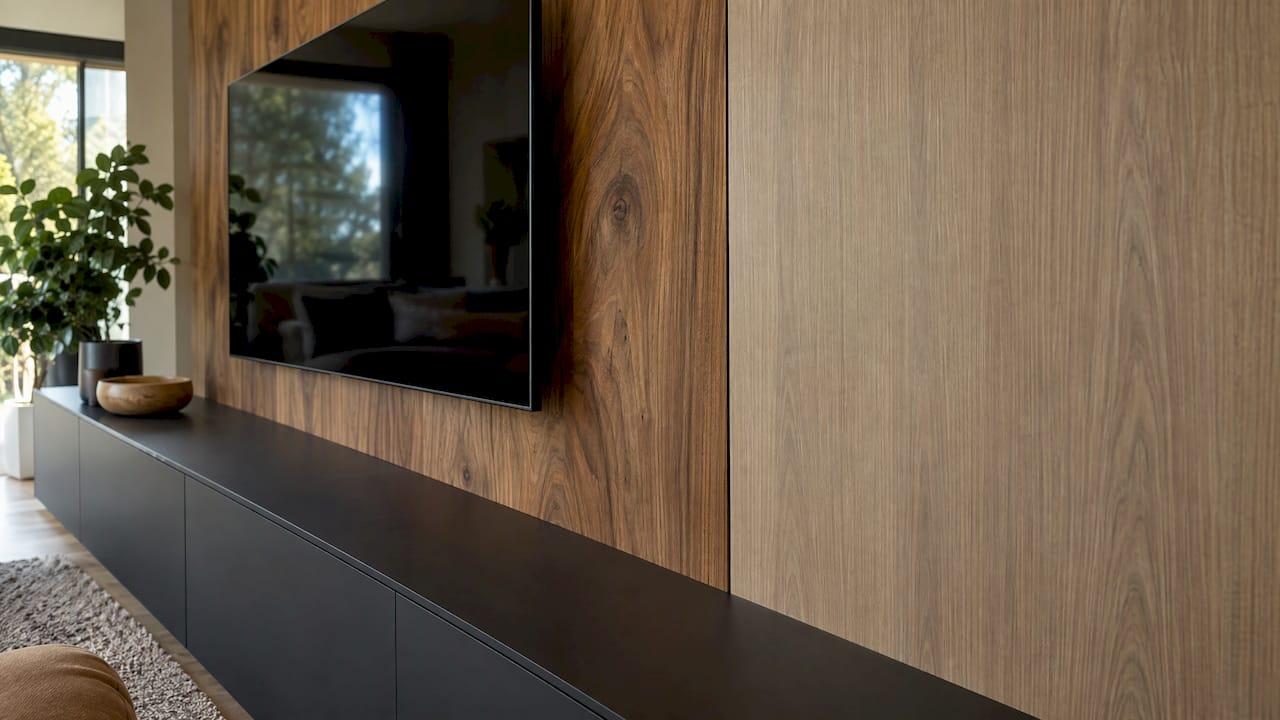
Veneer is a thin slice of real wood bonded to a core. Laminate is a printed, resin-sealed surface that imitates wood or a solid color. Choose veneer when you want real grain and a surface you can touch up over the years. Choose laminate when the wall will take daily knocks and you want wipe-and-go care. Both can look excellent on a feature wall. The right one depends on the room, how you live in it and how much upkeep you want.
TL;DR
- Look: Veneer carries real grain that shifts with the light. Laminate is a consistent printed pattern that stays exactly as made.
- Wear: Laminate is generally harder and more scratch- and moisture-resistant. Veneer can be lightly refinished within the limits of its thin layer.
- Cost: Per-square-foot prices overlap widely. Laminate panels run about $5 to $12 per square foot, and wood paneling spans $1 to $40.
- Best fit: Veneer suits a focal wall or media wall. Laminate suits hallways, family rooms and anywhere with grease or heavy contact.
- DIY: Both install well with simple, prefabricated panels if the wall is clean, dry and smooth.
Table of Contents
- What veneer and laminate actually are
- How to tell them apart on a wall
- Appearance: real grain or consistent design
- Durability and everyday wear
- What each costs in the U.S.
- Cleaning and caring for each
- DIY installation: what changes by material
- Which one fits your room
- Our perspective
- Plan your wall with us
- FAQ
- Sources
What veneer and laminate actually are
The names sound similar, but the two materials are built differently.
Wood veneer is real wood sliced or peeled into a thin sheet, then glued to a stable core such as MDF or plywood. Angi describes veneer as a thin slice of real wood attached to a core. It says veneer can sometimes be indistinguishable from solid wood and is the more visually appealing of the two. Because the top layer is natural, the grain, figure and color come from the actual species.
Laminate is manufactured. Layers of paper are saturated with resin and fused under heat and pressure. The face is a printed decorative layer or a solid color, usually sealed under a tough wear layer. Angi calls laminate the more durable of the two in the same comparison.
One point trips people up: laminate wall panels are not stained or painted afterward, since the look is built into the surface. Veneer panels are sometimes sold unfinished, so you stain or paint them yourself. Check the product description before you buy.

How to tell them apart on a wall
If you are standing in front of a sample, or a finished wall, a few checks help.
- Walk past it. Real wood has depth that changes as the light moves across it. A printed surface reflects evenly.
- Compare several sheets. Laminate patterns repeat. If you spot the same knot or swirl on different panels, it is printed.
- Look at the edges. Veneer shows a thin real-wood edge or a visible core. Laminate edges are often banded with a matching strip or show a dark line of layered material.
- Touch it. Veneer tends to feel warmer. Laminate feels uniform in a way natural wood does not.
- Look for a wood-grain cut-off. Grain that continues naturally around a corner points to veneer. Grain that stops dead and restarts points to a print.
None of these tests is absolute, since good laminate prints are convincing. When in doubt, ask the seller what the face layer is.
Appearance: real grain or consistent design
Veneer gives you what nature made. No two sheets match exactly, which is the appeal on a statement wall. Over time veneer develops a gentle patina, a soft depth that real wood gains with age and light. Many designers also match grain across panels so the pattern flows from one sheet to the next.
Laminate gives you control. The finish you choose is the finish you get, sheet after sheet, and it stays that way for years. That consistency is a real advantage when you want a uniform color across a large wall, or a finish that does not exist in nature, such as a deep charcoal with a subtle texture. The range of colors, patterns and textures is wide.
If warmth and natural variation matter most to you, lean veneer. If predictability matters most, lean laminate.
Durability and everyday wear
This is where the two differ most, and it is the question to ask about your own room.
Laminate is generally harder and more resistant to scratches, stains and moisture. Its wear layer is built for daily contact. The trade-off is repair: once the surface is chipped or deeply damaged, it cannot be sanded and refinished like wood. Small chips can be filled, and repair fillers and pastes exist for pinholes, shallow scratches and damaged edges. Large damage usually means replacing a panel.
Veneer can scratch and wear through because the wood layer is thin. It is also more sensitive to moisture, especially at the edges. The upside is that it can be touched up. Light sanding and a fresh coat of finish can renew it, within the limits of that thin layer. Never sand aggressively, or you will cut through the veneer to the core.

In practice, think about contact. A media wall behind a TV and a shelf sees little physical wear. A mudroom wall at backpack height or a kitchen-adjacent wall takes much more.
Moisture and heat
Neither material loves standing water or direct heat. Keep wall panels of any kind away from areas with direct contact with heat or water. That includes behind a stove or as a backsplash. Laminate tolerates humidity and splashes better than veneer. If you want wood-look panels in a bathroom or beside a kitchen sink, laminate is the safer fit.
Fireplaces deserve a note. If you plan an electric fireplace in your wall, follow the manufacturer's clearance guidance for the surrounding panels. Our electric fireplaces for media walls page is a good starting point for options built for this setup.
What each costs in the U.S.
Prices overlap more than most people expect, because the wood species, finish and panel style move the number as much as the base material.
| Item | Typical U.S. range | Source |
|---|---|---|
| Laminate wall panels (material) | $5 to $12 per sq ft | Angi, 2026 |
| Wood paneling (all types, material) | $1 to $40 per sq ft, averaging $20 | This Old House, citing 2024 Angi data |
| Professional labor, standard installation | $40 to $100 per hour, or $3 to $10 per sq ft | Angi, 2026 |
| Whole-project average, wall paneling | $2,800 (most pay $1,200 to $6,000) | Angi, 2026 |
In the wood range, pine and MDF sit at the lower end, while premium hardwoods and reclaimed wood cost more. So veneer can cost the same as laminate or far more, depending on the species and the grade. Where the budget is tight and you want a large wall, laminate is the easier way to control cost. Where one accent wall is the star of the room, a step up to a premium veneer can be worth the spend.
The biggest lever on total cost is labor. Choosing a prefabricated, pre-cut system you install yourself removes the hourly rate entirely. For a sense of how that adds up, read our step-by-step guide to installing wall panels.
Cleaning and caring for each
Laminate
Laminate is the forgiving one. For routine cleaning, Wilsonart's care guide calls for a damp cloth or sponge with mild soap or detergent, then a rinse with warm water and a wipe dry. For a stubborn mark, it suggests a paste of baking soda and water. It also lists what to avoid, including acidic or abrasive cleaners, oven cleaners, rust removers and steel wool, which can permanently damage the surface. Skip solvents too, since acetone-type products can dull the wear layer.
Veneer
Veneer needs a little more attention but is easy once you have a routine. Herman Miller's veneer care guide recommends these steps:
- Dust regularly with a slightly damp, soft, lint-free cloth, wiping dry in the direction of the grain.
- Clean monthly with a quality wood furniture cleaner.
- Apply a good furniture polish twice a year.
- Avoid aerosol cleaners, wax-based products and abrasive cleaners.
The same guide covers minor repairs. Water rings, stains and light scratches can be rubbed gently in the direction of the grain with 0000 steel wool, followed by a scratch-removing polish matched to the color. For deep scratches it points you to a professional furniture refinisher.
If you want to see how a small scratch behaves on a finished panel wall, our write-up on scratch repair on media wall panels walks through what is visible from across the room.
DIY installation: what changes by material
The material matters less than the system. Large, loose sheets are harder for a first-timer than pre-cut, labeled panels. A few rules from This Old House apply to both:
- Start with a clean, dry, smooth wall.
- Leave a 3/8-inch expansion gap around the edges.
- Use construction adhesive, which can provide up to 30% of the bond.
- Pick a simple design, such as shiplap or beadboard, if you are new to this. Prefabricated panels make it easier still.
Two practical differences. Laminate comes in stiff sheets that do not bend, so it suits flat walls rather than curves. Veneer is a natural product, so lay panels out dry on the floor first and arrange them for the best grain flow before you fix anything. For more on sheet-style options, see our DIY guide to decorative wall paneling sheets.
Which one fits your room
Here is the short version, room by room.
| Situation | Better fit |
|---|---|
| Media wall or feature wall in a living room | Veneer, for real grain and depth |
| Family room with kids and pets | Laminate, for scratch and stain resistance |
| Entryway or mudroom | Laminate |
| Bedroom headboard wall | Veneer or laminate, a style choice |
| Wall near a kitchen or bathroom | Laminate, and keep it clear of direct water and heat |
| Large wall on a tight budget | Laminate |
| A wall you want to refinish or touch up over years | Veneer |
Heavy daily wear, moisture or harsh cleaners favor laminate. A visual focal point or furniture-grade look favors veneer. Prefer to wipe and go? That favors laminate. Happy to do careful cleaning and occasional touch-ups? That favors veneer.
You can also mix them. Many designers use veneer where the eye lands and a tougher surface where hands and bags do. Warm wood tones also pair well with rich color schemes, as in these brown and blue living rooms, where wood warmth anchors cooler tones.
Our perspective
We see homeowners get stuck on the material name when the real question is how the wall will be used. Think about where the TV sits, who walks past it and how much upkeep you honestly want.
Our approach is to make the hard part easy. Our kits come pre-cut and pre-labeled, with hidden wire management, integrated LED lighting, floating cabinetry and slat accent panels in multiple finishes. You get a high-end look that goes up in a weekend, without paying for a custom build. Pick a finish you love, plan the layout and let the system do the precision work.
A media wall should look finished from the couch and from the doorway. Get the design right first, then the material choice becomes a style decision instead of a worry.
Jake
Plan your wall with us
If you are still deciding on finish, layout and where the TV and shelves go, a design package lets you settle it before you buy. Our design options include a Single Concept Design for $99, a 3 Concepts + Revision Design Package for $199 and a Full Design & Quote for $299. Prefer a kit you assemble yourself? Our how it works page shows the DIY path. In the SF Bay Area, we also offer white-glove installation.

For wood-tone slat looks, browse our Smoked Walnut acoustic slat panel or the Natural Oak 4-pack. For the finishing touches, see our floating shelves for media walls.
FAQ
Which costs more, veneer or laminate?
It depends on the wood and the grade. Laminate panels run about $5 to $12 per square foot, while wood paneling overall spans a much wider range. Premium hardwood veneer sits at the top and pine or MDF-based options near the bottom. Labor is the same hourly cost either way, so DIY is the biggest saver.
Is veneer or laminate more durable?
Laminate is generally harder and more resistant to scratches, stains and moisture. Veneer is thinner and can scratch, but it can be lightly refinished. For a busy hallway, laminate is the safer choice. For a low-contact feature wall, veneer holds up well with basic care.
Can you put wood veneer panels in a kitchen?
Only in spots away from direct heat, water and steam. Panels of any type are not recommended behind a stove or as a backsplash. A wall across the room from the cooking area is a different story, and a wipeable laminate is the easier choice there.
How do you tell laminate from veneer?
Look at the edges and compare several panels. A repeating pattern across sheets points to laminate, and grain that flows naturally around corners points to veneer. Veneer also feels warmer and shows depth that shifts with the light.
Sources
- Angi: Laminate vs. Veneer
- Angi: How Much Does It Cost to Install Wall Paneling?
- This Old House: Interior Wall Paneling Guide
- Wilsonart: Care & Maintenance
- Herman Miller: Wood & Veneer Care and Maintenance
- Floor Chem Depot: Laminate Filler or Paste