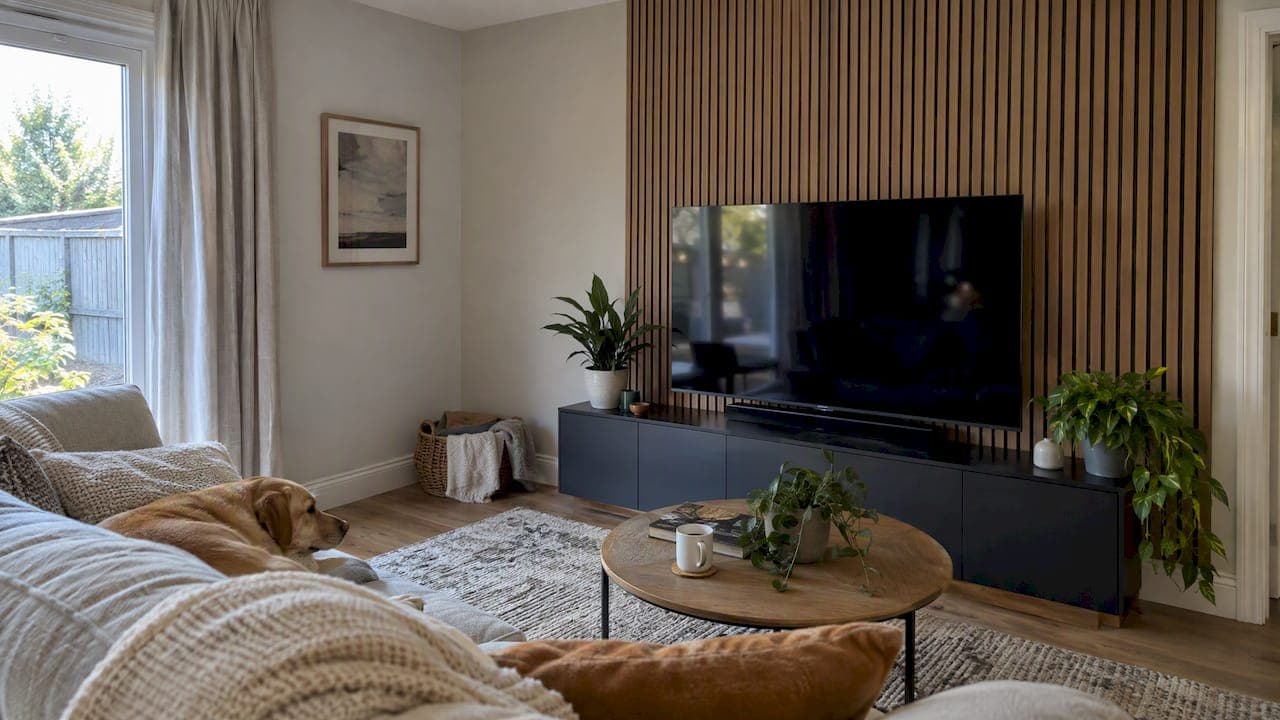
Paint wins on upfront cost and the freedom to change your mind every couple of years. Wall panels win when you want moisture resistance, impact durability, and a finish that lasts decades instead of years. For most homes, a hybrid works best: panels on the wall that takes the most wear or moisture, paint on everything else.
TL;DR:
- Paint costs $1 to $4 per square foot installed and lasts 3 to 7 years; PVC costs $3 to $7, lasting 10 to 25 years.
- Choose PVC or composite panels for bathrooms and basements because they resist moisture and mold better than paint; semigloss paint suits kitchen splash zones.
- For hallways with pets, choose panels or durable satin paint; MDF, wood, and three dimensional panels suit bedroom or living room focal walls.
- Precut, labeled kits can make one accent wall a weekend DIY project, reducing labor, the main source of the price gap with paint.
Table of Contents
- What Is Wall Paint: Types, Costs, and Expected Lifespan
- What Are Wall Panels: Materials, Styles, and Installation Approaches
- Cost and Lifespan Comparison: Up-Front Spend vs Long-Term Value
- Appearance and Design Flexibility: How Each Finish Affects Style and Updates
- Durability, Maintenance, and Room-by-Room Suitability
- How to Choose: A Short Checklist and Questions to Ask
- Publisher Perspective: How Pre-Cut Kits Change the Trade-Offs
- How The Media Wall Store Can Help if You Choose Panels
- FAQ
- Sources
What Is Wall Paint: Types, Costs, and Expected Lifespan
Interior paint comes in a handful of finishes that matter more than the color you pick. Flat and matte hide imperfections but scuff easily. Satin and eggshell balance washability with a soft sheen. Semi-gloss and gloss shed moisture and stains, which is why bathroom and kitchen formulations lean heavily on them.
Cost is driven by prep work, not the paint itself. A standard gallon runs $25 to $70, with premium lines reaching $100 to $120 according to the cost comparison between panels and paint. Installed, the cost typically comes to a few dollars per square foot.
- Flat and matte finishes suit bedrooms and ceilings where washability matters less.
- Satin and eggshell handle living rooms and hallways with light traffic.
- Semi-gloss and specialty bathroom paints resist moisture and mildew best.
A quality paint job typically holds up for 3 to 7 years before it needs a refresh, sooner in high-traffic or high-humidity rooms.
What Are Wall Panels: Materials, Styles, and Installation Approaches
Wall panels cover a wider range than most homeowners expect, from budget-friendly PVC sheets to stone composites that read as pure luxury. Each category has its own price point, look, and install difficulty.
- PVC panels run $1.50 to $4 per square foot in materials and about $3 to $7 per square foot installed, with strong moisture resistance according to the same wall panel cost guide.
- MDF and wood panels generally cost several dollars per square foot in materials, with higher installed costs, suitable for living rooms and bedrooms.
- 3D polyurethane panels material prices typically start in the few-dollars-per-square-foot range and are popular as textured accent walls.
- Stone and composite panels tend to be the most expensive material category, often priced significantly higher per square foot before installation.
Pre-cut, pre-labeled DIY kits have changed the install side of this equation. Where panels once meant hiring a contractor for precise cuts and layout, a kit system lets a confident homeowner complete a single wall over a weekend. Our DIY guide to paneling sheets walks through the basic techniques, and a broader panel materials overview covers how each style performs over time.
Cost and Lifespan Comparison: Up-Front Spend vs Long-Term Value
The numbers tell two different stories depending on your time horizon.
- Paint costs $1 to $4 per square foot installed but needs a full repaint every 3 to 7 years.
- PVC panels cost $3 to $7 per square foot installed and commonly last 10 to 25 years with minimal upkeep.
- MDF and 3D panels run $5 to $30+ per square foot but can last decades, according to the panel versus paint cost breakdown.
Homewyse estimates painting a wall at roughly $1.29 to $2.78 per square foot, while its wood panel installation calculator starts around $7.78 to $11.55 per square foot, giving a region-neutral anchor for both finishes.
Here's a worked example using a 400 square foot wall area, a typical 12 by 12 room with 8 foot ceilings. Paint installed at a typical mid-range cost can run around several dollars per square foot, summing to a moderate total for a standard room per coat. Repainted four times over 20 years (every 5 years), that totals $4,000. PVC panels installed at a moderate cost can total a few thousand dollars once, and if they last around 20 years with no replacement, the long-term expense becomes more favorable. MDF panels installed at a higher cost amount to several thousand dollars upfront, approximately comparable to repetitive repainting over time, but with reduced maintenance needs over the long term.

Appearance and Design Flexibility: How Each Finish Affects Style and Updates
Paint offers nearly unlimited color choice and can mimic textures through techniques like limewash, sponging, or color washing. Panels bring dimension that paint cannot fake: slat wood, raised wainscot profiles, 3D geometric textures, or real stone veneer.
- Paint updates in an afternoon with a roller and a new color.
- Panels update by repainting them (for MDF and wood) or by swapping sections rather than redoing an entire wall.
- Accent walls let you combine both: panel the focal wall, paint the rest.
Our accent wall ideas for living room media walls and 2026 accent wall inspiration both show this pairing in practice, panel texture behind the television, paint color carrying the rest of the room.
Pro Tip: Paint the panel wall's trim and surrounding walls in a tone pulled from the panel's natural color for a cohesive look without extra cost.
Durability, Maintenance, and Room-by-Room Suitability
Moisture is where panels separate from paint most clearly. PVC and composite panels resist water and mold far better than standard paint, which is why bathrooms and basements favor panels even at a higher upfront cost. Semi-gloss and specialty bathroom paints help, but they can't match a sealed PVC surface in a steam-heavy shower room.
Impact resistance follows a similar pattern. Panels shrug off scuffs, dings, and pet damage that would chip or mark painted drywall, and most wipe clean with a damp cloth rather than needing touch-up paint.
- Bathrooms and basements: PVC or composite panels for moisture control and mold resistance.
- Kitchens: semi-gloss paint or washable panels near splash zones.
- Living rooms and bedrooms: MDF, wood, or 3D panels for a focal wall, paint elsewhere.
- Hallways and high-traffic areas: panels or durable satin paint to handle contact and scuffs.
If your home has a space that fights moisture or heavy use every year, that's the wall where panels earn their cost difference fastest.
How to Choose: A Short Checklist and Questions to Ask
Run through this before you commit to either finish:
- What's your budget per wall, and does it allow for panels or only paint?
- How long do you plan to stay in the home or keep this look?
- Does the room deal with moisture, heavy traffic, or pets?
- What finish matches the style you want: color only, or texture and dimension?
- How comfortable are you with a weekend DIY project versus hiring it out?
Before buying from a supplier or booking an installer, ask:
- What's the warranty on the panel material and finish?
- What's the lead time between ordering and delivery?
- Is there a return policy if the panels don't fit or match as expected?
- Does the quoted price include installation, or materials only?
A hybrid approach makes sense whenever your budget can't stretch to panel every wall but one space (a bathroom, a media wall, an entryway) would benefit clearly from the upgrade.
Publisher Perspective: How Pre-Cut Kits Change the Trade-Offs

Most of the cost gap between paint and panels comes from labor, not materials. A contractor measuring, cutting, and fitting panels by hand adds hours that a pre-cut, pre-labeled kit removes almost entirely. When the panels already match the wall dimensions and every piece is marked for its spot, a weekend is often enough for one accent wall.
That shift matters because it changes who panels are realistically for. The math in the cost comparison above assumes installed pricing that includes labor. Strip out a chunk of that labor and panels start looking a lot more competitive against paint's lower sticker price, not just over 20 years, but on day one.
— Jake
How The Media Wall Store Can Help if You Choose Panels
If the moisture resistance, durability, or texture of panels fits your space better than another repaint cycle, our Media Wall Kits are built to remove the two biggest obstacles: cost and labor. Every kit ships pre-cut and pre-labeled, so assembly follows a clear sequence instead of custom measuring on-site.
We also resell the pieces that complete the look, fireplaces, floating shelves, lighting, and cabinetry, plus finish and hardware options so the panel wall matches the rest of the room. If you'd rather hand off the whole project, our Full Design & Quote service and White-Glove Installation cover design through install, and every kit purchase comes with support and a straightforward return policy if something doesn't fit. Browse the shop to compare kits and design packages, or see how the process works from order to finished wall.
FAQ
What are the downsides of using wall panels?
Panels cost more upfront than paint in most cases, with installed prices ranging from about $3 to $30 or more per square foot depending on material, according to the panel cost breakdown. Lower-end materials can look less premium up close, and replacing a damaged section sometimes means matching a discontinued style.
Is paneling on walls outdated?
No, panel styles have shifted rather than disappeared. Slat wood, 3D textured panels, and stone composites are common in current living rooms and media walls, while older paneling styles with dark wood strips tend to look dated.
Is it cheaper to panel or drywall?
Paint over drywall is almost always the cheaper upfront choice, running about $1 to $4 per square foot installed versus $3 to $30 or more for panels, per the cost comparison guide. Panels can close that gap over time since they often last decades and skip repeated repaint cycles.
Is panelling outdated in 2026?
Panelling isn't outdated: modern materials like slat wood and 3D polyurethane are widely used for accent and media walls. The look that reads as dated is usually the material and pattern, like glossy faux-wood sheets, not the concept of paneling itself.
Does painting or paneling add more resale value?
Neither finish has a documented resale premium on its own; both are judged more on execution and condition than material choice. A well-maintained accent wall, whether painted or paneled, tends to read as a care-for-the-home signal to buyers rather than a guaranteed value add.
Sources
- Wall Panel vs Paint: Which Is Actually Cheaper? (Full Cost Guide)
- Cost to Paint Wall - 2026 Cost Calculator (Customizable)