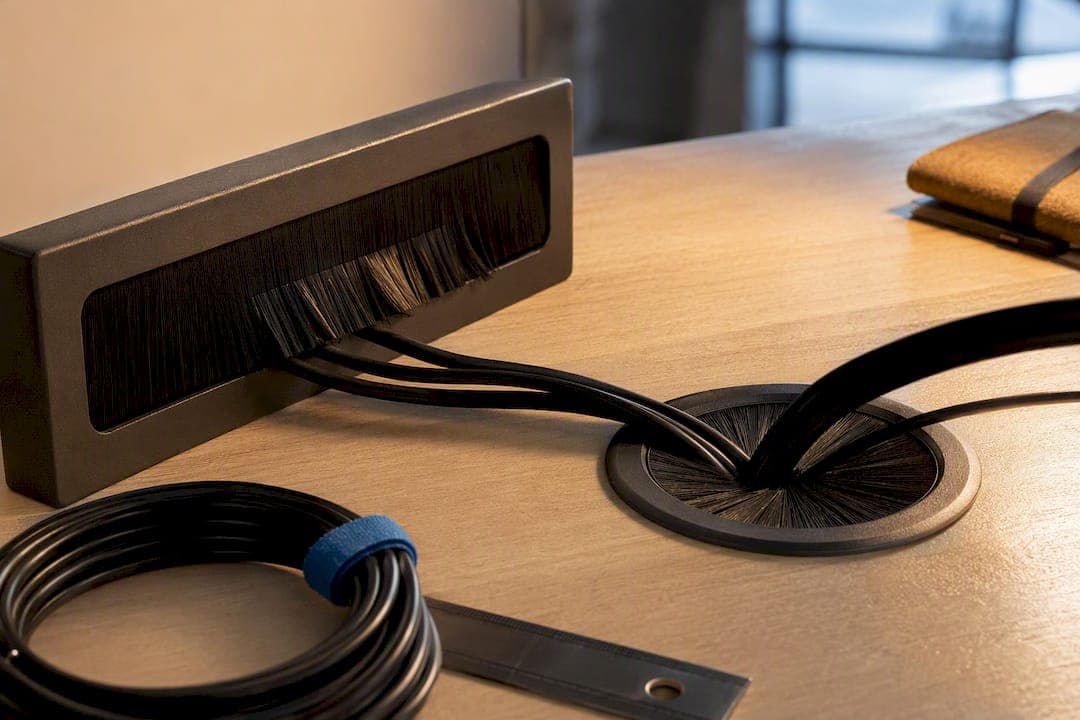
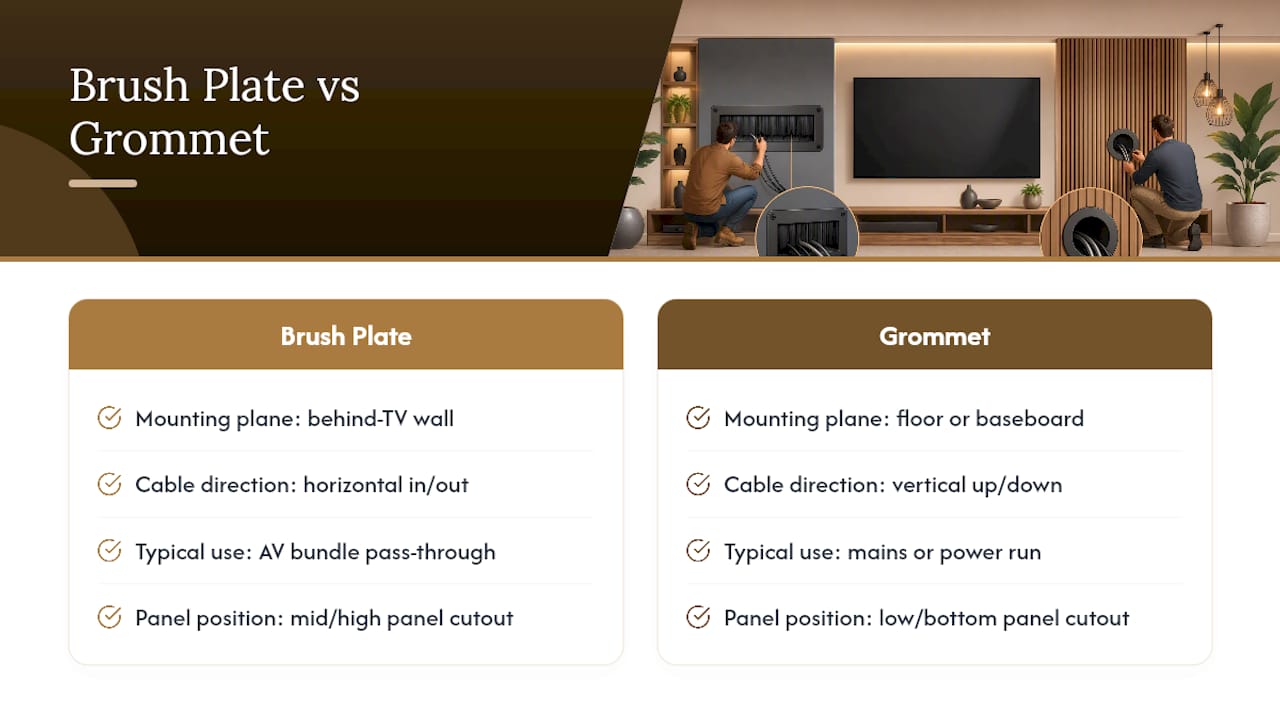
Use a brush plate for horizontal passthroughs, wall plates behind a TV, or rack-mounted patch cables. Use a brush grommet for vertical runs through raised floors, desk grommet holes, or bundles carrying thicker power and speaker cable. The deciding factor is almost always the mounting plane and the diameter of what you're feeding through it. Everything else, sealing, durability, looks, is a secondary decision once that first call is made.
TL;DR:
- Brush plates are ideal for horizontal cable entries behind TVs or in rack units, accommodating smaller bundles and frequent cable swaps with moderate airflow sealing.
- Grommets work best for vertical runs through floors or desks, handling thicker, bulkier bundles and providing superior sealing against dust and airflow leakage.
- Measure the cable bundle diameter accurately and match it to the product's rated capacity, ordering one size up to future-proof against additional cables.
- Install brush plates into standard wall boxes or rack spaces, ensuring cables are fed through before mounting; grommets require precise cutouts in tiles or desks and proper sealing against the surface.
- For runs involving mains power inside walls, always consult electrical codes and consider professional installation rather than using bristle-based passthroughs.
Table of Contents
- What Is a Brush Plate vs a Grommet?
- How Do You Choose Between a Brush Plate and a Grommet?
- How Do You Install a Brush Plate or Grommet?
- What Materials Hold Up Best Over Time?
- How Do These Pass-Throughs Fit Into a DIY Media Wall?
- What I'd Actually Tell a Friend Doing This
- A Simpler Way to Hide Your Wires Without Guessing at Pass-Throughs
- Sources
- FAQ
What Is a Brush Plate vs a Grommet?
A brush plate is a wall plate or rack-face insert lined with dense bristles that part around cables as you push them through, then close back up to hide the opening. A brush grommet does the same job with bristles, but it's built for a round or rectangular cutout in a horizontal surface, like a desk, a raised-floor tile, or a server cabinet's floor panel. Both rely on the same core idea: flexible filaments that seal around cable without needing a custom-cut hole for every wire size.
The mounting plane is the real split. Brush panels install into rack units or wall boxes for cable entry that runs horizontally, while brush grommets sit in floor cutouts for cable that drops down vertically into a plenum space or comes up from below a desk, according to comparisons of sealing performance between the two formats. That distinction shapes almost everything else about how each one performs.
Behind-TV installs are the classic brush plate scenario. You're routing HDMI, an antenna line, maybe a power cord, all in one bundle, through a wall plate that needs to look clean when the job's done. Low-voltage plate cover guidance consistently points homeowners toward brush-style plates for exactly this: multiple cables, frequent swaps, and a visible finish that matters.
Grommets earn their keep in different places: raised-floor server rooms, home office desks with a tangle of charging cables, or any spot where cable needs to pass through a horizontal surface rather than a vertical wall. They also do more to block airflow leakage and dust intrusion than a typical wall-mounted brush plate, since floor plenums often deal with pressurized airflow that wall cavities don't, per detailed grommet-type breakdowns.
| Factor | Brush Plate | Brush Grommet |
|---|---|---|
| Typical mounting location | Wall box, rack unit, behind-TV plate | Raised floor tile, desk cutout, cabinet floor |
| Best cable types / bundle size | Patch cables, HDMI, coax, small AV bundles | Thick power runs, speaker wire, mixed bulk bundles |
| Sealing / airflow performance | Moderate; some air/dust bypass | Higher; reduces plenum airflow leakage |
| Installation complexity | Low; fits standard gang box or rack cutout | Moderate; needs precise tile or desk cutout, split types ease retrofits |
| Durability / material notes | Nylon or polypropylene bristles, ABS frame | Similar bristles, often reinforced frame for floor traffic |
| When to prefer | Multi-cable, visible, frequently changed runs | Vertical drops, bulk bundles, airflow-sensitive spaces |
A few situational calls worth flagging before you order anything:
- Don't force a brush plate onto a floor cutout. The bristle orientation and frame depth aren't built for foot traffic or plenum pressure.
- Don't use a lightweight grommet for a visible wall install behind a TV. The finish looks wrong and the frame usually doesn't match standard wall plate dimensions.
- If you're swapping cables often (a hobbyist rack, a rotating AV setup), brush plates give easier hand access.
- If the bundle is thick, mixed power and data, go grommet. Brush plates lose sealing effectiveness fast once bristle density gets overwhelmed.
How Do You Choose Between a Brush Plate and a Grommet?
Run through this checklist before you buy anything or cut an opening:
- Identify the mounting plane. Wall or rack face means brush plate. Floor, desk, or cabinet base means grommet.
- Measure your cable bundle diameter. Bundle it loosely with a zip tie and measure across. Most standard brush plates handle bundles up to about an inch comfortably; thicker bundles want a grommet rated for bulk cable.
- Decide how often cables will change. Frequent swaps favor a brush plate's easy hand access over a tighter grommet seal.
- Check sealing and airflow needs. Data closets and raised-floor rooms need the tighter bypass control a grommet provides.
- Confirm box or tile compatibility. Standard gang boxes fit most brush plates; old-work boxes need a plate rated for retrofit. Raised-floor tiles vary in thickness, so measure before ordering a grommet frame.
When measuring an opening, always account for the cutout size stated by the manufacturer, not just the visible bristle ring. Frame lips and mounting screws add to the footprint. For floor tiles, note the tile's actual thickness since some grommet frames are only rated for a narrow range.
Pro Tip: Order one size up on bundle capacity if you're not sure. Adding a single cable later is common, and a bundle that's packed too tight kills the brush's ability to seal around it.
How Do You Install a Brush Plate or Grommet?
Before touching a drill, confirm two things: whether the cable is low-voltage (data, AV, speaker wire) or carries line-voltage power, and what your local code says about running power inside a wall cavity. NEC-compliant approaches to powering a wall-mounted TV cover this in detail, and it's worth reading before you assume a plate opening can double as a power pass-through.
Installing a brush plate:
- Mark the opening location and confirm it lines up with a standard gang box or existing rack unit.
- Cut or install the box if it's new construction; for retrofits, use a plate rated for old-work boxes.
- Feed cables through the bristle opening before final mounting, not after, to avoid snagging the frame.
- Screw the plate into the box and check that bristles close fully around the bundle.
- Dress the cable slack behind the wall or rack to avoid strain on the plate.
Installing a brush grommet:
- Size the tile or desk cutout using the manufacturer's spec sheet, not a generic hole saw guess.
- For retrofits where cable is already run, use a split grommet that opens on a hinge instead of requiring the cable to be threaded through blind, a detail covered well in grommet type guidance.
- Secure the frame flush with the surface; a proud or recessed frame breaks the seal.
- Route thick bundles through gradually, checking that bristles aren't bunching or tearing.
Basic install tips also apply across both formats: pre-drill pilot holes for screws, avoid oversizing the cutout beyond the frame's rated range, and never force a bundle that's visibly too tight, since general grommet installation guidance flags large-diameter cutouts as a common point of failure.
What Materials Hold Up Best Over Time?
Most consumer brush plates and grommets use an ABS or polycarbonate frame with nylon or polypropylene bristles. Nylon tends to hold its shape longer under repeated cable insertion; polypropylene is often cheaper but softens faster with heat exposure near warm AV equipment.
- Higher bristle density seals better against dust and airflow but adds drag when threading cable through.
- Metal-frame grommets show up in heavier-duty settings, like server rooms, where foot traffic or cabinet weight makes plastic frames a liability.
- Industrial brush specification guidance notes that filament diameter and trim height directly affect wear rate, the same logic applies at consumer scale, just with lower stakes.
Pro Tip: Check bristles every year or two if the passthrough sees regular cable changes. Flattened or split filaments stop sealing properly long before the frame itself looks worn out.
How Do These Pass-Throughs Fit Into a DIY Media Wall?
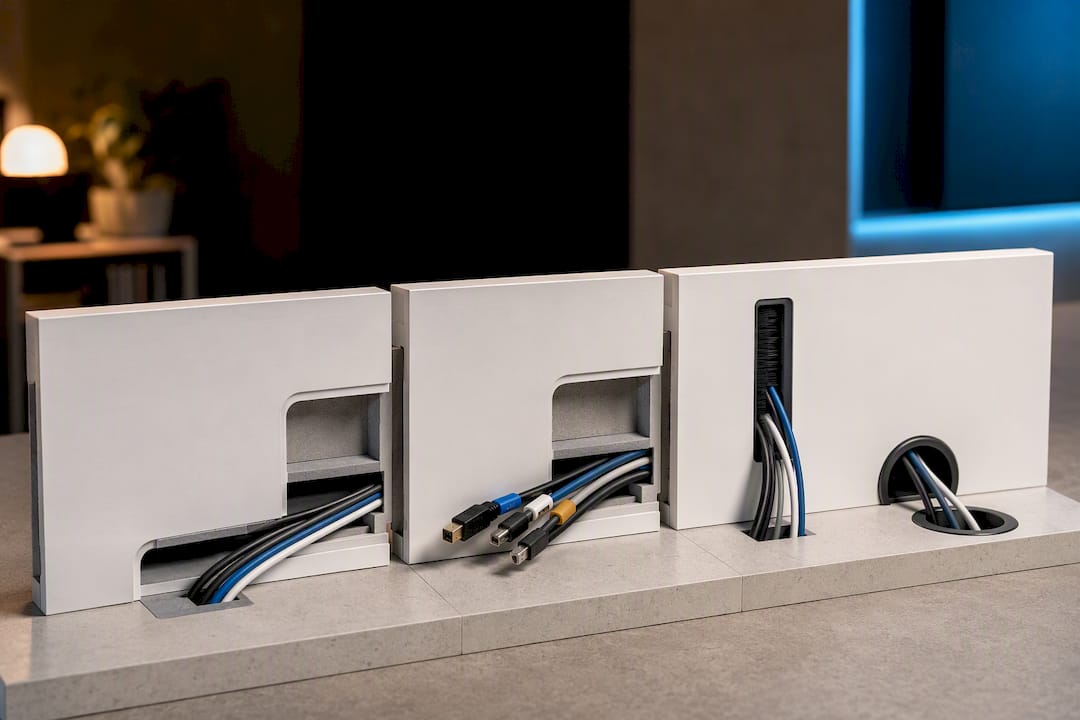
Inside a pre-cut media wall kit, brush plates and grommets do the same job they'd do anywhere else, they just get planned in ahead of time instead of retrofitted. Pre-cut, pre-labeled panels are designed with wire paths already mapped out, so you decide during planning whether a given opening needs a brush plate for a behind-TV AV bundle or a grommet-style passthrough for a floor-fed power run.
The sequence that works best: route and label every cable before the panels go up, then match your pass-through choice to each opening's mounting plane. Homeowners tackling a full DIY build can also route wires without cutting into finished walls using the kit's built-in channels. If mains power is involved anywhere in the run, white-glove installation is worth considering over a pure DIY approach.
What I'd Actually Tell a Friend Doing This
Skip the debate and check two things: which way is the cable traveling, and how thick is the bundle. Horizontal, behind a TV or into a rack, brush plate. Vertical, through a floor or desk, or carrying anything thicker than a slim AV bundle, grommet. The one time to stop and call an electrician instead of grabbing either product is any run involving mains power inside a wall cavity. Code exists there for a reason, and no bristle plate changes that.
— Jake
A Simpler Way to Hide Your Wires Without Guessing at Pass-Throughs
If cutting openings and matching bristle density to bundle size sounds like more troubleshooting than you want, that's exactly what pre-planned kits solve. Themediawallstore builds its DIY media wall kits with hidden wire management routed into the panel design from the start, so you're not improvising a brush plate or grommet choice mid-install.

Every kit ships pre-cut and pre-labeled, which means the wire paths, and where a passthrough needs to go, are already worked out before the panels reach your living room. If your project involves a fireplace insert, mains power, or anything you'd rather not wire yourself, White-Glove Installation handles it for you. Browse the current kit lineup or request a design quote to see what fits your wall.
Sources
- Brush Panels vs Cable Grommets: Which Seals What?
- Best Low Voltage Plate Covers for Clean, Hidden Cable Management – Trowbridge Electrical
- Brush Grommet: Complete Guide to Types, Uses and Installation - Wrindu
- How to install grommets
- Brush Table for Sheet Metal: What to Specify - Regios Industrial Brushes
FAQ
What Is the Purpose of a Brush Plate?
A brush plate hides cables passing through a wall or rack opening while keeping the look clean and the opening reasonably sealed against dust. It's built for horizontal cable entry, most often behind a TV or on a patch rack, according to low-voltage plate guidance.
What Are the Different Types of Wall Plates?
Wall plates for cable passthroughs generally fall into brush plates, pass-through plates with a fixed grommet hole, and blank plates with a keystone or coax jack. Brush plates suit multiple, frequently changed cables, while pass-through plates fit a single large cable or connector better.
Which Is Better for My Audio System, Bare Speaker Wire or Banana Plugs?
That's a connector choice, not a passthrough one, but it affects which pass-through you need. Bare speaker wire routes fine through a brush plate's bristles, while banana plugs need a slightly wider opening or a grommet sized to clear the plug body.
What Are the Differences Between Nylon and Thermoset Wall Plate Materials?
Nylon frames and bristles resist repeated flexing and hold their shape over years of cable changes. Thermoset plastics are typically stiffer and more heat-resistant but can crack under stress, which matters more for the frame than the bristles themselves.
Does Themediawallstore's Kits Include Wire Passthroughs?
Themediawallstore's media wall kits route hidden wire management into the panel design, with openings planned to match brush plate or grommet-style pass-throughs depending on the setup. Current pricing and kit options are listed on the shop page.