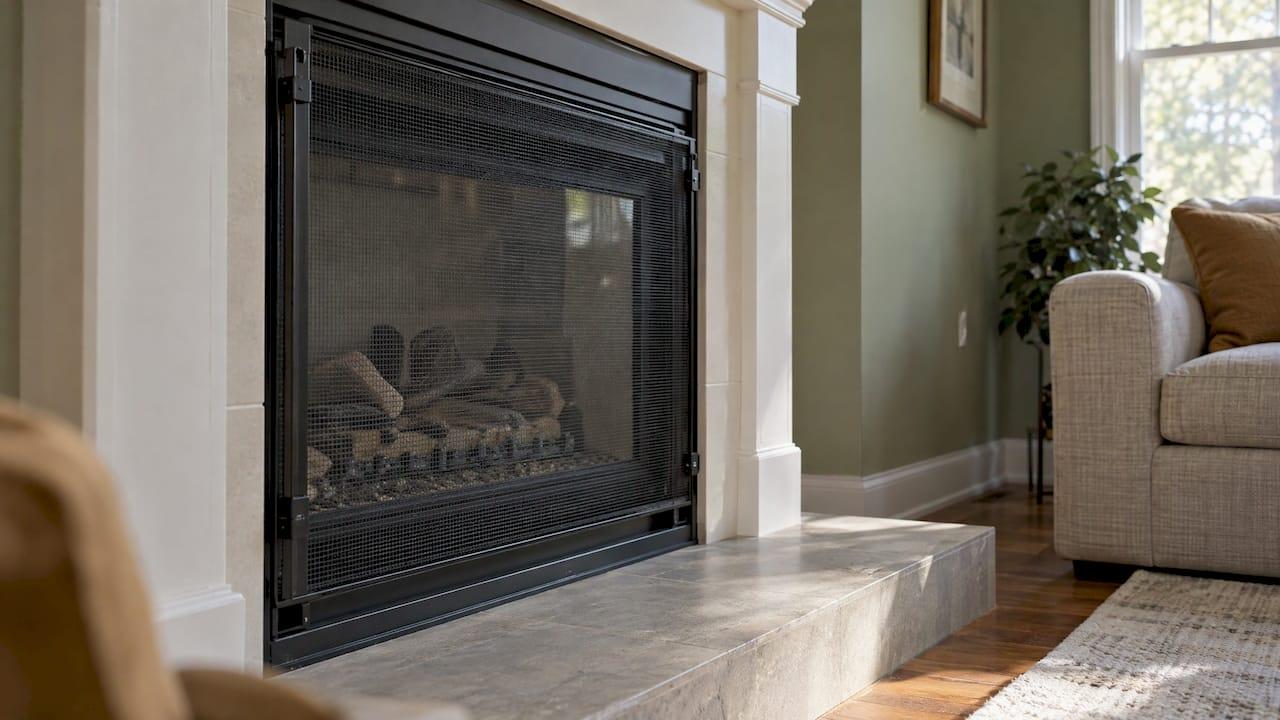
The glass front on a gas fireplace is a hot surface, not a window. It can reach several hundred degrees, it stays hot long after the flames go out, and toddlers are the people most often hurt by it. The fix is a layered one: keep a barrier installed, control who can switch the fireplace on, and treat the glass as hot until you have confirmed it is not. If you are planning a media wall around a fireplace, build those layers in at the design stage, when they cost the least.
TL;DR
- Gas fireplace glass can reach 1,328 degrees Fahrenheit and stay hot for an hour after the fire is off, so "off" does not mean "safe to touch."
- Gas fireplaces made after January 1, 2015 must ship with a protective barrier. Older units often have none, and you can add one.
- On a wood fire, keep the mesh screen closed. Glass doors are generally run fully open while wood burns, and sealed gas glass stays closed.
- With a toddler in the house, the strictest approach is to switch the fireplace off and block it, not to rely on a screen alone.
- If you are designing a media wall, choose the fireplace, the clearances and the barrier before you cut or mount anything.
Table of Contents
- Why fireplace glass burns so badly
- The 2015 barrier rule, and what it means for your house
- Glass doors open or closed: it depends on the fireplace
- Protect kids and pets: five layers that work together
- Care and maintenance habits that keep glass safe
- Building a media wall around a fireplace
- Our perspective
- Plan the fireplace wall with us
- FAQ
- Sources
Why fireplace glass burns so badly
The glass on a sealed gas fireplace is part of the heating system. The Consumer Product Safety Commission says glass fronts can reach 500°F or even 1,000°F, and that severe burns can happen in seconds. Nationwide Children's Hospital adds that the glass stays hot for an hour or two after the fire is turned off.
To put that in context, a burn surgeon quoted by UW Health notes that water at 157 degrees can burn skin all the way through in one second. Fireplace glass is far hotter than that. The Madison-area Safe Kids Coalition, also quoted there, says the glass can heat to 400 degrees in six minutes and take 45 minutes to cool fully.
Who gets hurt, and how
Young children carry most of the risk. UW Health's burn specialists report that most of their glass-door victims are 11 to 14 months old, the age when a child is pulling up on furniture and reaching for anything bright. The American Burn Association describes three common patterns: kids losing their balance while learning to walk, walking too close to the glass, and touching it out of curiosity.
A chart review of 50 children at Shriners Hospital for Children in Boston, summarized by the Model Systems Knowledge Translation Center, shows what these burns look like. 90% were palm burns, 12% needed hospital admission and 4% needed surgery. Children's skin is thinner than an adult's, which is why Nationwide Children's gives a simple rule: if a surface feels warm to you, it is too hot for a child.
The Hearth, Patio & Barbecue Association (HPBA), the industry's trade body, also lists the elderly, the infirm and pets among those at risk. If you have a dog that sleeps near the hearth or a grandparent who steadies themselves on furniture, they belong in your safety plan too.

The 2015 barrier rule, and what it means for your house
In response to these injuries, the industry standard changed. According to HPBA, certified fireplaces, stoves and inserts manufactured after January 1, 2015 include a safety screen or barrier that must be installed. The American Academy of Pediatrics (AAP) notes that the standards require new gas-burning fireplaces to be sold with a safety barrier and information about burn risks.
Two practical points follow.
- Check your unit's age. The manufacturing date is on the rating plate, usually inside the firebox or on the control compartment. If it is from 2015 or later, a barrier should have come with it. Look for it, and make sure the previous owner did not remove it.
- Older units have no guarantee. The University of Colorado Anschutz notes that many homes still have pre-2015 units without a barrier. The MSKTC review adds that manufacturers are not required to retrofit installed units, so the 2015 standard alone does not prevent every burn. The AAP recommends that families with an existing gas fireplace, especially with toddlers, buy a barrier or covering separately.
Keep the barrier on
Manufacturer manuals are blunt about this. Mendota's ML-Series instructions (February 2026) require that a barrier designed to reduce burn risk from the hot viewing glass be installed and that the fireplace not be used without it. A damaged barrier is to be replaced with the manufacturer's own, and any screen removed for servicing goes back on before the fireplace runs. The same manual says not to operate the unit with glass that is removed, cracked or broken.
The earlier September 2024 edition also asks that furniture stay at least 60 inches in front of the barrier. That clearance matters for layout: a sofa pushed up to a fireplace wall is a design choice that quietly breaks the manual. Always follow the manual for your own model.
Glass doors open or closed: it depends on the fireplace
This is the question behind most searches on this topic, and the answer differs by fireplace type.
| Fireplace type | Glass | What to do while it burns |
|---|---|---|
| Sealed gas fireplace | Fixed glass front | Glass stays closed. Keep the barrier installed. |
| Wood-burning, prefabricated | Tempered glass doors | Keep doors open, mesh screen closed. |
| Wood-burning, masonry | Often ceramic glass doors | Follow the door maker's instructions. |
| Firelogs | Doors per fireplace maker | Doors open, screen closed. |
Sealed gas fronts. Chimney 911's guide notes that a sealed gas fireplace's fixed glass front stays closed during use, gets hot enough to burn, and newer units ship with a protective barrier screen.
Wood fires. The mesh screen is what stops sparks and rolling embers. Chimney 911 explains that door manufacturers commonly instruct owners to burn wood fires with the glass open. Operate doors fully open or fully closed: one Majestic manual it cites warns that partly open doors may draw gas and flame out of the firebox.
Glass type matters. Fireplace Doors Online explains that tempered glass doors, required on prefabricated fireplaces, can shatter under high heat and should be kept open while burning. Ceramic glass on masonry fireplaces is designed for very high temperatures, and installing ceramic glass on a prefab unit is a code violation.
Firelogs. Duraflame's safety FAQ says firelogs need combustion air, so doors should stay open while a firelog burns unless the fireplace maker's instructions say otherwise. Close the mesh screen after lighting, and keep the damper open until the ashes are cool.
What "fireproof glass" means
People often ask whether fireproof glass exists. In practice, fireplace glass is heat-rated rather than fireproof: tempered glass and ceramic glass handle heat differently, and neither is a reason to relax. Ceramic glass tolerates far higher temperatures than tempered glass, which is why the two are not interchangeable on a given unit. Neither one is cool to the touch. A heat-resistant pane is still a burning-hot pane, so the barrier rules above apply regardless of the glass type.
Protect kids and pets: five layers that work together
No single device is perfect, so stack several.
1. A barrier made for your fireplace
HPBA lists three kinds of protective products: attachable safety screens that fasten to a specific gas fireplace, free-standing safety gates with an adult-access door, and free-standing mesh screens set back from the front. It cautions that aftermarket screens could affect safe operation, so the screen maker should confirm that the fireplace manufacturer approves the screen. Do not improvise with a screen from a different model.
Nationwide Children's adds that screens can get hot too, so children should look but not touch, and that multi-panel safety gates or baby gates can keep toddlers at a distance or out of the room.
2. Control the switch
Many injuries happen because someone turned the fireplace on without thinking about it. HPBA advises installing a switch lock and keeping remotes out of children's reach. Nationwide Children's suggests removing the light switch and fitting a switch-plate cover, taking the batteries out of the remote, or adding a permanent barrier. HPBA also warns that some appliances use a thermostat to turn the fire on and off automatically, so the glass should always be treated as potentially hot.
3. Shut it off completely when a toddler is around
Dr. Steven Moulton of the University of Colorado and Children's Hospital Colorado says that with a toddler in the home, the best practice is to turn the fireplace off and shut the gas supply rather than rely on a screen. His reasoning is realistic: an older child or a grandparent may flip the switch without knowing, and the toddler can wander to the glass. If you want to understand the gas supply side of your home better, these gas line maintenance tips are a good place to start. For shutting off or repairing a gas line, call a licensed plumber or your gas utility.
4. Plan for the cool-down
HPBA says to wait for the appliance and glass to cool before letting anyone near it, and that cool-down can take an hour or more. Build that into your evening: the risky moment is often after the fire is off, when the room feels calm and everyone relaxes. Keep children out of the room until you have confirmed the glass is cool.
5. Supervise
HPBA recommends supervising children and other at-risk people while the appliance is operating or recently turned off. A barrier lowers the odds. An adult in the room is what actually closes the gap.
Care and maintenance habits that keep glass safe
Glass that is cracked is glass that can fail. Chimney 911's care guidance offers these rules:
- Clean the glass only when it is cool, and avoid ammonia and harsh chemicals.
- Never throw water or anything cold on hot glass.
- Keep logs from leaning against the glass, because excessive heat can make glass lose its temper and break.
- Replace cracked or chipped glass with the door maker's specified part before you close the doors on a fire again.
Mendota's manual makes the same point for gas units: only certified glass doors may be used, and the fireplace should not run with cracked or broken glass. Hot surfaces around the fireplace also deserve a look. Mendota's manual says the surfaces immediately surrounding the fireplace can be too hot to touch, and that this is normal when required clearances and finishing materials are used. So the wall beside the glass can be a hazard for small hands too.
Building a media wall around a fireplace
A fireplace wall is where glass safety and design meet. The hearth sits low, at toddler height, and the TV, shelves and cabinets go around it. A few planning rules:
- Read the clearances before you choose finishes. Wall panels, slat accents and shelves near a heat source need the clearances your fireplace manual lists. Our guide to a safe slat wall behind a fireplace covers the 6-inch clearance question, and our piece on mounting a TV above a fireplace covers heat at the screen.
- Keep furniture out of the barrier zone. Lay out the seating so the 60-inch clearance from the manual is respected.
- Think about the whole wall, not just the glass. Low cabinet doors are the next thing a toddler grabs. See our notes on childproof media cabinet doors and the kid-safe TV wall layout.
- Ask whether the fireplace should be recessed. If you are weighing an electric unit, read our safety rules for recessed electric fireplaces before you frame the opening.
Our perspective
Most of the fireplace safety problems we hear about are layout problems. The glass was fine. The sofa was too close, the barrier was left in the garage, or the switch was within reach of a one-year-old.
That is why we treat the fireplace as the first decision on a media wall, not the last. Our kits are pre-cut and pre-labeled, with hidden wire management and floating cabinetry, so once you have settled the fireplace, clearances and cabinet placement, the rest goes together in a weekend. Our design packages exist so those choices are made on paper before anyone picks up a drill.
Our advice: pick the fireplace and read its manual first. Keep the barrier on. Plan seating and cabinet doors around a child's reach. A wall that looks high-end and is safe for a toddler is the one worth building.
Jake
Plan the fireplace wall with us
If you are building or updating a fireplace wall, our design services settle the layout before you buy materials: a Single Concept Design is $99, a 3 Concepts + Revision Design Package is $199, and a Full Design & Quote is $299, all one-off prices. Our media wall kits come pre-cut and pre-labeled with options for fireplaces, and in the San Francisco Bay Area we also offer white-glove installation. You can browse our fireplace options for media walls too.

FAQ
Is it safe to touch fireplace glass after the fire is out?
Not right away. The glass can stay hot for an hour or two after a gas fireplace is switched off, according to Nationwide Children's. Wait until it has cooled completely, and keep children and pets away in the meantime.
Should fireplace glass doors be open or closed when the fire is burning?
It depends on the fireplace. Sealed gas glass stays closed with the barrier in place. On wood-burning prefab units and firelogs, doors are generally kept fully open with the mesh screen closed. Always follow the manual for your fireplace.
My gas fireplace was made before 2015. What should I do?
It may have no barrier. The AAP recommends buying a barrier or covering separately, especially with toddlers in the home. Choose one the fireplace maker approves, as HPBA advises, and add a switch lock.
Can I clean fireplace glass while it is warm?
No. Clean it only when cool, avoid ammonia and harsh chemicals, and never spray or pour cold liquid on hot glass. If the glass is cracked or chipped, replace it with the part the door maker specifies before using the fireplace again.
Sources
- AAP: Glass-fronted gas fireplace burns
- CPSC OnSafety: Protective barriers on gas fireplaces
- Nationwide Children's: Fireplace safety
- UW Health: The dangers of glass fireplace doors
- MSKTC: Burns from glass fireplace doors
- HPBA: Glass safety FAQs
- University of Colorado Anschutz: Keeping children safe from fireplace burns
- Mendota ML-Series instructions, February 2026
- Mendota ML-Series instructions, September 2024
- Chimney 911: Fireplace glass doors and screens explained
- Fireplace Doors Online: Open or closed while burning
- Duraflame: Safety FAQs
- Gas line maintenance tips