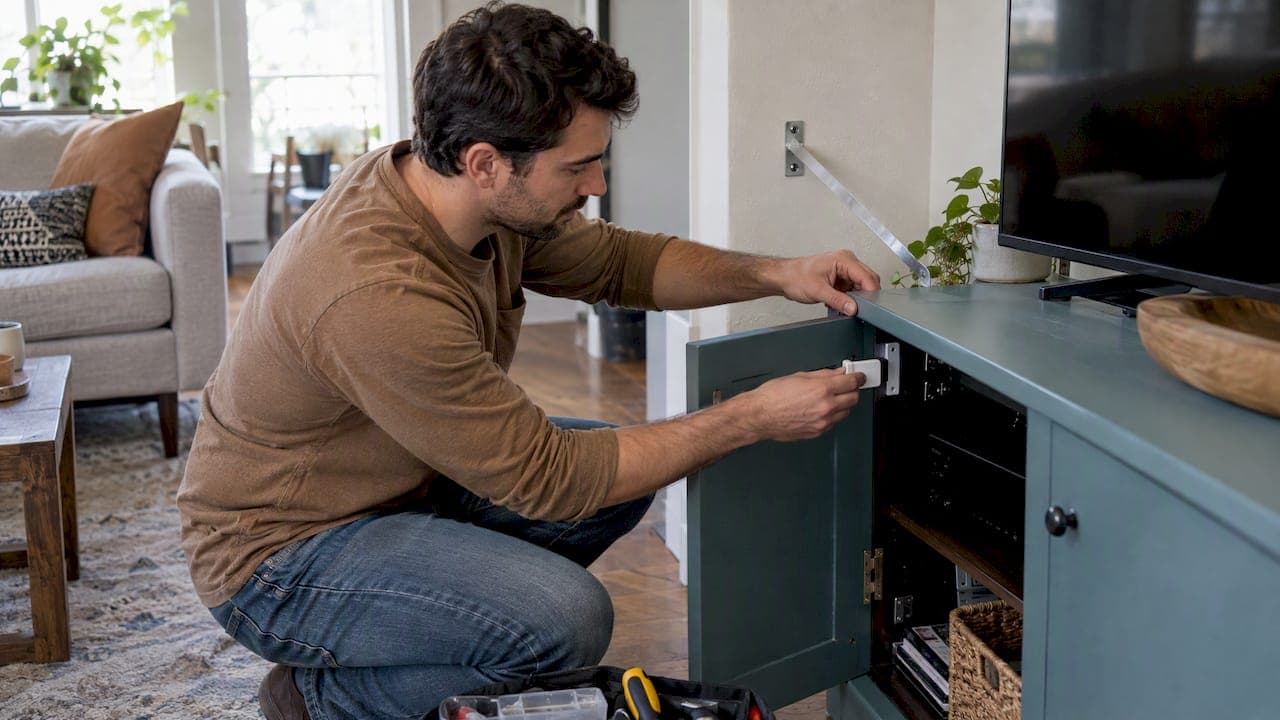
The best way to childproof media cabinet doors is to use a magnetic lock mounted inside the door, then anchor the whole cabinet and TV to a wall stud. Locks keep small hands out. Anchors keep the cabinet from coming down on a child who climbs it. You need both, and the anchor matters more.
This guide covers which lock suits which door, how to install it so it stays put, what to do about cords, remotes and pets, and how to plan a media wall so the safe setup is built in from the start.
TL;DR
- Use magnetic locks inside the cabinet. They leave no pinch gap and no visible hardware, and adults open them with a magnetic key.
- Locks do not stop tip-overs. Anchor the cabinet and mount the TV to a wall stud with metal hardware.
- Clean the door surface with isopropyl alcohol before using adhesive locks. Most failures come from bad prep, not a bad lock.
- Hide or secure cords, clear the top surface, and use an IR repeater so you can keep the doors shut while using the remote.
- Planning a new media wall? Put the safety decisions (closed storage, a wall-mounted TV, concealed wiring) into the design before you build.
Table of Contents
- Why the doors are only half the job
- Which lock fits which door
- How to install adhesive locks so they last
- Anchor the cabinet and the TV
- Cords, remotes and the rest of the surface
- Pets are a different problem
- Design it in from the start
- Our perspective
- Planning a new media wall with safety built in
- A quick safety checklist
- FAQ
- Sources
Why the doors are only half the job
A toddler pulling on a cabinet door is a nuisance. A toddler climbing the cabinet is the real danger. The U.S. Consumer Product Safety Commission reports that between 2000 and 2023 there were 581 tip-over fatalities involving furniture, TVs or appliances, 472 of them involving children. The CPSC urges anchoring furniture to the wall, and it recommends metal hardware because plastic can become brittle and fail over time.
The American Academy of Pediatrics makes the same point from the pediatric side: child locks do not replace anchoring. Locks prevent access. Anchors prevent the unit from falling. The AAP also notes that anchoring may mean moving the furniture so the anchor lands in a stud.
So the order of work is:
- Anchor the cabinet and TV.
- Lock the doors and drawers.
- Manage cords and clear the surfaces.
If you only have an hour, do step 1.
Which lock fits which door
Media cabinets come with glass doors, solid wood doors, slatted or louvered doors, and push-to-open fronts. The right lock depends on the door, not on the price.
| Door type | Best lock | Watch for |
|---|---|---|
| Glass or framed wood doors | Interior magnetic lock | Adhesive needs a clean, oil-free surface |
| Solid flat doors, no handles | Interior magnetic lock | Check the gap between door and frame so the latch aligns |
| Doors with matching handles or knobs | Handle-spanning lock | Plastic loops can leave a gap, so pinch hazards matter |
| Frameless (Euro-style) doors | Magnetic or screw-mounted interior lock | Some adhesive double-door locks only fit framed cabinets |
| Push-to-open doors | Magnetic lock that overrides the push latch | Test that pushing the door does not defeat the lock |
Why magnetic locks win for media cabinets
For glass or wood media doors, magnetic locks are the usual "invisible" choice because they install entirely inside the cabinet. External plastic latches can let the door crack open, which creates a pinch hazard. A magnetic lock holds the door fully shut and releases only when you hold a magnetic key against the outside of the door.
Consumer versions exist in every big-box and baby store. One example is the Safety 1st adhesive magnetic lock set, which installs with adhesive inside the cabinet and opens with a magnetic key. That is a product description, not a test result, so check the weight and door-thickness limits on whatever you buy.

Check the frame type before you buy
Some double-door locks are made for standard framed cabinets only. Qdos, for instance, states that its adhesive double door lock does not work on frameless (Euro or IKEA-style) cabinets. Look at your cabinet front before ordering: if the door sits flush inside a face frame, it is framed. If the door covers the whole box edge, it is frameless.

Handle-spanning locks
A bar or strap that loops two handles is cheap and fast. It works when the handles are sturdy and spaced within the lock's stated range. Cablematic's version, for example, lists a maximum handle distance of 16 cm, so measure first. These are also the easiest to defeat for a determined older child, so use them as a stopgap, not a final fix.
How to install adhesive locks so they last
Most adhesive lock failures trace to surface prep. Furniture polish and oils weaken the bond, and wiping the area with isopropyl alcohol first fixes the usual problem.
- Remove the door contents and measure. Find where the latch half and the catch half meet when the door is closed.
- Clean both surfaces with isopropyl alcohol. Let them dry fully.
- Dry-fit before peeling. Close the door and check that the two parts line up. Mark with painter's tape.
- Press firmly and wait. Follow the maker's cure time before closing the door and loading the shelf.
- Test with a pull. Tug the door the way a toddler would, with both hands and body weight.
- Keep the key high. Store magnetic keys out of sight, not on the fridge at toddler height.
If your cabinet is real wood or thick plywood, screw-mounted locks hold better than adhesive over years of use. Construction matters here too: plywood versus MDF affects how well screws and hardware hold, so know what your cabinet box is made of before you drill into it.
Anchor the cabinet and the TV
This is the step people skip, so be exact.
- Find a stud. Anchoring into drywall alone is a weak connection. The CPSC's tip-over research notes that the anchor-to-wall connection is frequently where failure begins, and that hardware must match the wall material. If studs are not where you need them, read our guide to mounting a TV on drywall with studs first and studless methods. Metal studs need different fasteners: see how to mount a TV on metal studs.
- Use metal brackets or straps rated for the load. The AAP suggests metal anchors where possible, and the CPSC warns that plastic can turn brittle.
- Do not assume the furniture was tested for this. The federal rule built on ASTM F2057-23 covers clothing storage units, meaning dressers and similar pieces. A media console may not fall under it, and the standard tests the furniture, not your wall anchor.
- Mount the TV to the wall rather than leaving it on top. Fixed mounts hold the screen flat with almost no movement, which suits homes with very young children who might pull or push the television. The same source recommends prioritizing this kind of passive safety over relying only on locks, which can be bypassed if the furniture itself is not stable.
Getting the height right also helps safety and comfort: our guide to the right TV mounting height explains where to place the screen so it is both viewable and out of reach.
Cords, remotes and the rest of the surface
A locked door does not help if the hazard is hanging off the back.
- Secure loose cords with raceways or zip ties. Cords are a strangulation and shock risk, and the same source advises clearing remotes and DVD cases off the top surface so there is nothing tempting to climb for.
- Make the top boring. Toddlers are visual, so clear the clutter and make the cabinet baby-boring.
- Keep the doors shut and still use the remote. If closed doors block your remote signal, an IR repeater or extender placed inside the cabinet relays it to your equipment, so you never need to open the doors.
- Think about heat and airflow. Closed doors trap heat around consoles and streaming boxes. Check each device's ventilation guidance, and consider a cabinet with vented backs or a perforated panel.
Cable slack deserves its own attention behind a wall unit. Our piece on how precut media wall kits tame cable slack shows how to route wiring so nothing dangles within reach.
Pets are a different problem
Readers also ask about a pet-proof TV wall. The logic overlaps: closed storage, concealed cords, a wall-mounted screen. The differences are in the details.
- Cats push on lightweight latches and doors. Magnetic locks usually beat them, but test with a determined cat.
- Dogs chew cords, so conduit or in-wall routing is better than zip ties alone.
- Low floating consoles can become jumping platforms. Mount a floating unit high enough that it is not a ledge. Our floating TV cabinet height guide covers clearances for each room.
- Wagging tails clear open shelves in seconds. Put breakables behind doors.
Design it in from the start
If you are building or redoing a wall, the easiest childproofing is the kind you never have to retrofit. Favor:
- Closed storage at kid height, open shelving only above reach.
- A wall-mounted TV with the console floating below or beside it. Our floating TV cabinet guide explains how these are hung.
- Concealed wiring, so there are no cords to pull.
- Smooth, handle-free or recessed fronts that give little hands nothing to grab and nothing to climb.
We wrote about the full approach in our kid-safe TV wall guide. If you are working with a fireplace, read how to keep heat in check in our fireplace heat clearance guide before you place a screen above it.
Renters or anyone who cannot drill face a harder problem, and this guide is aimed at owners who can anchor into studs. Still, the passive-safety idea carries over: stable furniture and secure mounting come first, and removable, no-drill wall panel ideas can handle the decorating side without touching the structure. Never treat that as a replacement for anchoring a tall or heavy unit.
Our perspective
We build media walls, so we see the same mistake again and again: people shop for a lock and ignore the structure. A lock on a cabinet that is not anchored is a tidy-looking hazard.
Our kits are pre-cut and pre-labeled, with hidden wire management, floating cabinetry and a modular layout. That setup suits a childproof plan because the wall itself does the hard work: the structure goes into studs, the cords vanish, and the doors you choose get magnetic locks installed inside. We would rather you design the wall around safety than patch a finished one.
Our practical advice:
- Decide who uses the room before you pick fronts. A family room with a crawler needs different doors than a grown-up den.
- Put the heavy components low and the breakables high, and keep the lowest doors lockable.
- Check the studs before you finalize the layout, because stud positions decide where anchors and mounts can go.
- Treat every lock as a second layer, never the first.
— Jake
Planning a new media wall with safety built in
If you would like a layout that accounts for closed storage, concealed wiring and a wall-mounted TV before you buy anything, our design packages are priced up front: Single Concept Design at 99 $, 3 Concepts + Revision Design Package at 199 $, and Full Design & Quote at 299 $, each billed once. Our How It Works page explains the DIY kit route and the custom install route. In the SF Bay Area we also offer white-glove installation. Hardware and finishes are on our accessories pages.
A quick safety checklist
Walk the room with this list once everything is installed.
- Is the cabinet anchored to a stud with metal hardware?
- Is the TV wall-mounted or strapped, and does the mount match your wall type?
- Do all lower doors and drawers have working locks, tested with a hard pull?
- Are all cords bundled, covered or inside the wall?
- Is the top surface clear of remotes, toys and anything worth climbing for?
- Are the magnetic keys stored high, and do all caregivers know where?
- Do you recheck adhesive locks every few months?
If you have a heavy older TV, a very tall unit or doubts about your wall, ask a licensed contractor or handyperson to check the anchoring. For a child who has already pulled on a TV or furniture, call your pediatrician if you notice any injury.
FAQ
What is the best way to childproof cabinet doors on a media console?
Install magnetic locks inside the doors. They leave no visible hardware, hold the door fully closed and open with a magnetic key. Pair them with a wall anchor so the console cannot tip.
Are adhesive locks strong enough for a toddler?
Yes, when the surface is prepped properly. Wipe with isopropyl alcohol, let it dry, and wait for the adhesive to cure before loading the door. For heavy wood doors you can also use screw-mounted locks for a longer-lasting hold.
Do I still need to anchor my TV stand if the doors are locked?
Yes. Locks only block access, while tip-overs happen when children climb or pull on the unit. The AAP recommends anchoring furniture and TVs even when other safeguards are in place.
How do I use the remote if the doors stay locked?
Place an IR repeater or extender inside the cabinet. It relays the signal to your equipment through the closed doors, so you do not have to open them.
How do I make a TV wall pet proof too?
Use the same closed storage and concealed cords, then add conduit for chewers and avoid low ledges that invite jumping. A wall-mounted TV keeps the screen out of reach for most pets.
Sources
- CPSC: Anti-tip-over kits news release
- HealthyChildren.org: Preventing Furniture and TV Tip-Overs
- CPSC: Furniture Tipover Prevention
- Federal Register: Safety Standard for Clothing Storage Units
- Journeyman HQ: Protecting glass TV stand doors from toddlers
- Safety 1st: Adhesive magnetic locks
- Qdos: Adhesive double door lock
- Cablematic: Child safety guard with double lock
- Penniless Parenting: Secure TV wall mounting
- Watsons: 9 Ways to Baby Proof Your Entertainment Center
- OurFamilyWorld: How to Baby-Proof a TV Stand