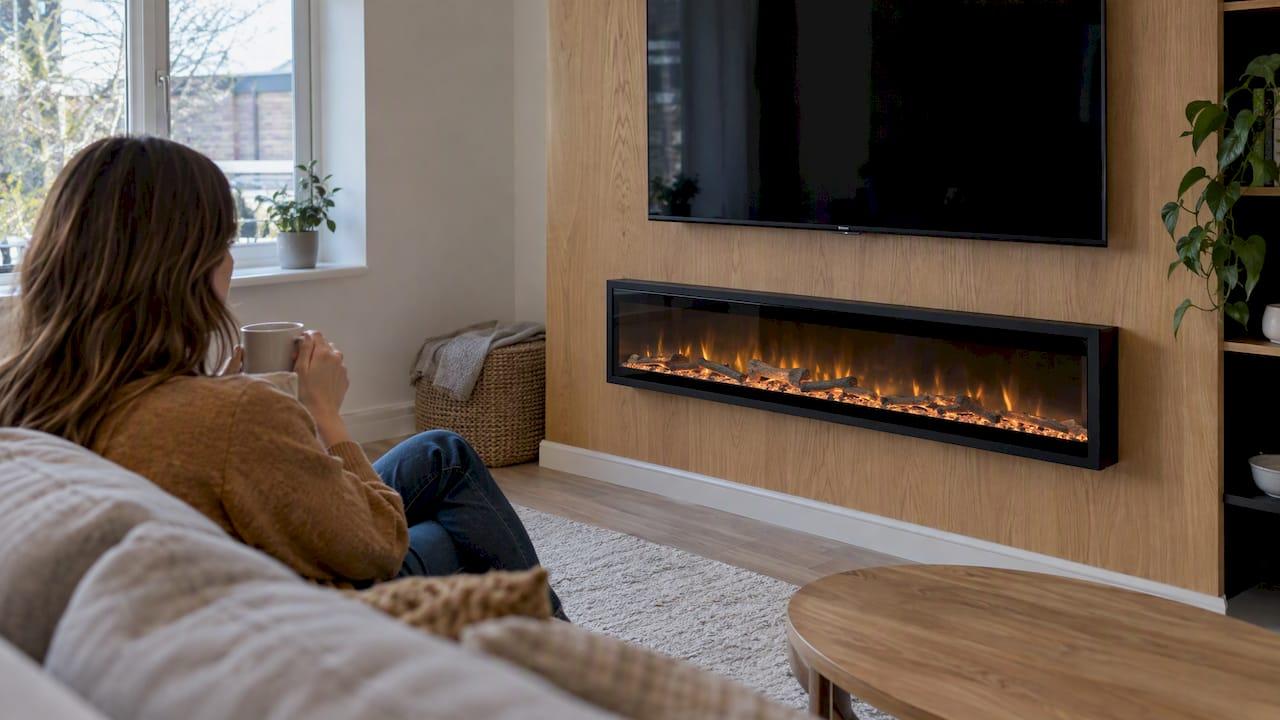
A floating fireplace hangs on the surface of your wall and projects out from it. A recessed fireplace sits inside a framed cavity with its face flush with the wall. Choose floating if you want a quick, low-commitment install, you rent-adjacent (or may move soon), or your wall can't hold a cavity. Choose recessed if you're building or rebuilding the wall anyway and want the fireplace to look like it was always part of the architecture.
The rest of this guide gets specific: how each type looks in a TV wall, what the install really involves, how they heat, where safety rules bite, and how to decide.
TL;DR
- Floating (wall-mounted): goes up like a flat-screen TV, on a bracket fastened to the finished wall. It's the easy, reversible option, and it stands a few inches proud of the wall.
- Recessed: needs a framed cavity so the face sits flush. It looks custom and built-in, but it is closer to a carpentry and electrical project than a hanging job.
- Heat: both are electric, so heat output comes from the heater inside, not from how the unit is mounted. Flame-only mode adds ambiance without much warmth.
- Safety: follow the manufacturer's clearances, look for a recognized safety mark such as CSA, and keep combustibles at least 3 feet away from a fireplace.
- Best for a media wall: plan the fireplace and TV together. Decide on the cavity before you pick panels, shelving and lighting.
Table of Contents
- What "floating" and "recessed" actually mean
- How they look in a TV or media wall
- Side-by-side comparison
- Installation: what each one really involves
- Do floating fireplaces give off heat?
- Sound, depth and the TV above
- Safety checks before you buy or build
- How to decide: five questions
- Our view: plan the wall, then pick the fireplace
- Plan it with a design and a kit
- FAQ
- Sources
What "floating" and "recessed" actually mean
The terms are used loosely, so let's pin them down.
A floating fireplace, also sold as a wall-mounted or surface-mounted unit, attaches to the wall like a flat-screen TV. Bob Vila's electric fireplace roundup describes wall-mounted models as hanging via brackets, while recessed inserts fit into a wall cavity with the surface flush. "Floating" is the design-world word for the look: no visible legs, no mantel, just a slim linear box that appears to hover.
A recessed fireplace is set into the wall. The firebox goes into a framed opening, and only the front frame and glass show. Some products sit in between. Many modern linear units can be installed recessed, wall-mounted or freestanding, so the same fireplace can sometimes serve either approach, depending on what the manufacturer allows. Always check the specific model's manual before you cut anything.
There's also a partial-recess approach, where the unit sinks part of the way into the wall. That gives an in-wall look without a full-depth cavity, and it can be a good compromise when you can't go deep, for instance on an exterior wall or a wall with plumbing or ductwork behind it.
How they look in a TV or media wall
This is where most people decide, so it's worth slowing down.
The floating look
A floating unit reads as an object on the wall. It has a visible depth, a shadow line underneath, and a deliberate, sculptural feel. Placed under a TV, with a floating cabinet below and a slat panel behind, it works well as a layer in the composition. The trade-off is that the front of the unit sits a few inches off the wall, so it can compete with the TV for visual weight if the two are close in width.
The recessed look
A recessed unit disappears into the surface. The wall stays one plane, the frame becomes a clean rectangle of light, and the whole wall looks more architectural. That's why designers reach for it in minimalist and modern rooms. Popular Mechanics notes that a recessed insert sits flush for a streamlined look, and that's the point: the fireplace becomes part of the wall rather than an addition to it.
Is a faux or electric fireplace tacky?
People ask this a lot, and the honest answer is that it depends on execution, not on the type. Tacky usually comes from three things: a fireplace that's too small for the wall, flame effects set to a cartoonish orange, and a unit stuck on a bare wall with nothing around it. A fireplace that's sized to the wall, framed by panels or a surround, and run on a subtle flame setting reads as intentional. Floating units can look great when they're integrated into a wider design. Recessed units tend to forgive more, because the flush frame hides the box.
Side-by-side comparison
| Factor | Floating (wall-mounted) | Recessed |
|---|---|---|
| Look | Sculptural, projects from the wall | Flush, built-in, architectural |
| Install method | Bracket on the finished wall | Framed cavity, then finishing |
| Skill level | Beginner-friendly in most cases | Carpentry, electrical and drywall work |
| Reversibility | Easy to remove, with minimal patching | Considered permanent |
| Wall requirement | Solid mounting into studs or proper anchors | Room for a cavity of the unit's depth |
| Best for | Existing walls, tight budgets, first homes | New builds, remodels, full media walls |
| Heat | Same heater technology, same output class | Same heater technology, same output class |
The practical split is simple. A wall-mounted unit can even serve as a temporary step before you commit to the construction a recessed insert needs. That's a sensible path if you're not sure about your final layout.
Installation: what each one really involves
Floating: a mounting job
Installing a floating fireplace is close to hanging a large TV. You find studs, mount the bracket level, lift the unit on, and plug it in. Electric models need a nearby outlet, and most low- to mid-priced inserts can't be hardwired, so plan the outlet location before you finish the wall. The cord is the one thing that can ruin the floating look, so decide early whether you'll run it through the wall behind the unit or hide it in a cabinet or panel.
Most homeowners handle this themselves. Measure the space, then follow the manufacturer's instructions, which is the same advice Bob Vila gives for any electric fireplace purchase.
Recessed: a small construction project
Recessed installs need a custom-cut space. Here's the realistic sequence:
- Confirm the model's rough-in dimensions (width, height, depth, and any required air gaps) from the manual.
- Check what's inside the wall: studs, wiring, plumbing, ductwork. Exterior walls bring insulation considerations.
- Frame the opening to the manufacturer's specifications, usually with a header above.
- Run power to the cavity. Some units are plug-in; others call for a dedicated circuit, which is the moment to involve a licensed electrician and follow local code.
- Set the unit, then close up the wall around the trim.
- Finish: tape, mud, sand and paint, or cover the wall with panels.
That last step is where many first-time DIYers stall. Clean joints around a cutout are the difference between a custom look and an obvious patch, so it's worth reading a step-by-step drywall finishing guide for homeowners before you start, especially if you plan to paint rather than panel over the seams.
Time and cost
Floating installs are measured in an hour or so of focused work. Recessed installs are measured in days once you count framing, electrical, drywall drying time and paint. The cost gap follows the labor gap: a recessed project adds framing materials, finishing supplies and often an electrician. Prices for the fireplaces themselves vary widely by size, flame technology and heater type, so get current quotes for the exact model you want rather than relying on a general range.
Do floating fireplaces give off heat?
Yes. Mounting style doesn't change the heating technology, so a floating electric fireplace heats the same as a recessed one of the same type. What matters is the heater inside.
The U.S. Department of Energy explains that electric resistance heating converts all the incoming electric energy to heat. In other words, when the heater is on, every watt you pay for ends up as heat in the room. Flame effects alone use far less power, so you can run the visual for ambiance in summer without heating the room.
For coverage, Bob Vila reports that fan-type fireplaces offer supplemental heat for rooms up to 450 square feet, while infrared models can warm rooms up to 1,000 square feet. Treat any electric fireplace as a supplement, not a whole-house heating system.
One mounting-related difference is worth knowing. A recessed unit sits inside the wall, so check the manual for airflow requirements and for where the heat exits. A floating unit has open air around it, which generally makes heat delivery easier to predict. For the TV above, see the section on clearances below.

Sound, depth and the TV above
Media walls add two issues that fireplace-only guides skip.
Sound. Deep recessed alcoves can trap low frequencies. That may help dialogue but can dull action sound if the alcove is very deep, and six to eight inches is a practical range that avoids eating floor space. If you're building a cinema-style wall, keep the cavity shallow and put speakers on a different plane from the fireplace.
Heat and the screen. A fireplace under a TV is the classic combination, and the worry is heat rising to the screen. Recessed alcoves can act as a natural buffer, potentially protecting electronics above, according to the same source. The safest approach is to read your TV maker's guidance and your fireplace's manual for the maximum surface temperature and minimum gap. Our own walkthrough on safely mounting a TV above a fireplace covers the temperature target in detail.
Safety checks before you buy or build
Electric fireplaces have no flame, gas line or chimney, but they're still heating appliances.
- Look for a recognized safety mark. Bob Vila notes that a CSA seal indicates the fireplace meets safety standards and has undergone testing, and that many units include automatic shutoffs set to a time or heat level.
- Keep combustibles back. The U.S. Fire Administration's home fire safety guidance says to keep anything that can burn at least 3 feet from fireplaces. Apply that to curtains, furniture and décor, and read your unit's manual for its own, often stricter, clearances.
- Plug directly into a wall outlet. The same guidance says to plug space heaters directly into outlets, and to choose heaters with an automatic shut-off if they tip over. An electric fireplace's heater is a different appliance, but the logic holds: avoid extension cords and power strips for anything drawing heater-level power.
- Hire a licensed electrician when wiring is involved. If a recessed model needs hardwiring or a new circuit, local electrical code applies. That is not a DIY shortcut.
- Keep the cavity to spec. Recessed units usually specify framing dimensions, gaps and finishing materials. Follow them exactly.
If you're building a recessed fireplace into a media wall, our guide to safety rules for recessed electric fireplaces goes through the specifics. If you plan a slatted accent wall behind the unit, see our notes on clearance behind a fireplace before you panel.
As for the question of whether a fireplace affects homeowners insurance, that depends on your carrier and policy. Call your insurer and tell them what you're installing. They can answer in a minute what no general guide can.
How to decide: five questions
- Are you opening the wall anyway? If you're framing a TV wall, adding panels or remodeling, recessed costs you less extra effort than it would on a finished wall.
- How long will you stay? Floating units come off with minimal patching. Recessed ones are permanent. For a starter home you might sell or a layout you may change, floating is the lower-regret choice.
- How deep can the wall go? A recessed unit needs the full cavity. If there's plumbing, ducts or an exterior wall in the way, go floating or partial recess.
- What look do you want? Sculptural and layered: floating. Seamless and architectural: recessed.
- How comfortable are you with carpentry and electrical work? Be honest. Floating is a weekend afternoon. Recessed needs a plan, the right tools and often a pro for the electrical part.
No type is inherently better. The right choice depends on the project stage, the wall type and the look you want.
Our view: plan the wall, then pick the fireplace
We build media wall kits for homeowners who want a high-end look without hiring a general contractor, so we see this decision constantly. Our advice: don't choose the fireplace first. Choose the wall.
Start with the TV size and the wall width. Decide whether you want the fireplace centered below the TV, offset beside it, or part of a long linear composition with floating cabinets. Then decide the depth of the whole system, because panels, cabinetry and fireplace all need to land on the same plane. When those pieces are designed together, a floating fireplace looks deliberate and a recessed one looks seamless. When they're bought separately and forced together, both look like afterthoughts.

For most first-time DIYers, we like a floating or partially recessed linear unit inside a pre-cut, pre-labeled panel system. You get the built-in effect, you avoid opening the wall, and you hide the cord and wiring behind the panels. For homeowners already in a remodel with the studs exposed, a full recessed unit is wonderful, and it's easy to plan the cavity into the wall layout.
One more point: don't skip the layout drawing. An hour of measuring and sketching saves the most expensive mistakes, like a cavity cut four inches too high for the TV above it.
— Jake
Plan it with a design and a kit
If you'd like help placing the fireplace in your wall before you cut or mount anything, we offer design services on our shop page: a Single Concept Design for $99, a 3 Concepts + Revision Design Package for $199, and a Full Design & Quote for $299. Our media wall kits come pre-cut and pre-labeled for weekend assembly, and we offer white-glove installation in the SF Bay Area. You can browse electric fireplaces for media walls to match a unit to your layout, or explore our media wall designs for ideas.
For more help sizing and picking, these guides go deeper:
- How to choose the right electric fireplace size
- Best recessed electric fireplace for media walls
- Best electric fireplace for a TV wall
- TV and fireplace wall layouts
FAQ
Do floating fireplaces give off heat?
Yes, if the model includes a heater. Electric resistance heating turns all the electricity it uses into heat, per the Department of Energy. Most units let you run the flame effect with the heater off, which gives ambiance with much lower power use.
Can I put a TV above a floating or recessed fireplace?
Often, yes, but check both manuals first. Each states a minimum gap and a maximum surface temperature for what sits above. A recessed alcove can also act as a buffer for the screen. Our guide on fireplace heat clearance for TVs explains how to measure it.
Which is easier to install yourself?
Floating. It mounts on a bracket like a TV and takes a fraction of the time. A recessed unit needs a framed cavity, power to the opening and finished drywall or panels, and some models require a licensed electrician. If you want the recessed look without opening the wall, a panel system with a partial recess is a good middle path.
Is a floating or recessed fireplace better for a first home?
For most first-time buyers, floating is the lower-risk pick. It costs less to install, comes off with minimal patching and doesn't lock in a layout you might change. If you're remodeling with the walls open and plan to stay long term, recessed is worth the extra effort.
Sources
- The Best Electric Fireplaces, Bob Vila
- The 8 Best Electric Fireplaces, Popular Mechanics
- Electric Resistance Heating, U.S. Department of Energy
- Home Fire Safety, U.S. Fire Administration
- Fireplace and TV Wall Ideas, Homenory