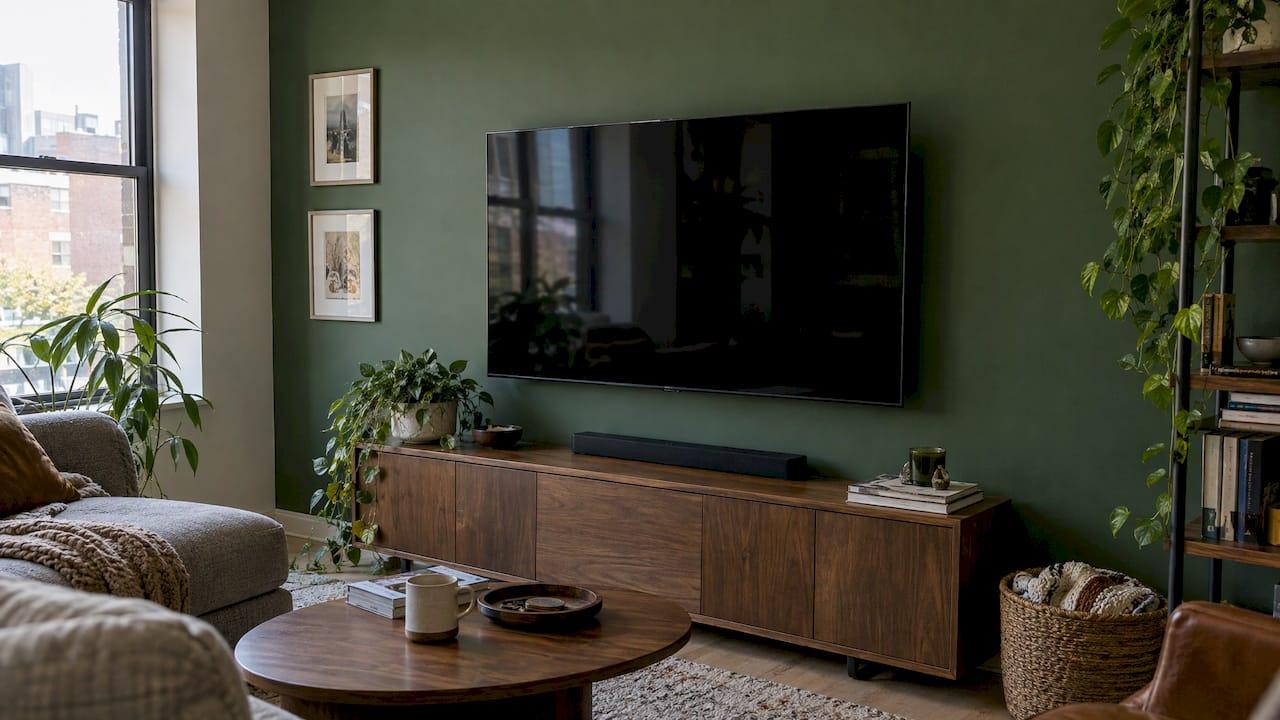
For the wall behind a TV, choose flat, matte or, at most, eggshell paint. The finish matters more than the color, because a shiny wall reflects lamps, windows and the screen's own light back at you. Satin is a workable compromise only where you need easy cleaning and the wall is smooth. If you want the whole wall to look built-in and high-end, we design our media wall kits around the same idea: calm surfaces that let the screen be the focus.
TL;DR
- Pick flat or matte for the best glare control. Eggshell is the highest sheen most TV walls can take.
- Gloss and semi-gloss turn the wall into a mirror and make every flaw on the drywall show.
- Color is more forgiving than sheen: darker shades distract less, but a low-sheen finish is the part to hold firm on.
- Two coats over primer on a clean, smooth wall give the most even result, and a typical 12-foot wall costs roughly $35 to $55 in materials.
- Sample in the sheen you plan to buy, because the same color looks different in each one.
Table of Contents
- Why sheen matters more than color behind a TV
- How the four common finishes compare
- Match the finish to your room
- Choosing a color once the finish is set
- Prepare the wall before you paint
- Quick cost guide
- Perspective
- Go beyond paint with a complete media wall
- FAQ
- Sources
Why sheen matters more than color behind a TV
Sheen is how much light a painted surface bounces back. A TV is a light source sitting against a wall, and anything on that wall that reflects will compete with the picture. A bright, shiny wall opposite a screen creates glare, and reflections make your eyes keep switching focus between the reflected image and the screen, which is a recipe for tired eyes during a long movie night.
There is a second effect. When the TV is on, a glaring wall beside a bright picture forces your eyes to handle two very different brightness levels at once. When the TV is off, a glossy wall around a black screen makes the rectangle stand out like a hole. A matte, mid-to-dark wall does the opposite: it absorbs stray light and lets the screen blend in.
A home theater podcast put the priority plainly: paint finish matters more than paint color, and colored walls rarely distort the picture unless the lights are very bright. Its advice was that you can compromise on color but should hold the line on a low-sheen finish. That is a good rule for a living room, too.
How the four common finishes compare
Paint makers measure sheen in gloss units, using a light beam bounced off the dried paint at a set angle. Lower numbers mean less reflection. Benjamin Moore's Regal Select brochure lists flat at 1 to 4 and matte at 3 to 5 (both measured at 85°), eggshell at 15 to 22 at 85°, and satin at 20 to 30 at 60°. Angles differ between finishes, so treat the numbers as a ranking, not a precise side-by-side.
| Finish | Glare behind a TV | Cleaning | Shows wall flaws? | Best use on a TV wall |
|---|---|---|---|---|
| Flat | Lowest | Hardest to wipe | Hides them best | Dark, dramatic walls in low-traffic rooms |
| Matte | Very low | Easier than flat in modern formulas | Hides most | The default choice for most TV walls |
| Eggshell | Low | Cleans more easily | Shows some | Family rooms with fingerprints and dust |
| Satin | Moderate | Easiest of the four | Shows most | Only on very smooth walls in controlled light |
Flat
Flat paint soaks up light, hides imperfections and is difficult to clean. That makes it the best performer for glare and for covering a less-than-perfect wall. The trade-off is scuffing: Benjamin Moore notes that constant rubbing can burnish flat paint in high-traffic areas. Behind a wall-mounted TV, where nobody brushes past, that is rarely an issue.
Matte
Matte is a touch shinier than flat and many brands have reformulated it to wipe clean better. Consumer Reports describes flat and matte as nonreflective or low luster, best for living rooms and bedrooms with little wear. For most homeowners, a washable matte is the sweet spot: almost no glare, forgiving of flaws, and tough enough for a living room.
Eggshell
Eggshell has a faint glow, like the shell it is named for. It cleans more easily than flat or matte but tends to accentuate surface imperfections. If your TV wall is close to a play area, a hallway or a spot where hands land, eggshell is a reasonable upgrade, as long as the drywall is smooth.
Satin
Satin is easy to clean and resists scuffs, but it shows imperfections and does not touch up easily. Behind a TV it carries the most risk. The home theater podcast host mentioned above called it a practical compromise and uses it in his own rooms, so it is not off the table. Just make sure the wall is well prepared and the room does not have strong windows or lamps facing it.
Gloss and semi-gloss
Skip them. Sherwin-Williams warns that high-gloss walls in dark, artificially lit spaces catch and reflect all that light, causing excessive glare. A TV room is exactly that kind of space in the evening.
Match the finish to your room
The right choice depends on what shines at the wall.

A room with big windows. Light pouring in is the main source of reflection. Sherwin-Williams suggests that sheen choice should account for room lighting and window position, and that you might avoid high-gloss in a room flooded with natural light. Go flat or matte here, and place the TV so it does not face the glass directly.
A dim room for movie nights. Darker, low-sheen walls help most. A deep matte color keeps the surround from lighting up and makes the screen look larger and deeper. If you also want soft light behind the screen, our guide on how to plan, wire and light a dimmable LED TV wall covers the layout.
A busy family room. Choose a washable matte or eggshell. Prices vary by line: a 2026 US guide puts matte at roughly $3 to $6 more per gallon than flat, which is a small price for a wall you can wipe.
A wall with flaws. Textured, patched or uneven drywall will show in higher sheens. Stay with flat or matte, or fix the wall first. Using semi-gloss on uneven drywall is a common finish mistake because every flaw shows.
If glare persists after repainting, the cause is often the layout or the lamps, not the paint. Our TV glare fixes walk through the quick ones.
Choosing a color once the finish is set
With the sheen decided, color is a style question, and darker generally means less distracting. Reasonable options include charcoal, deep green, navy and coffee brown, and a true matte black for a bold, built-in look. DG Floors calls a deep matte TV wall the most effective under-$50 upgrade and recommends matte or eggshell with two coats over quality primer.
Two cautions that save repainting:
- Sheen changes how color looks. Flat and matte mute a color, while eggshell and satin make it read deeper, so test the sample in the sheen you will actually buy.
- Do not mix sheens in the same plane. Light bounces differently off each, and the wall looks patchy at an angle.
For specific shades and a primer approach, read our guide to getting a deep TV wall color in two coats with gray primer. If black is the goal, our matte black TV wall guide shows how to keep it looking high-end rather than flat and heavy. For lighter ideas, see our accent wall paint ideas for living room media walls.
Prepare the wall before you paint
Low-sheen paint hides flaws better than gloss, but it does not erase them. A TV wall is also the one wall you will stare at with a bright rectangle in front of it, so preparation pays off.
- Remove the TV, mount and any hardware. Fill old anchor holes and patch dents.
- Let patching compound dry fully, then sand smooth. Wipe off all dust.
- Prime. Skipping primer is the most common reason deep colors look streaky. A pint of primer plus a quart of paint is about $35 to $55 and covers a typical 12-foot TV wall.
- Paint two thin coats. Keep a wet edge and roll in one direction. Benjamin Moore lists flat and matte Regal Select as touch dry in about an hour and ready to recoat in one to two hours, but always follow the label on your can.
- Let it cure before re-hanging. Wait before mounting heavy hardware or wiping the wall.
If the wall is damp, soft, peeling or has a crack that keeps reopening, repair the cause first. Paint will not hold on a failing surface.
Quick cost guide
Per-gallon prices in a 2026 US retail comparison ranged from $38 to $46 for a mid-line option up to $95 to $110 for a premium line, depending on brand and product. One wall needs far less than a gallon, so even a premium can is a modest cost. Prices shift with retailer and season, so check the store before you buy.
If you are still choosing the screen itself, a guide to OLED, QLED and Mini-LED costs helps you budget, and the screen type is worth settling before you pick a finish, since brighter panels handle ambient light differently.
Perspective
Most paint advice treats the TV wall as a color problem. In our experience designing media walls, it is a surface problem: how the whole wall behaves when light hits it.
That is why we build around calm, uniform surfaces. Slat accent panels, floating cabinetry, integrated LED lighting and hidden wire management all work toward one goal, a wall that frames the screen instead of fighting it. Paint is the first layer of that thinking, and a matte or low-sheen finish is where it starts.
If you want the whole look without hiring a contractor, our kits arrive pre-cut and pre-labeled so you can install in a weekend, with finishes you can choose to suit your room. Pick the finish, pick the layout, and the rest goes quickly.
Jake
Go beyond paint with a complete media wall
A paint job makes the wall behind the TV calmer. A media wall makes it look designed. The Media Wall Store offers luxury DIY media wall kits with pre-cut, pre-labeled panels, integrated LED lighting, floating cabinetry, slat accent panels and hidden wire management, in multiple finishes. You can browse the media wall kits and design packages: a Single Concept Design is $99, a 3 Concepts + Revision Design Package is $199 and a Full Design & Quote is $299, each a one-off price.

If you are in the San Francisco Bay Area and want someone else to do the work, we also offer White-Glove Installation. You can see how both routes work on our How It Works page.
FAQ
What is the best paint finish for a TV wall?
Matte or flat is best, because both reflect the least light and hide wall flaws. Eggshell is fine if you want easier cleaning and the drywall is smooth. Avoid gloss and semi-gloss, which reflect lamps and windows onto the screen.
Is satin okay behind a TV?
It can work in a room with controlled lighting and a very smooth wall. Satin shows imperfections and is harder to touch up, so it is a riskier pick than matte or eggshell. If you choose it, sample it first and view it with the TV on and off.
Should the TV wall be darker than the other walls?
It can be. A deep matte color makes a black screen blend in when it is off and reduces the contrast between a bright picture and the wall when it is on. You do not have to go black: charcoal, navy and deep green also work. Keep the same low sheen as the room for a consistent look.
Does paint finish change how a color looks?
Yes. Flat and matte mute a color, while eggshell and satin deepen it and bring the undertone forward. Test a sample in the finish you plan to buy, and view it in daylight and in the evening with the TV on.
Sources
- DisplayMate: Minimizing Glare
- HDTV and Home Theater Podcast #488: Painting Your Home Theater
- Comparing Popular Paint Finishes (Lowe's)
- How to Choose a Paint Finish (Benjamin Moore)
- Regal Select brochure (Benjamin Moore)
- Pick the Perfect Paint Finish for Every Room (Consumer Reports)
- Differences Between Paint Sheens (Sherwin-Williams)
- Sheen and gloss guide (Sherwin-Williams)
- Interior Paint Finishes 2026: Flat vs Eggshell vs Satin
- Wall Behind TV Ideas (DG Floors)
- OLED vs QLED vs Mini-LED costs