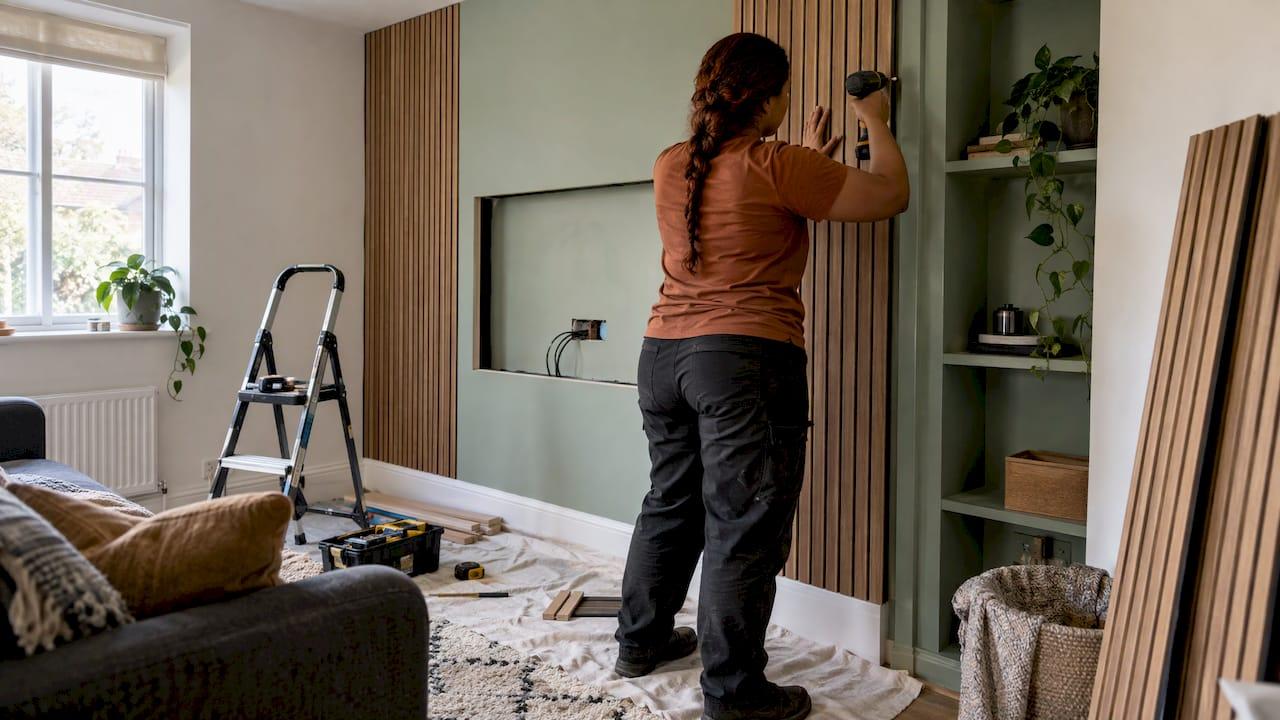
A typical media wall takes 2 to 5 days of work from framing to finishing, and a pre-cut kit sits at the short end of that range. The spread comes from size, finish and extras like a fireplace or rewired outlets. The honest planning number is a long weekend for the build, plus drying time for any mud, plaster or paint.
Below you'll find the time each stage takes, how a DIY schedule compares with a hired one, and what you can do in advance to avoid losing days.
TL;DR
- Most residential media walls take 2 to 5 days of active work depending on size, features and finish. A simple wall can be done in a day.
- A kit with pre-cut, pre-labeled panels removes most measuring, cutting and finishing from the schedule, so a weekend is a realistic target for a standard wall.
- A from-scratch DIY wall with drywall finishing is a different animal: one builder puts it at 30 to 50 hours spread over 3 to 4 weeks.
- Fireplaces, new electrical runs and stone or tile finishes are the usual reasons a schedule stretches.
- Order materials, confirm outlet locations and clear the room before day one. That is the cheapest way to save time.
Table of Contents
- How long a media wall takes, by build type
- The stages of a media wall installation
- What makes a media wall take longer
- DIY versus hired help: where the hours go
- A realistic schedule for a kit-based weekend build
- Perspective
- How to keep your project on schedule
- Fireplace, electrical and custom finishes: what each adds
- Plan the project from preparation to completion
- Start with a kit built for a weekend
- FAQ
- Sources
How long a media wall takes, by build type
The answer depends on what you are building. Here is a quick view before we go stage by stage.
| Build type | Active work | Calendar time |
|---|---|---|
| Pre-cut kit with panels and cabinetry | About 2 to 3 days | A weekend to a long weekend |
| Framed wall, TV and electric fireplace, finished by you | About 16 hours in one UK build | 2 to 3 days of work plus about a week for plaster to dry |
| Full DIY build including drywall finishing | 30 to 50 hours | 3 to 4 weeks |
| Same build, drywall finishing hired out | 15 to 25 hours | 1.5 to 2 weeks |
| Professional custom build | Typically 2 to 5 days on site | Add design and ordering lead time |
One DIY guide puts a TV wall niche at 2 to 3 weekends of work, with materials typically between $500 and $1,500 depending on whether you choose shiplap, acoustic panels or something else. The takeaway: the more of the wall that arrives ready to mount, the fewer hours and drying gaps you have to schedule.
The stages of a media wall installation
Every media wall, kit or custom, runs through the same sequence. What changes is how long each step lasts.
1. Planning and layout (a few hours to a day)
Mark stud locations, the TV center height, outlet and cable positions and the width of the wall. Decide on shelving and lighting at this point, because they determine where wiring goes. Seating distance matters here too: clearance guidance for furniture around a fireplace is a good check before you lock in the wall's depth and width.
2. Framing (3 to 8 hours)
In a build from scratch, the frame and drywall boards are the biggest single block of work. The UK example above allots about 8 hours to the frame and boards for a wall with a TV and fireplace. A kit replaces most of this with pre-engineered panels that attach to the wall, which is where the weekend timeline comes from.
3. Electrical and wire management (1 to 4 hours, longer if rerouting)
Running hidden cables for the TV, soundbar and lighting is quick when outlets are already behind the wall. Moving an outlet or adding a circuit is slower, and in many places it requires a licensed electrician. Budget around $200 for electrician labor if a fireplace unit needs hardwiring to your panel, and book the visit early so it doesn't hold up the rest.
4. Finishing: mud, plaster or panels (the biggest variable)
This is where timelines split. Joint compound dries by evaporation at roughly 24 hours per coat at room temperature and normal humidity, and longer in cold or humid rooms. A wall needing three coats plus sanding eats most of a week even though the hands-on time is small. That gap is why the full DIY figure runs to weeks while a kit with factory-finished panels does not.
5. Paint and trim (2 to 4 hours of work, plus cure time)
Painting a media wall takes a couple of hours per coat. Paint feels dry long before it is hard, so paint curing times are worth reading before you mount heavy shelves or push a cabinet against fresh paint. Pre-finished slat panels and finishes skip this stage entirely.
6. Mounting the TV, cabinetry and lighting (2 to 4 hours)
The last stage is the satisfying one: mount the TV, hang floating cabinets or shelves, connect LED strips and plug in the fireplace insert. Leave an hour to tidy cables and test every device.
What makes a media wall take longer
Most delays trace back to a short list.
- Size. A 20-foot wall is more than double the work of an 8-foot one, because panels, cable runs and finishing scale with it.
- Fireplace. A linear electric insert is a plug-in job in many cases, but a recessed firebox needs framing, a clearance check and sometimes a dedicated circuit.
- Electrical rerouting. Moving outlets or switches adds an inspection or a trade visit to your calendar.
- Heavy finishes. Stone veneer, tile or multiple recesses add cutting and setting time, and complex designs can run past the 5-day mark.
- Wet trades. Mud, plaster and primer each add a drying gap. Dry finishes (panels, slats, pre-finished cabinetry) do not.
- Missing parts. A back-ordered fireplace or the wrong mounting hardware can stall a project for days.
DIY versus hired help: where the hours go
A from-scratch DIY wall is mostly about drywall finishing. Stewart Milne Homes recommends a hybrid: frame it yourself in a day, hire a drywall finisher for $400 to $800, then paint and finish the rest. That keeps most of the savings and removes the phase that tends to slow first-timers.
A kit gives you a second route. Because panels arrive cut and labeled, there's no drywall taping to schedule, and the work is assembly rather than construction. If you'd rather not touch the wall at all, we also offer white-glove installation in the SF Bay Area.

A realistic schedule for a kit-based weekend build
Here is how a standard wall with a TV, LED lighting and floating cabinetry can flow. Your wall may differ, so treat it as a template.
- Before the weekend: receive the kit, check every panel against the list, confirm outlet locations, clear the wall and the floor in front of it.
- Saturday morning: locate studs, mark the layout, attach the base and panels in the labeled order.
- Saturday afternoon: run cables and power through the hidden channels, install the LED lighting and test it.
- Sunday morning: hang cabinetry or shelves, fit the fireplace insert if you have one.
- Sunday afternoon: mount the TV, connect devices, tidy cables and touch up.
If you want to see how others plan it, our guides on a weekend media wall project and building a media wall in 2 to 3 days walk through the budget and the build in more detail.
Perspective
Most of the time on a media wall is lost in the steps that wait: mud that needs to dry, paint that needs to cure, a part that has not arrived. We designed our kits around that. Panels come pre-cut and pre-labeled, wire management is hidden inside the system, and the finishes are chosen up front, so the wall goes up in the order the labels say.
Our view is that a luxury look should not need a month of weekends or a contractor's calendar. When you remove drywall finishing and on-site cutting, a wall that would take weeks becomes a weekend, and the savings against a custom build stay in your pocket.
If you want help before you order, our design packages let you lock the layout, lighting and cabinetry first, so day one starts with a plan instead of a question.
Jake
How to keep your project on schedule
These steps cost little and protect days.
- Measure twice, then order everything at once. Cabinetry, fireplace, lighting and hardware should all be on site before you start. Our accessories cover fireplaces, floating shelves, lighting, audio and visual, cabinetry, hardware, smart tech and finishes, so you can complete the order in one go.
- Settle the electrical plan first. If an outlet has to move or a circuit has to be added, schedule the electrician before the build weekend.
- Pick dry finishes where you can. Panels and pre-finished components avoid the 24-hour wait between coats.
- Clear the space. Move furniture, protect floors and keep a clean spot for laying out labeled panels.
- Check ventilation for storage. If cabinets will hold a receiver or console, plan airflow now. Our guide on media wall storage ideas covers it.
- Keep the instructions and a stud finder handy. Most mistakes come from guessing at placement.
Fireplace, electrical and custom finishes: what each adds
A fireplace usually adds half a day to a day. A plug-in linear electric unit, like our electric fireplaces for media walls, fits into the layout early and gets wired through the same hidden channels as the TV. Our guide to the fireplace media wall shows how the pieces go together.
New electrical runs can add anywhere from a few hours to a separate trade visit, and costs vary by location and scope. Custom finishes add time only if they are wet or heavy. Wood-tone slat panels, such as our acoustic slat wall panels, attach in a few hours and need no paint.

Plan the project from preparation to completion
A reasonable total timeline for a kit build looks like this:
- Design and layout: a few days, depending on how quickly you decide. Our design packages are $99 for a single concept, $199 for three concepts with a revision, and $299 for a full design and quote.
- Shipping and delivery: varies by item and address, so plan to have everything on site before you take the weekend off.
- Installation: a weekend to a long weekend.
- Settling in: a day or two before loading shelves if you used any paint or adhesive.
For a from-scratch build with drywall finishing, allow several weeks. For a hybrid, allow two. If you want the numbers side by side, see how much a media wall costs in 2026.
Start with a kit built for a weekend
If your goal is the shortest path to a finished wall, start with a system designed for it. Our kits include pre-cut, pre-labeled panels, integrated LED lighting, floating cabinetry and hidden wire management, with multiple finishes to choose from. We offer expert support while you build and risk-free returns.
Browse the DIY media wall kits, or use the build your own bundle to choose the pieces that suit your wall. You can also see how it works for both DIY kits and custom installs.
FAQ
How long does it take to install a media wall?
Most residential media walls take 2 to 5 days of active work, depending on size, features and finish. A pre-cut kit for a standard wall is designed to go up in a weekend. Allow extra calendar time for any mud, plaster or paint to dry.
Can I install a media wall in one day?
Smaller walls with simple panels can be finished in a single day, especially when there is no fireplace and no electrical work. Add a fireplace, hardwiring or custom finishes and a second day is the safer plan.
How long should I wait before using the wall after finishing?
If you used joint compound, wait about 24 hours per coat before sanding or priming, and longer in humid rooms. Paint should be given time to cure before you push furniture against it or load shelves. Pre-finished panels can be used as soon as the TV and devices are connected and tested.
Do I need an electrician for a media wall?
Not for plug-in components, but you may need one if you are moving outlets, adding a circuit or hardwiring a fireplace. Rules vary by city and state, so check your local permit requirements and book a licensed electrician before the build day.
How long does a professional installation take compared with DIY?
A professional crew typically finishes in 2 to 5 days on site. A full DIY build with drywall finishing can stretch to 3 to 4 weeks of calendar time, while a hybrid with a hired finisher takes about 1.5 to 2 weeks.
Sources
- Stewart Milne Homes: DIY Media Wall Build Guide
- Wood Create: How to Build a Media Wall with TV and Fireplace
- Mingsun Group: How to Build a TV Wall Niche
- Yake Climate: How Long Does Drywall Take to Dry?
- HomeAdvisor: Electric Fireplace Installation Cost
- Ottawa Cabinet Painting: Paint Curing Times
- Cozy Home: Corner Fireplace Furniture Layouts