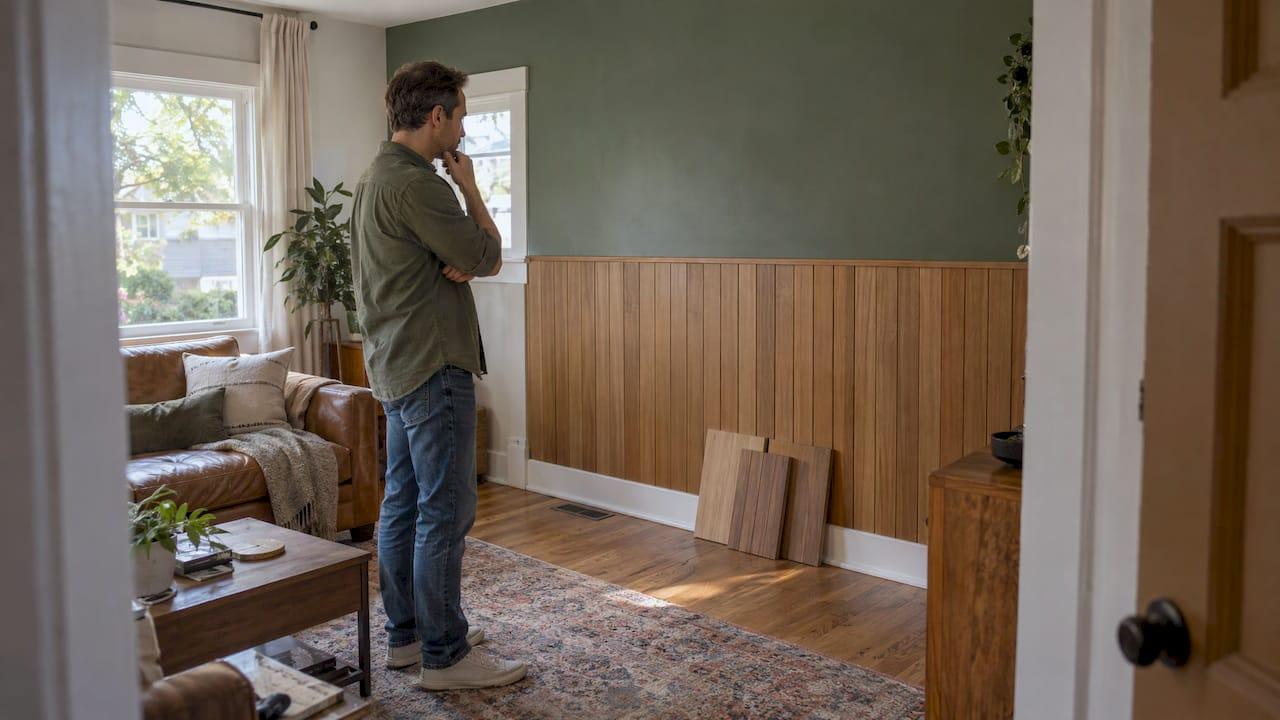
The most sustainable wall panel is the one that is verified, durable and used where it counts. For a media wall, that usually means one well-planned feature wall in a material with documented sourcing and low emissions, not every wall in the room. Below you'll find how to read green claims, how the main materials compare, what they cost in the US and how to install them yourself. We also explain why a pre-cut kit built around a single wall is a practical way to put that into practice.
TL;DR
- Treat words like "eco" and "green" as marketing until a third-party label, test report or sourcing document backs them up.
- Look for low-emission certification (CDPH-based or GREENGUARD Gold), an Environmental Product Declaration (EPD) and FSC or PEFC chain of custody for any timber.
- Reclaimed wood, bamboo, recycled-content panels and wood-based slat panels all work for a feature wall, and each has a different weak point to check.
- Installed costs in 2026 guides run from about $3.50 per square foot for laminate to $23 or more for reclaimed wood, so a single feature wall keeps both cost and material use down.
- Plan the wall before you buy: a design package with exact dimensions prevents the over-ordering that wastes both money and material.
Table of Contents
- What makes a wall panel sustainable
- How to verify a green claim in ten minutes
- The main sustainable panel materials compared
- What sustainable panels cost in the US
- Use less material before you choose a better one
- Installing a sustainable feature wall yourself
- Safety and compliance points
- Why plan first, then buy
- Start your media wall with a plan
- FAQ
- Sources
What makes a wall panel sustainable
No single feature does it. A panel is more sustainable when several things line up: where the raw material came from, how much of it is recycled or renewable, what the panel releases into your indoor air, how long it lasts and what happens when you eventually take it down.
That is why the claim on the box is not enough. The EPA's Indoor AirPlus guidance cautions consumers about vague labels such as "environmentally friendly," "eco safe" and "green," calls misleading versions greenwashing and points to third-party tested labels instead. The same document focuses on the CDPH Standard Method V1.2-2017, a California test that measures the volatile organic compounds (VOCs, chemicals that evaporate from materials into room air) a product gives off.
Before you compare materials, write down which of these five criteria matter most to you:
- Sourcing: certified or reclaimed timber, rapidly renewable fiber, or recycled content.
- Recycled content: the percentage, and which parts of the panel it covers.
- Emissions: what was tested, and to which standard.
- Repairability: can you refinish a scratch or replace a single panel?
- End of life: can it be reused, taken back or recycled?
A panel that scores well on three of these and honestly documents them beats one that claims all five in a single adjective.
How to verify a green claim in ten minutes
Ask for the product page, the spec sheet or the manufacturer's documentation and look for these items.
Emissions certification. Arch2o's guide to sustainable interior materials notes that UL GREENGUARD Gold limits emissions of hundreds of individual VOCs and total chemical emissions, and requires compliance with the California Department of Public Health standard method. This matters most for anything glued, coated or finished indoors, because that is where emissions come from.
An EPD. An Environmental Product Declaration is a third-party verified life-cycle report. Its headline figure is global warming potential, in kilograms of CO₂ equivalent per declared unit. Arch2o's checklist says to confirm that a recognized program operator verified it, that the declared unit and life-cycle stages match what you're comparing and that it is still current, since most are valid for five years. An EPD discloses impacts. It does not certify that they are low, so use it to compare two products measured the same way.
Chain of custody for wood. FSC and PEFC are the two forestry certification systems. Look for a certificate number tied to the specific product, and check it on the certifier's own database rather than trusting a logo.
Recycled content. A percentage is only useful if it says what it applies to: the core, the surface or the whole panel.
The same habit applies well beyond walls. If you want a quick refresher on what eco-friendly really means when a home service uses the word, the logic is identical: ask what is in the product and what backs the claim.
The main sustainable panel materials compared
Here is how the common options behave on a feature wall. Each has a style, a strength and one thing to check.
| Material | Look | Main sustainability case | What to check |
|---|---|---|---|
| Reclaimed wood | Weathered, varied grain | Reuses existing timber, no new harvest | Dimensional variation, possible lead paint, kiln-drying |
| Bamboo | Clean linear grain | Fast-growing, renewable | Binders and adhesives, FSC certification, shipping distance |
| Recycled PET felt or acoustic panels | Soft, modern, sound-absorbing | Made from post-consumer bottles | Recycled percentage, fire classification |
| Paper-waste or cellulose boards | Matte, contemporary | Diverts industrial waste | Moisture limits, takeback options |
| Wood-composite (WPC) | Uniform, wood-like | Recycled fiber and polymer | Declared recycled content |
| Fiber cement | Smooth, mineral | Very long service life | Higher embodied carbon from cement |
| FSC-certified wood slats or veneer | Warm, architectural | Certified forestry, repairable | Chain-of-custody certificate, finish emissions |
Reclaimed wood
Reclaimed wood gives a feature wall character that new boards rarely match. This Old House warns that salvaged boards may carry lead-based paint, recommends sealing them with water-based polyurethane or shellac and advises buying boards that the dealer has kiln-dried, which prevents warping and removes insects. If your home was built before 1978, treat unknown old paint seriously and have it tested before you sand or cut anything.

Bamboo
Bamboo regrows quickly and has a clean, contemporary grain. Its weak spots are the binders that hold the strips together and the distance it travels. So look for FSC certification and a stated emissions standard rather than assuming the plant's reputation carries over to the panel.
Recycled PET and paper-waste panels
These make the most direct case for recycled content, and many double as sound control, which suits a media room. Check the recycled percentage and the fire rating. Some paper-based boards are not meant for bathrooms or other high-moisture rooms, so keep them to living rooms, dens and bedrooms.
Fiber cement and high-pressure laminate
Both are durable, and durability is a sustainability argument: a panel that lasts decades is replaced less often. Fiber cement carries higher embodied carbon because of its cement content, so it suits wet or high-wear areas more than a living room feature wall. Laminate-faced panels extend replacement cycles, and some use certified fiber inputs, so ask for the supplier's documentation.
Wood slat panels
Slat panels are the look most media wall buyers want: vertical lines, warm tones and a built-in acoustic effect. Our Acoustic Slat Wall Panel in Smoked Walnut and Red Walnut are examples of this style. For more on how slat panels perform in a living space, see our guide to the best acoustic slat panels for homeowners.
What sustainable panels cost in the US
Price varies more by material and complexity than by whether it is "green." The 2026 Builds and Buys cost guide, which cites NAHB and Remodeling Magazine data, lists these installed totals (material plus labor) per square foot:
| Material | Installed cost per sq ft (2026 guide) |
|---|---|
| Reclaimed wood | $11 to $23 |
| Bamboo | $12 to $19 |
| Solid wood | $14 to $30 |
| Wood veneer | $10 to $15 |
| 3D panels | $7 to $16 |
| MDF | $5 to $8 |
| Laminate | $3.50 to $6 |
The guide also notes that complexity, material waste, wall prep, trim, electrical work and disposal move the total. Separately, This Old House reports installed wood paneling averaging $20 per square foot, within a very wide $1 to $40 range, using 2024 Angi figures. Treat all of these as ranges for the period they were published. Lumber and delivery costs shift, so get a current quote before you commit.
A worked example: a 10 ft by 8 ft media wall is 80 square feet. At the reclaimed wood range, that is roughly $880 to $1,840 installed. Covering a whole 12 ft by 14 ft room (about 416 square feet of wall at 8 ft ceilings, before subtracting doors and windows) at the same rates would run roughly $4,600 to $9,600. Same material, a fraction of the footprint.

Use less material before you choose a better one
The greenest square foot is the one you never buy. A single feature wall behind the TV delivers most of the visual impact of a fully paneled room, and it keeps the budget available for a premium material in the place everyone looks. Partial-height treatments work the same way: panels to a set height with paint above can give you the look with less material.
The second source of waste is miscutting. Every wrong cut is a panel that goes in the trash. That is where planning pays off, and where a pre-cut, pre-labeled kit earns its place: the pieces arrive sized for the wall, so you are assembling rather than improvising. If you are still deciding what to build, our decorative wall panels guide and panel interior design guide walk through layouts and styles.
Installing a sustainable feature wall yourself
Most of these materials install with basic tools. The steps below follow the guidance from This Old House, adjusted for a feature wall.
- Prepare the wall. It should be clean, dry and smooth. Fix damp problems first, because no panel survives a wet wall.
- Plan the layout. Mark studs, outlets and the TV mount position before you cut. Our kits include hidden wire management, so decide where cables will run now rather than after the panels are up.
- Let the material settle. Wood products move with humidity. Leave a 3/8-inch expansion gap at edges, as This Old House recommends, which trim or the floor and ceiling lines will cover.
- Fix the panels. Construction adhesive does much of the work on lightweight panels, and fasteners add holding power. For the full method, see our step-by-step wall panel installation guide.
- Seal and finish. Choose water-based finishes where you can and match them to the certification you chose the panel for.
- Maintain gently. Most interior panels need only a dry or lightly damp cloth. Harsh solvents can damage coatings, so follow the maker's care sheet.
Thin milled plywood sheets are more stable, cheaper and quicker to install than heavy solid wood, according to This Old House, which makes them the friendlier choice for a first project.
With our kits, the panels arrive pre-cut and pre-labeled, so the layout and cutting steps are largely done for you. If you would rather skip the build entirely, we also offer white-glove installation in the San Francisco Bay Area.
Safety and compliance points
- Fire. Some panels need fire-rated backing to meet code, and fire classifications differ by material. Read the rating on the spec sheet, especially near a fireplace.
- Moisture. MDF should never go in bathrooms, per Builds and Buys. Keep moisture-sensitive panels out of damp rooms.
- Old paint. Test pre-1978 paint for lead before cutting, sanding or removing it. A certified lead professional is the right call if the test is positive.
- Air quality. Choose products tested to a low-emission standard and ventilate while adhesives and finishes cure.
For a non-US benchmark of what a strict standard looks like, the Nordic Swan Ecolabel criteria for interior panels require a high share of renewable or recycled material, at least 70 percent certified wood, no halogenated flame retardants and strict formaldehyde and solvent limits. It is not a US label, but it shows what a rigorous standard asks for.
Why plan first, then buy
Most regret in a panel project comes from three things: the wrong amount, the wrong finish and cables nobody planned for. A design stage fixes all three on paper, where changes are free.
Our design services are priced one-off: Single Concept Design at $99, the 3 Concepts + Revision Design Package at $199 and the Full Design & Quote at $299. You can also browse custom media wall designs by style first.
Our view: build one wall well
People often come to us after reading a long list of green buzzwords and feeling more confused than when they started. Our advice is simpler. Decide which criteria matter to you, choose one wall, and make it count.
A media wall is the one place in a room where panels, lighting, shelving and cabinetry all work together. That is why we build our kits as a modular system with pre-cut, pre-labeled panels, floating cabinetry, slat accent panels, integrated LED lighting and hidden wire management. Everything is sized for your wall, so you assemble it over a weekend instead of cutting and recutting boards.
We also offer multiple finishes, so you can pick the look you will still like in ten years. A wall you love is a wall you don't tear out, and that is the most reliable sustainability move there is. And if you have questions about finishes or fit, our team gives expert support before and after you order.
Jake
Start your media wall with a plan
If a feature wall is the right scale for your room, our kits are built for it. They come pre-cut and pre-labeled, with finish options, integrated LED lighting and hidden wire management, and they ship nationwide with risk-free returns. Over 1,000 customers have already used them to get a high-end look without a contractor.
Browse the full range of media wall kits and design packages, or pair your wall with electric fireplaces and floating shelves from our accessories collection. For a look at how the process works from order to finished wall, see how it works.
FAQ
Is bamboo or reclaimed wood the better sustainable choice?
It depends on what you check. Reclaimed wood reuses existing timber and is often sourced domestically, but it needs sealing and may carry old paint. Bamboo regrows quickly, but binders and shipping distance matter, so look for FSC certification and a stated emissions standard.
How do I know a wall panel is not greenwashed?
Ignore adjectives and look for documents. The EPA advises caution with vague terms and recommends third-party tested labels. Ask for the recycled-content percentage, the emissions test standard and any FSC or PEFC certificate, then confirm certificates on the certifier's own database.
Are sustainable wall panels more expensive?
Not always. In 2026 guides, reclaimed wood and bamboo land at roughly $11 to $23 and $12 to $19 per installed square foot, while laminate and MDF sit lower. Limiting the project to one feature wall is the easiest way to keep the total in check.
Can I install sustainable panels myself?
Yes, in most cases. Prepare a clean, dry wall, leave an expansion gap, use construction adhesive and fasteners as the maker directs, and seal natural wood. Pre-cut, pre-labeled kits remove most of the measuring and cutting risk.
Sources
- Indoor AirPlus: How to Find Compliant Building Materials (EPA)
- Sustainable Interior Materials: EPDs, VOCs, Certifications (Arch2o)
- Interior Wall Paneling: A Guide to Wood Clad Options (This Old House)
- Wall Paneling Cost Guide (Builds and Buys)
- Panels and mouldings for interior use (Nordic Swan Ecolabel)
- What eco-friendly really means (Carpet and Tile Plus)