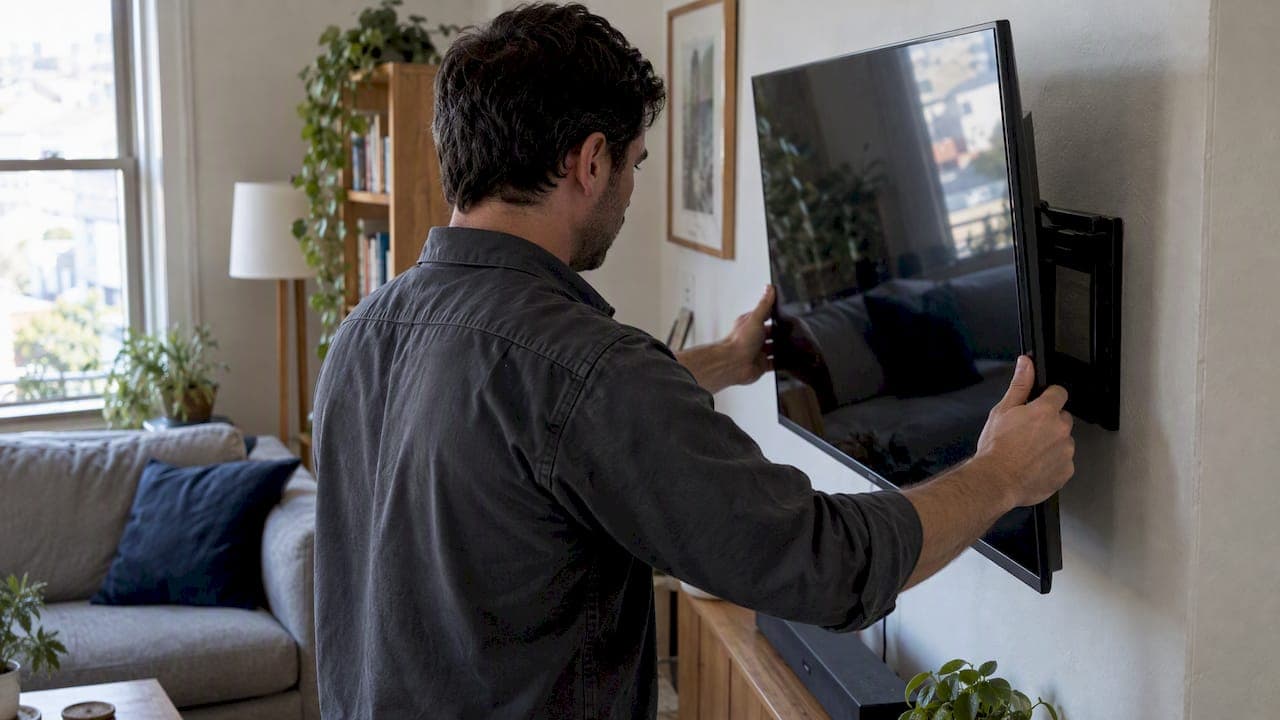
If you live in the Bay Area, a TV on the wall should be fastened to wood studs with hardware rated well above the TV's weight. Anything standing below it should be tied back to the wall as well. A TV that is only screwed into drywall, or that sits loose on a console, is the one most likely to come off during strong shaking. Most of this comes down to what is behind your wall, not which mount you buy.
This guide covers how to mount a TV for earthquake country, how to handle a full media wall with shelves and cabinets, and where DIY stops and a professional should take over.
TL;DR
- Anchor the mount into solid wood studs, never drywall alone, and follow the mount maker's lag bolt specs for your TV's weight.
- If the TV stays on furniture, strap the TV to the unit and the unit to the wall studs.
- Tall cabinets and floating shelves need their own top and base connections. Don't rely on one fastener.
- Secure the small heavy things too: soundbars, consoles, decor. They become projectiles.
- Plaster, brick, metal studs and condo walls change the method. Check before you drill.
Table of Contents
- Why the Bay Area is a different case
- What actually holds a TV on the wall
- Walls that change the method
- If the TV stays on furniture
- Media walls, shelves and cabinets: the leverage problem
- Wiring, power and fireplaces
- Homes with kids
- Step by step: a secure install
- Perspective: what we see in the Bay Area
- Get a plan before you drill
- When to hire a professional
- Frequently asked questions
- Sources
Why the Bay Area is a different case
The Bay Area is not a place where "someday" is a safe assumption. A USGS handbook for the region cites a 62% chance of at least one magnitude 6.7 or larger earthquake striking the San Francisco Bay region before 2032. USGS scientists also put the chance of one or more magnitude 6.7 or larger quakes somewhere in California over 30 years at greater than 99%. Nobody can predict the timing, but the odds are high enough to plan around.
The last big reminder was 1989. The Loma Prieta earthquake caused at least 63 deaths, more than 3,757 injuries and damage estimated to exceed $5.9 billion. The USGS describes it as a wakeup call for the region.

What matters for your living room is how people get hurt at home. Emergency guidance explains that the shaking itself is not what causes most injuries. Objects that move, fall or fly across a room do the damage. A 65-inch TV that comes off a wall is exactly that kind of object.
You also don't need to wait for a perfect, expensive project. Cal OES's preparedness messaging stresses that small steps, like securing a single TV mount, add up rather than needing one overwhelming effort.
What actually holds a TV on the wall
The mount is only half of the system. The other half is the wall. A bracket rated for 100 pounds is useless if it is anchored into half an inch of gypsum board. During shaking, a TV does not just pull straight down. It whips, rocks and levers against the top fasteners, which is how drywall anchors tear out.
For earthquake country, think in three layers:
- The structure: wood studs (or the right fasteners for metal studs, brick or concrete).
- The mount: a bracket rated comfortably above your TV's weight, with a lock or safety screw so the TV can't lift off its hooks.
- The TV connection: every screw the mount maker specifies, fully seated, into the VESA holes.
FEMA's guidance at Ready.gov points homeowners to securing heavy items like televisions to wall studs, using proper straps, latches or mounts. The Earthquake Country Alliance calls wall-mounting a TV with a mounting kit "perhaps the best choice" and tells you to follow the manufacturer's instructions closely.
Hit the center of the stud
A lag bolt that bites only the edge of a stud can split the wood or pull out under load. Find both edges with a stud finder, mark them, and drill at the center line. Our guide to the best stud finder for TV mounting covers what works. Confirm with a small pilot hole before you commit.
On bolt length, the common rule of thumb for a heavy TV is lag bolts of roughly 2.5 to 3 inches so they pass through the drywall and sink deep into the stud. Treat that as a floor for planning, and defer to the hardware that ships with your mount and its stated weight rating. If your mount comes with short screws, replace them with the specified lag bolts.
If studs don't line up with your layout
Studs are usually 16 inches on center, but your TV may not center on them. Don't solve this by using drywall anchors. Use a mount with a wide plate or a sliding stud-to-stud bracket that lets you land both sides on wood. Our drywall guide covers studs first and the studless methods that are still sound for lighter loads.
Walls that change the method
San Francisco housing stock is varied. Victorians, Edwardians, stucco-faced Sunset houses and newer concrete condo towers are different jobs.
| Wall type | What to know | Where to start |
|---|---|---|
| Drywall over wood studs | The easy case. Anchor into stud centers. | Mount a TV on drywall |
| Plaster and lath | Older SF homes. Studs are harder to find and plaster can crack. | Mount a TV on plaster |
| Metal studs | Common in condos and commercial conversions. Needs the right fasteners. | Mount a TV on metal studs |
| Brick or masonry | Needs masonry anchors and the right bit. | Mount a TV on brick |
If you own a condo, there is an added layer: building rules, shared walls and concrete or metal framing. We wrote a separate piece on when SF condo owners should buy a kit or hire a pro. Read your HOA rules before drilling.
If the TV stays on furniture
Not everyone wants a wall mount. If your TV sits on a console, the Earthquake Country Alliance describes a simple option: use flexible nylon strap packages with buckle or Velcro fasteners. Attach one end to the furniture and the other to the back of the TV, either through the mount holes or with adhesive fasteners. If the furniture is tall, the same page says to secure it to wall studs.

The point to remember: strapping a TV to a console that itself can tip is half a fix. The strap holds the TV to the console, and the console still needs to be tied to the wall.
Media walls, shelves and cabinets: the leverage problem
A media wall adds weight, height and a lot of connected parts. The risk is different from a single TV bracket.
Tall units and floating shelves behave like levers. Even a unit that feels solid can fail if the top isn't braced independently of the base. Engineering detail libraries, such as the Lawrence Berkeley National Laboratory seismic anchorage library, show anchoring typical equipment with details developed by structural engineers. That library is written for lab equipment, not homes, but the principle carries over: connect at more than one point.
In practice, for a home media wall:
- Anchor the wall frame or panels to studs, not just to the drywall skin.
- Fix cabinets at the top and the base. A floating console should go onto a ledger or cleat tied into studs. A floor-standing unit should be fastened to the wall at the top rail, and to the floor where the design allows.
- Check shelf load ratings and keep the heaviest items low.
- Keep the TV mount independent. The mount's lag bolts go into studs. Don't hang it off a decorative panel that isn't anchored.
The USGS Bay Area handbook notes that tall furniture should be fastened at the top corners to a wall stud, not just into the wall surface.
Stabilize the small stuff
People spend an hour on the TV and forget what sits next to it. Soundbars, game consoles, speakers, and decorative objects are heavy enough to hurt someone or damage the wall and mount. Museum putty or hook-and-loop fasteners hold them for a few dollars. Put heavy decor on lower shelves and keep breakables away from the edges.
Wiring, power and fireplaces
Hidden wiring is part of a clean media wall, but keep it code-compliant. Cords should not run through walls unless they are rated for it. We lay out two legal ways to power a wall-mounted TV, per the NEC.
If the plan includes a fireplace insert below the TV, an electric unit avoids the gas and venting issues of a combustion one. It also needs its own secure framing. Whatever you pick, the TV mount should still be tied to studs and not rely on the fireplace surround.
Homes with kids
Families get a second reason to anchor everything. A toddler climbing a console puts forces on it that look a lot like a small tremor. General babyproofing checklists, such as this babyproofing checklist that puts anchors and stairs first, also treat anchoring furniture as a priority action. Our own piece on a kid-safe TV wall with pre-cut engineered kits shows how to get a stylish wall that also keeps little hands away from cords and edges.
Step by step: a secure install
- Weigh the TV and check its VESA pattern. Pick a mount rated well above that weight.
- Locate studs with a stud finder and mark both edges.
- Pick the height and mark the bracket holes on stud centers.
- Drill pilot holes at the right diameter for your lag bolts so the wood doesn't split.
- Fasten the bracket with the specified lag bolts. Don't over-tighten.
- Attach the TV plates, hang the TV and engage any lock or safety screw.
- Tug-test. Pull down and out with firm pressure. Nothing should shift.
- Route and secure cables so they can't yank the TV if the console moves.
- Secure peripherals with putty or fasteners.
Perspective: what we see in the Bay Area
We sell DIY media wall kits and offer design and installation help in the SF Bay Area, so we think about this daily. Our view is simple: the most common failure isn't a bad mount. It's a good mount in a bad spot. People trust a nice-looking bracket and then screw it into whatever they hit first.
That is why we like pre-cut, pre-labeled panel systems for homeowners. When panels are engineered to a known layout, you aren't guessing where the structure is or improvising around it. You do still have to anchor into your house's studs, and no kit can do that for you. We'd rather tell you to take the extra hour finding studs than sell you a tidy wall that sits on drywall alone.
Our second view: don't wait for the ideal project. Strap the TV, tie the bookcase to the wall, put putty under the soundbar tonight. Then plan the bigger media wall properly. If your walls are plaster, brick, metal stud or part of a condo, get a second opinion before you drill.
— Jake
Get a plan before you drill
If you want the wall to look high-end and be built on a clear plan, our design packages are a low-risk first step: Single Concept Design at $99, 3 Concepts + Revision Design Package at $199, or Full Design & Quote at $299. For Bay Area homeowners who'd rather not do the install themselves, we also offer white-glove installation. You can also see how it works for DIY kits and custom installs, or browse floating shelves and electric fireplaces to match your layout.
When to hire a professional
DIY is realistic for a standard drywall wall with accessible studs and a TV under a moderate weight. Bring in a licensed contractor or structural professional if:
- The wall is load-bearing or you aren't sure what's inside it.
- You are mounting over a fireplace with heat or gas considerations.
- The wall is brick, concrete or metal stud and you don't have the right anchors and bits.
- You're building a full-height unit with heavy cabinetry.
- You live in a condo, where HOA rules or shared walls apply.
For the wiring side, a licensed electrician should do any in-wall power work.
Frequently asked questions
Can I mount a TV on drywall in an earthquake zone?
Only if the mount is anchored into wood studs. Drywall alone is too weak for the whipping forces of shaking, and anchors in drywall can pull out. If studs don't line up with where you want the TV, use a wider mount plate.
Is a wall mount safer than a TV on a stand?
A properly anchored wall mount is often the strongest option, and the Earthquake Country Alliance calls it perhaps the best choice. A stand can also work if you strap the TV to the furniture and tie tall furniture to wall studs. An unsecured TV on a loose console is the weakest setup.
How likely is a big earthquake in the Bay Area?
The USGS can't predict timing. Its modeling in the Bay Area handbook gave a 62% chance of at least one magnitude 6.7 or larger quake in the region before 2032. Plan as if it can happen any day.
Do I need to secure items on the shelves too?
Yes. Soundbars, consoles and decor can fall or fly, and they can hit people or damage the wall. Museum putty or hook-and-loop fasteners are cheap and quick. Keep heavy items on low shelves.
Should I pay for a pro to mount my TV in San Francisco?
If your wall is plaster, brick, metal stud or part of a condo, or if the build includes tall cabinetry, a pro is worth it. For a simple stud wall, a careful DIY install is realistic. Read our condo guide to decide.
Sources
- Televisions, Computers, and other Electronics, Earthquake Country Alliance
- Earthquakes, Ready.gov
- Earthquake Preparedness: What Every Child Care Provider Needs to Know, Ready.gov
- Putting Down Roots in Earthquake Country, USGS
- Forecasting California's Earthquakes, USGS
- M 6.9 October 17, 1989 Loma Prieta Earthquake, USGS
- Loma Prieta Earthquake: Strong ground motion, USGS
- Seismic Anchorage Typical Detail Library, Lawrence Berkeley National Laboratory
- Earthquake Preparedness Month press release, Cal OES