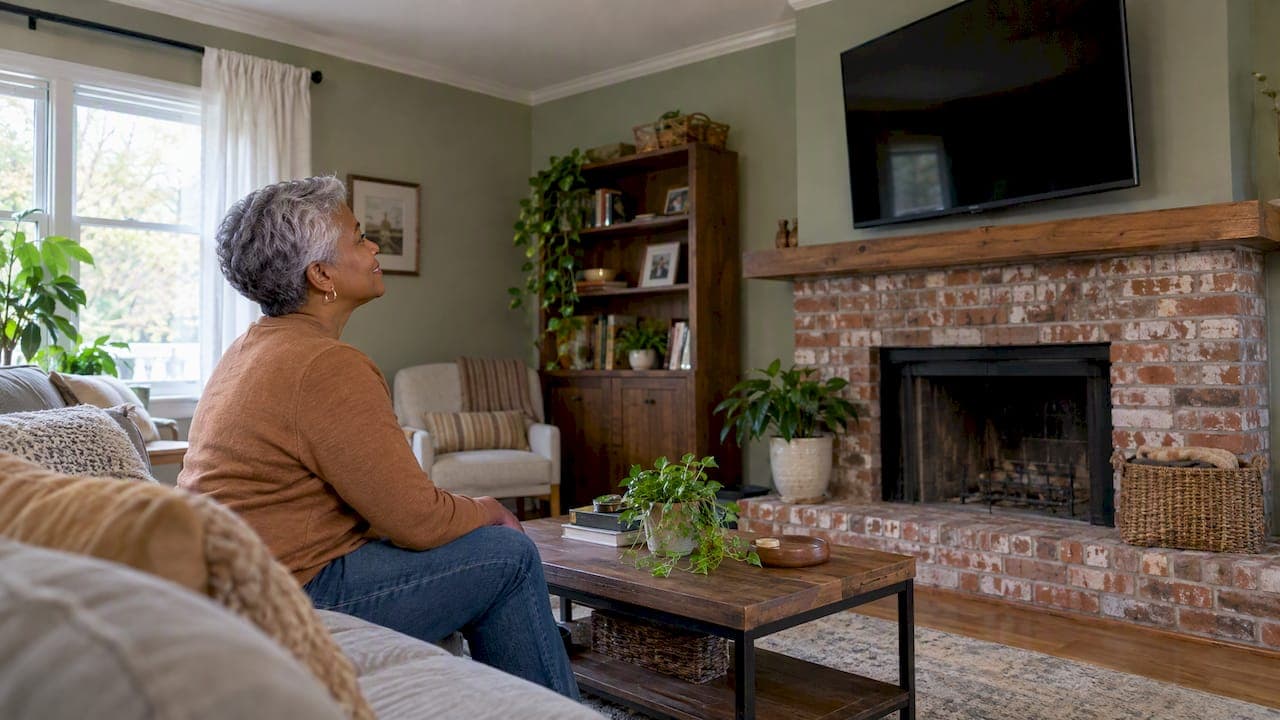
You can skip the drill in some setups, but you can't skip the safety checks. Whether a TV belongs above your fireplace depends on heat, weight and what is behind the wall, not on how the mount attaches. A mount that needs no drilling still has to carry the TV, and the spot still has to stay cool. Below, we cover what "no drill" can and can't mean, how to test the heat, how to hide cables legally, and when to put the TV somewhere else.
TL;DR
- Heat decides the location first. Run the fireplace at full burn for 30 minutes and check the wall with an infrared thermometer. Readings above 100°F are too hot for a flat-screen.
- "No drill" usually means no pilot holes in brick or tile, or no studs. It rarely means no fasteners. Adhesive strips and hooks are not a plan for a heavy TV above a heat source.
- On a framed wall, the safest route is still the mount maker's hardware into wood studs. Brick and stone need masonry bits and rated anchors.
- A TV power cord can't be buried in the wall. Use a code-compliant in-wall power kit and CL2 or CL3 rated cable for low-voltage runs.
- If the wall heats up, or you burn wood regularly, put the TV elsewhere or have a professional assess the wall.
Table of Contents
- What "no drill" really means above a fireplace
- Step one: decide if the spot is cool enough
- Step two: match the mount to the TV
- Step three: hide the cables without cutting into the wall
- When to skip the over-fireplace spot
- Perspective
- Build the wall around the TV instead
- Get help planning your wall
- A quick pre-install checklist
- FAQ
- Sources
What "no drill" really means above a fireplace
People searching this usually have one of three situations. Some rent or don't want holes in a finished wall. Some have brick or stone and dread the masonry work. Others have drywall with no studs where the TV needs to go.
Each situation has a different honest answer:
- Drywall with no stud in the right place. Specialty mounts exist that fasten to drywall with their own self-anchoring screws, and some are rated for TVs up to roughly 80 inches. They still put screws in the wall. They just skip the separate drilling step and the toggle anchors. Check the weight rating on the box against your TV.
- Brick or stone. Surfaces like this normally call for masonry drill bits, anchors and a mount rated for the material. Woodland Direct's guidance says the structure behind the wall must also support the TV's weight. Our guide on mounting a TV on brick walks through that job.
- Adhesive strips and hooks. You will see them suggested for brick. For a TV that hangs over a heat source, we would not rely on adhesive. Heat can soften adhesives, and a falling TV is an expensive, dangerous failure. Use them for a picture frame, not a screen.
If you want zero holes in the existing wall, the most reliable no-drill answer is to avoid hanging the TV from the wall at all. A floating TV panel or a freestanding electric fireplace TV stand carries the screen on its own structure. We come back to that below.
Step one: decide if the spot is cool enough
Every other decision comes after this one. TVs are sensitive to heat, and placing one above a heat source that you use often can shorten its life or cause long-term internal damage. Excessive heat from gas or wood fireplaces can also degrade picture quality and may void a television's warranty.
The 30-minute wall test
This is a simple test you can do yourself:
- Light the fireplace the way you normally would on a cold evening, and run it at full burn.
- After 30 minutes, point a digital infrared thermometer at the wall where the center and bottom of the TV would sit.
- Write down the highest reading.
Express Mounting's guidance treats the spot as safe when the wall stays below 100°F at full burn after 30 minutes, with 6 to 12 inches of mantel clearance and a mount that tilts or pulls down. Above 100°F, the location is too hot for a flat-screen.
We go deeper on this in how homeowners can safely mount a TV above a fireplace.
Read both manuals
The thermometer is a check, not a replacement for the paperwork. Check the TV manual and the fireplace installation manual for clearance requirements. Hearth & Home Technologies says its main objective is to redirect heat away from the TV, and that its recommended clearances are good-faith recommendations, not a guarantee that a TV's temperature limits will be met. So the manual number and your own reading both matter.
Fuel type changes the odds
| Fireplace type | Heat risk to the TV | What to do |
|---|---|---|
| Wood-burning | Highest, especially with regular use | Test the wall. If it heats up or you burn often, mount the TV elsewhere |
| Gas | Moderate to high | Test the wall, add a deep mantel or heat deflector if the manual allows |
| Electric | Lower, often adjustable or usable without heat | Still follow the maker's clearance, for example 8 inches on some Touchstone models |
Electric units are generally considered the safer pairing because many let you run them without heat. If you are still choosing, see our best electric fireplace for a TV wall guide.
Step two: match the mount to the TV
Two specs decide whether a mount fits: the weight it is rated for, and the VESA pattern, which is the spacing of the four bolt holes on the back of the TV. Both are printed in the TV manual and on the mount's packaging.
Before you buy, do this:
- Find your TV's weight without the stand, and compare it to the mount's rated capacity. Leave a comfortable margin.
- Measure the hole spacing on the back of the TV, horizontally and vertically, in millimeters, and compare it to the mount's supported VESA sizes.
- Check the screen size range the mount lists.
- Check how deep the TV sits once mounted. A TV that tilts down needs room behind its top edge.
A no-drill or self-anchoring mount is only as good as the wall it grips. Drywall alone is weaker than a stud, and the rating on the box assumes the install instructions are followed exactly. On a framed wall, fasten into wood studs with the hardware the mount manufacturer specifies. Our article on mounting a TV on drywall covers stud finding first and studless methods second.
Choose the right motion
Above a fireplace, the TV sits high. A fixed mount leaves you looking up. A tilting mount angles the screen down toward the seats, and a pull-down mount lowers the screen to eye level. Tilt or pull-down is the type Express Mounting pairs with safe fireplace installs. If the TV sits high, an angled screen also reduces neck strain. See our TV and fireplace wall layouts for height and viewing-distance ideas.

Glare is the other thing a high TV picks up. Windows opposite the screen can wash it out, and a good window treatment solves that without moving the TV. Drapery Company's notes on TV glare and window treatments show what works for rooms that get strong sun.
Step three: hide the cables without cutting into the wall
The hanging cord is what makes a fireplace TV look unfinished. The tempting fix is to push the cords down inside the wall. Do not do that with the power cord.
Power: use a kit, not the cord
A TV's power cord is not rated for in-wall use. Running standard appliance cords inside wall cavities violates NEC 400.8 in most jurisdictions and creates a fire hazard. The NEC's rules on flexible cords also restrict attaching them to building surfaces, which is why a loose cord stapled or tucked inside a wall is a problem.
The compliant approach is a UL-rated power relocation kit. It uses in-wall-rated wiring between a recessed outlet behind the TV and a lower recessed outlet, and that lower outlet plugs into an existing receptacle. It does involve cutting openings in the wall, so it is not a no-drill route. If you want no wall cutting at all, use a surface cord cover painted to match the wall, or build the cable run into a media wall panel.

Low-voltage cables
HDMI, Ethernet and speaker wire are a different category. For in-wall use they need a CL2 or CL3 rating under the National Electrical Code, published as NFPA 70. Check the jacket of any cable you plan to put in a wall.
If the cabling steps look like more than you want to take on, our wire management kit guide compares the options.
When to skip the over-fireplace spot
Sometimes the right answer is not a better mount. Choose another location, or bring in a professional, if:
- The wall reads over 100°F in your 30-minute test.
- You burn wood regularly. Express Mounting advises mounting elsewhere in that case.
- You are unsure about the wall structure, the clearance or the wiring. The same source advises a professional assessment when in doubt.
- You haven't had the fireplace and chimney looked at lately. The CPSC advises professional inspection of fuel-burning heating systems, including fireplaces and chimneys, every year. Fireplaces and chimneys were involved in an average of 15,400 fires a year from 2020 to 2022, with an average of 30 deaths and 90 injuries annually.
If you decide against the spot, a fireplace-and-TV wall can still look intentional. Place the TV beside the fireplace or on its own panel, and let the fireplace carry the warmth visually.
Perspective
We hear this question a lot, and the honest answer is that the mount is rarely the real problem. The real problem is building a wall that holds a screen, hides the wiring and keeps the heat away, all at once.
That is why we build our kits as a system. Pre-cut, pre-labeled panels, hidden wire management and a modular layout mean the TV, the fireplace and the cable path are planned together, so you are not improvising a mount over a hot firebox. An electric fireplace linear insert gives you a controlled heat source, and floating cabinetry and slat panels finish the wall around it.
For many homeowners, that beats fighting with anchors in brick or hunting for studs that aren't where you need them. You get a high-end look, a weekend install and a fraction of the cost of a custom build.
Jake
Build the wall around the TV instead
If your goal is to avoid drilling into brick, or to skip a stack of fixes, a wall designed around the TV changes the problem. Instead of hanging a screen on whatever surface exists, you install a framed or paneled structure and mount into that.
Here is how that looks in practice:
- Electric fireplace inserts and TV stands. Our 70-inch distressed white electric fireplace TV stand has a linear insert and a walnut shelf, and it sits on the floor rather than hanging from your masonry. Browse the full electric fireplace range too.
- Floating TV panel. A floating TV panel design gives the screen a clean, wall-mounted look.
- Lighting and shelves. LED and ambient lighting and floating shelves finish the look.
- Mantel or no mantel. A deeper mantel can help direct heat away from the screen, and our mantel or no mantel guide helps you decide. Still check your fireplace manual for what it allows.
For the full picture, read what a fireplace media wall is, and compare floating and recessed fireplaces if you are choosing a unit.
Get help planning your wall
Not sure whether your wall, fireplace and TV can work together? Our design services are priced as one-off packages: a Single Concept Design is $99, a 3 Concepts + Revision Design Package is $199, and a Full Design & Quote is $299. They are listed on our shop page. Our media wall kits ship nationwide as DIY packages designed to install in a weekend, and we offer white-glove installation in the San Francisco Bay Area. See how it works for the steps.

Prefer to start with parts? Our accessories cover fireplaces, lighting, cabinetry, hardware and smart tech, and the hardware finishes come in brass, chrome and matte black.
A quick pre-install checklist
- Read the fireplace and TV manuals for clearance and weight.
- Run the 30-minute full-burn test and record the highest wall temperature.
- Confirm the wall behind: wood stud, drywall only, brick or stone.
- Pick a mount rated above the TV's weight, matching its VESA pattern, with tilt or pull-down.
- Plan power with a code-compliant kit and low-voltage with CL2 or CL3 cable.
- If any step fails or feels uncertain, move the TV or call a professional.
FAQ
Can I mount a TV over a fireplace with no drilling at all?
In most cases, no. Even "no drill" mounts use screws, and brick or stone normally needs masonry bits and rated anchors. The closest to zero wall work is a freestanding electric fireplace TV stand or a panel system that carries the screen itself.
Are adhesive strips safe for a TV above a fireplace?
We wouldn't use them. A TV is heavy, the spot may get warm, and a failure could drop the screen. Choose a mount rated for your TV's weight and fasten it as the manufacturer specifies.
How hot is too hot for a TV above a fireplace?
Run the fireplace at full burn for 30 minutes, then measure the wall with an infrared thermometer. Over 100°F is too hot for a flat-screen. Also check the TV and fireplace manuals for clearance.
Can I hide the TV power cord inside the wall?
Not the standard cord. It isn't rated for in-wall use, and burying it violates code. Use a UL-rated in-wall power kit with a recessed outlet, or a surface cover if you don't want to cut into the wall.
Is an electric fireplace safer under a TV?
Generally yes, because many electric units run with the heat off or adjustable. You still need to follow the maker's clearance, such as 8 inches on some models.
Sources
- TV Over a Fireplace: Is It Safe? | Express Mounting
- Can I Hang A TV Over My Fireplace? | Woodlanddirect.com
- Hearth & Home Technologies: TV over fireplace poster
- Safely Mount a TV Above an Electric Fireplace | Touchstone
- How to Mount a TV Above Your Fireplace Safely | Infinite Fire Features
- How to Hide TV Wires in the Wall | QuickMountTV
- Out Of Sight, Out Of Mind | Electrical Contractor Magazine
- CPSC: Keep Warm and Safe This Winter
- CPSC: Be Cautious When Using Space Heaters, Furnaces and Fireplaces
- TV Glare and Window Treatments