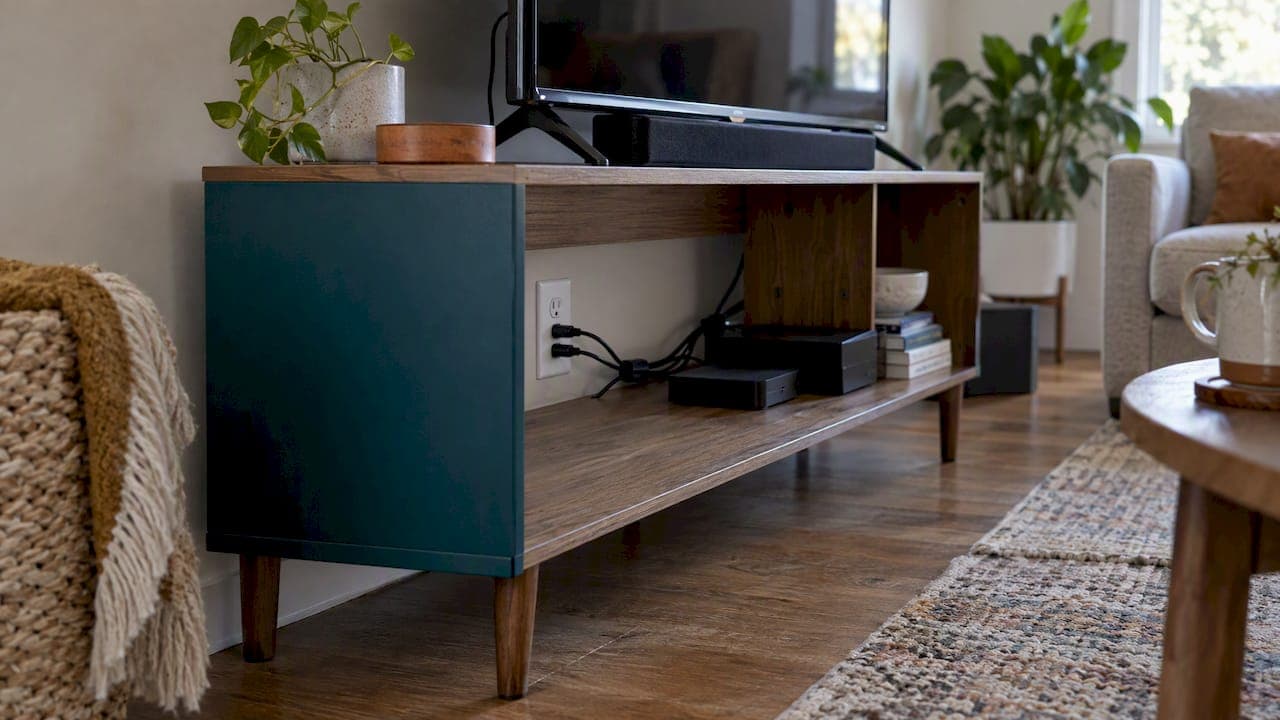
The safe way to get power into a media cabinet is a fixed, accessible receptacle placed where the cabinet needs it, not a cord run through a hole and not a power strip buried at the back. You can have it behind the cabinet, inside it, or in a recessed box in the wall. What you can't do is seal a standard outlet behind solid furniture and forget about it. Here is how the options compare, what the code says, what it costs, and how to plan it so the finished cabinet looks clean.
TL;DR
- Required outlets have to stay reachable. Covering one completely with a fixed cabinet is a code problem unless the assembly is a listed one that meets the exceptions (NEC 314.29 proposal text).
- Extension cords and power strips are not a permanent answer for entertainment gear. Move the furniture or add a fixed receptacle instead.
- Adding one outlet typically runs $150 to $300 nationally, mostly because of the one-hour minimum and trip fees.
- Plan outlets before you buy or build the cabinet, and book the electrician for the same day as the install.
Table of Contents
- Can you put an outlet in a media cabinet?
- Why a power strip behind the cabinet is the wrong fix
- Your four real options
- Where to put the outlet
- What it costs to add an outlet
- Step by step: planning the power for a cabinet or media wall
- Our perspective: plan the outlets first, the finish second
- Matching the cabinet to the outlet plan
- Work with us on the design
- Mistakes we see most often
- FAQ
- Sources
Can you put an outlet in a media cabinet?
Yes, with a distinction that matters. There are three different things people mean by it:
- A cutout in the cabinet back so the cabinet sits over an existing wall outlet, with the plug still reachable.
- A power strip or built-in outlet strip inside the cabinet, fed by a cord to the wall.
- A new receptacle installed in the wall (or in a recessed box) at the spot the cabinet or TV needs it.
Option 3 is the one that holds up best over years. Option 1 is fine as long as nothing blocks access. Option 2 is where most problems start, and we cover why below.
The question "is it okay to cover an outlet with a cabinet?" has a short answer: not if the cabinet makes the outlet inaccessible. The National Electrical Code requires that boxes and the devices in them be installed so the wiring can be reached without damaging the surrounding finish. The code revision text under review for NEC 314.29 is explicit about that accessibility principle. There is an exception for listed device assemblies that can be removed from a surface opening without damaging the building materials. That is what makes some flush, high-end designs legal. It is not a loophole for plugging into a box and then screwing a panel over it.
Local rules differ. Your jurisdiction adopts its own edition of the NEC, and your inspector has the final say, so ask your electrician which edition applies in your town.
Why a power strip behind the cabinet is the wrong fix
A media cabinet holds a lot of draw: a TV, a soundbar, a console, a streaming box, a router. The temptation is to plug a power strip into the one outlet and run everything off it.
The Electrical Safety Foundation International advises against relying on extension cords and power strips as permanent power, and recommends arranging furniture so you can use wall outlets. The same booklet notes that electrical cords and plugs were involved in roughly 5,200 fires in one year. It also warns against letting furniture rest on cords, which can make them overheat, and against fastening cords to walls or baseboards with nails or staples.
Two habits cause most of the trouble inside cabinets:
- Pinching the cord. A cabinet pushed tight to the wall flattens the plug and cord. Leave clearance, or use a cutout.
- Daisy-chaining. Plugging one strip into another stacks the load on a cord that was never meant to carry it.
Also look at the wall plate itself. ESFI describes tear-drop shaped darkening on a wall plate as a warning sign of heat buildup at the connection, and says it needs prompt attention from a licensed electrician. If you see it behind an existing cabinet, stop using that outlet.
Your four real options
| Option | What it is | Best for | Watch out for |
|---|---|---|---|
| Cabinet cutout over an existing outlet | Notch in the cabinet back so the plug reaches the wall | A freestanding cabinet where an outlet is already in the right spot | Plug must stay reachable; leave room for the cord bend |
| Surface-mount or in-cabinet outlet strip, plugged into the wall | Fixed strip inside the cabinet | Gear that needs 6 or more plugs | Still a cord to the wall; don't chain strips |
| New receptacle at the cabinet location | Electrician adds a box, often at floor or mid-wall height | Floating or wall-hung consoles | Cost of the visit; planning before drywall is closed |
| Recessed box behind a wall-mounted TV | Box set into the wall so plugs sit flush | A TV mounted tight to the wall | Must be installed to code and kept accessible |
If you are mounting a TV above the cabinet, there is a separate question: how power reaches the TV itself. We wrote up two legal ways to power a wall-mounted TV under the NEC if that is your situation. Short version: running the TV's own cord inside the wall is not one of them.
Where to put the outlet
Placement decides whether the finished cabinet looks clean. A few rules of thumb we use.
Put power where the cords already want to go. For a floating console, that is usually behind the cabinet near one end, low enough to be hidden by the cabinet body and still reachable with the cabinet removed or opened. For a wall-mounted TV, it is directly behind the screen, not off to the side.
Count your devices, then add. A TV, soundbar, game console, streaming box and router already fill five plugs, and chargers and lighting arrive later. Our guide on media wall outlet placement recommends planning for 6 to 10 receptacles so you never reach for a power strip down the road. Even if you don't wire all of them now, running the wire and boxes while the wall is open costs far less than reopening it.

Separate power from low voltage. HDMI, coax and Ethernet should have their own path, away from line-voltage wiring. Labeling both ends makes service painless. Here are four cable labels worth using.
Think about heat. Cable boxes and consoles run warm. Whatever you choose, give gear ventilation and keep remote sensors unblocked. See how to hide a cable box without blocking remotes or overheating.
Keep kitchen rules in mind only if it's a kitchen. Recent code discussion on outlet placement near countertops, for example island and peninsula receptacles, is about work surfaces. A living room media cabinet is a different situation, but the underlying lesson about cord pulling carries over: keep cords short, tidy and out of reach of small children.
What it costs to add an outlet
HomeGuide puts the national average for adding an outlet at $150 to $300, depending on cable routing, wall access and local labor rates. A big share of that is not the outlet itself. Many electricians charge a one-hour minimum, and some add a trip fee, so a ten-minute job can bill like a full hour.
That is why bundling pays. The guide from MountingMyTV on how electricians run power behind a TV suggests scheduling the electrical work the same day as the TV mounting or media wall setup. The electrician is there once, and can coordinate with where the cabinet and mount will actually land.
The same guide recommends talking to an electrician before starting a custom cabinet or media wall. Many jurisdictions may allow one outlet to be added to an existing circuit without a new permit, but that depends on where you live, and the electrician is the person who checks that the new load doesn't exceed what the circuit can carry. Confirm permit rules with your local building department.
Prices vary by city, and Bay Area rates are not Midwest rates. Treat the national average as a ballpark and get a local quote.
Step by step: planning the power for a cabinet or media wall
- Measure and mark the cabinet footprint on the wall, including the TV position above it.
- List every device that will live in or on the cabinet, with its plug type (some power bricks are bulky).
- Mark where each cord exits the equipment and where the existing outlets are.
- Decide: reuse, strip or add. If an existing outlet falls in the right place and stays accessible, a cutout may be enough. If not, call an electrician.
- Book the electrician before you install, ideally the same day as the build.
- Install the cabinet or kit with cord clearance. Never let it press a plug flat against the wall.
- Label cables at both ends and leave a service loop so you can pull gear out later.
- Test and look: after a week of use, check wall plates and plugs for warmth or discoloration.
If your house was built before 1980, the ESFI booklet says a licensed professional should inspect when you have doubts about outlet accessibility or wiring condition. Older wiring is exactly where adding more load to an existing circuit deserves a second pair of eyes.
Our perspective: plan the outlets first, the finish second
We sell DIY media wall kits, so we see the same pattern in customer questions over and over. People spend weeks choosing finishes, slat panels and lighting, and then ask about power the day before install. By then, the easy options are gone.
Our view is simple. The outlet plan is the foundation of the wall, and everything else sits on top of it. A pre-cut, pre-labeled kit makes the carpentry fast, which is exactly why the electrical decisions need to be made first: once panels are up, you don't want to be cutting them for a box you forgot.
Here is what we tell buyers:
- Treat power as a requirement, not an accessory. Decide on the number and position of receptacles before you pick a kit.
- Don't rely on a strip hidden behind the cabinet. Floating cabinetry looks best with a short, planned cord path, and a fixed outlet where the cabinet hides it.
- Hire a licensed electrician for any new wiring. Our kits are designed for weekend DIY assembly, but line-voltage work is not a DIY job for most people.
- Use the kit's hidden wire management for low-voltage cables and give plugs breathing room. Our post on cable slack management in precut kits explains how slack helps prevent heat and strain.
- If you're still deciding on how to conceal wires on a finished wall, read how to hide wires from a mounted TV without cutting walls.
An outlet you can reach, a cord that isn't pinched, and gear that can breathe: that is most of what makes a media setup both beautiful and safe.
— Jake
Matching the cabinet to the outlet plan
Some cabinet styles make power easier than others.
Floating consoles. The space between the cabinet and the floor, plus the cabinet's open back, make cord routing simple. A wall-hung console like the 71-inch floating TV console in black wood grain pairs naturally with a receptacle placed behind one end.
Fireplace stands. Electric fireplaces need their own plug and often draw significant power, so plan a dedicated receptacle rather than sharing a strip with your AV gear. Check each unit's rating before wiring. See our electric fireplaces for media walls.
Cabinets with lighting. LED strips and shelves with built-in lights add small loads, but they add plugs. The media wall lighting range is easier to live with when a receptacle is planned near it.
Full media walls. A slat wall with a floating cabinet gives you hidden cavities for wiring. That is where planned power matters most, because the electrician can place boxes before panels are installed.
Work with us on the design
If you want power, cabinetry and finishes planned together before you build, our design services are built for that. A Single Concept Design is $99, a 3 Concepts + Revision Design Package is $199, and a Full Design & Quote is $299, all one-off. In the San Francisco Bay Area, we also offer white-glove installation if you would rather not do the build yourself. Kits ship nationwide, with expert support and risk-free returns.
Mistakes we see most often
- Buying the cabinet first. Then discovering the only outlet is blocked.
- Cutting one big hole. A giant cutout in the cabinet back weakens it and looks unfinished. Cut only what the cord needs.
- Using a strip as wiring. Strips are for convenience, not for permanent distribution.
- Ignoring the one-hour minimum. Paying for two separate electrician visits when one would do.
- Forgetting future gear. A new console, a turntable, a charger dock. Plan extra capacity.
FAQ
Is it okay to cover an outlet with a cabinet?
Only if the outlet stays accessible. The NEC requires that boxes remain reachable, with a narrow exception for listed assemblies that can be removed without damaging the finish. If a fixed cabinet seals the outlet in, move the cabinet or have an electrician relocate the receptacle.
How much does it cost to put an outlet behind a TV or cabinet?
HomeGuide reports a national average of $150 to $300 for a new outlet, driven by labor minimums and trip fees. Your local rate may differ. Booking the electrician on the same day as your install usually lowers the total.
Can I use a power strip inside my media cabinet?
It works short term, but safety groups like ESFI advise against using strips and extension cords as permanent power. If you need many plugs, ask an electrician to add receptacles. If you do use a strip, plug it directly into the wall and never chain it.
Do I need a permit to add an outlet?
It depends on your jurisdiction. Some places may allow a single outlet added to an existing circuit without a new permit, but not all do. Call your local building department or ask your electrician, who also checks that the circuit can handle the load.
Sources
- How Much Does It Cost to Install an Electrical Outlet? (HomeGuide)
- Indoor Electrical Safety Check Booklet (ESFI)
- NEC 314.29 accessibility proposal (NFPA)
- Kitchen Island and Peninsula Outlets and the NEC (NFPA)
- How Electricians Run Power Behind a TV (MountingMyTV)