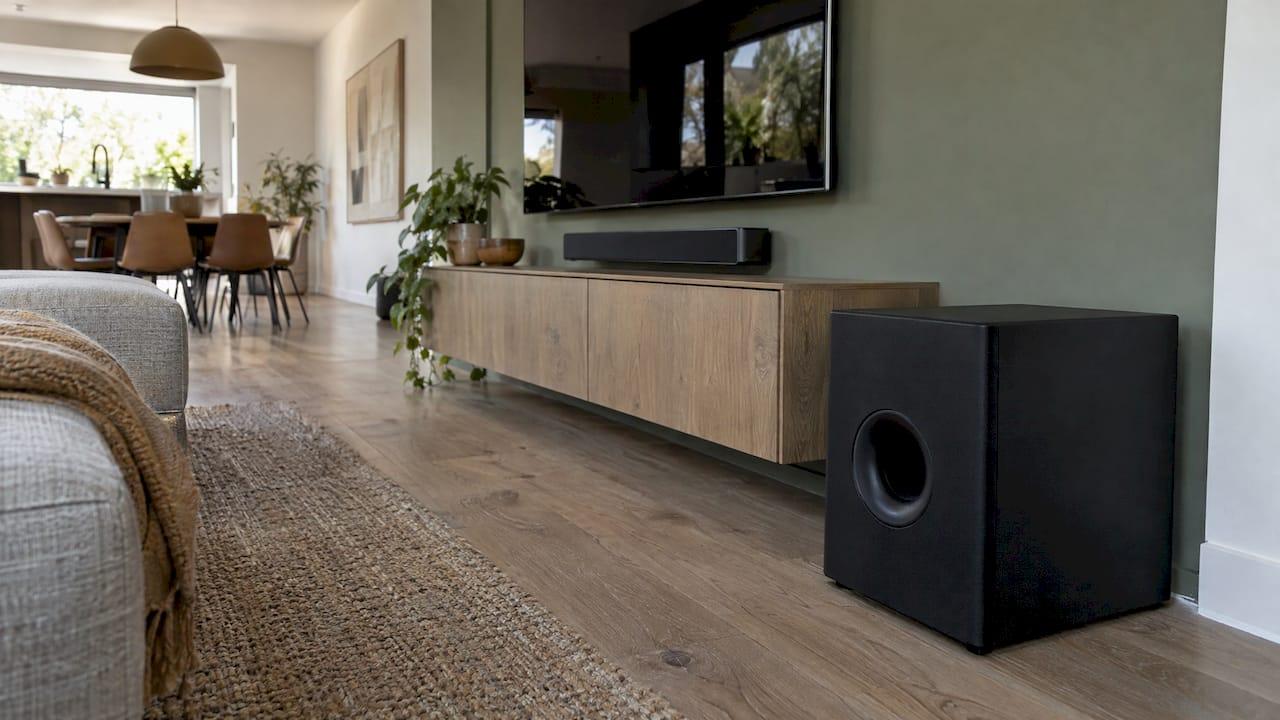
Put the subwoofer on the floor at the front of the room, a foot or two to the left or right of the TV wall, facing your seat. Keep it out of closed cabinets, pull it off the wall, and then fine-tune by ear. That is the starting point manufacturers like Dolby recommend, and it works for most living rooms. If you are building a media wall, plan the sub's spot before you cut or mount anything. It is much harder to fix later.
TL;DR
- Start on the floor, beside the TV wall and soundbar, in the front half of the room, facing the seating area.
- Don't bury the sub in a closed cabinet or shove it into a tight shelf opening. Give it open air.
- Leave at least 6 inches around the port and back, and try 12 to 18 inches from the wall if it must sit along one.
- A modern flat-panel TV is generally fine next to a sub. Move the sub farther away if the picture looks distorted.
- Use the "subwoofer crawl" to find the smoothest spot, then plan your media wall layout around it.
Table of Contents
- The short answer for a TV wall
- Height: floor first
- Should the subwoofer go inside the media wall cabinet?
- How far from the TV and the wall?
- Corners: more bass, less control
- Find your spot with the subwoofer crawl
- Stop the rattle
- Plan the layout around the sub
- Our perspective
- Plan your wall with us
- FAQ
- Sources
The short answer for a TV wall
Most people end up in the same place: next to the TV, at the front of the room. Dolby's soundbar guide describes the most common placement as near the soundbar and TV, often left or right, in the front half of the space, pointed at the listening position. Roku's support team gives the same advice for blending the sub with the higher frequencies from your other speakers.
Why does that spot work? Bass from a sub and the lower midrange from your main speakers or soundbar then start from roughly the same place, so they line up better. One calibration-focused guide, HomePictureCinema, explains it as a shared launch point that reduces phase problems between the sub and the main channels.
Treat that as a starting position, not a verdict. Every room is different. Dolby itself says to begin near the soundbar and TV and then move the sub around until it sounds best in your space.
Height: floor first
Put the sub on the floor. The Seismic Audio guide recommends the floor for best performance, and adds that a stand can help if thick carpet would soak up the bass.
On a TV wall, that means the sub should sit lower than the soundbar. In a March 2025 piece, Expert Reviews quotes Jason Brisbois saying a sub should generally sit lower than a soundbar, and that because low frequencies are non-directional, height does not affect your ability to locate sound sources. So you don't need to hide the sub, and you don't need it at ear level. Floor level is fine.
That has a design consequence. If your media wall has a floating TV cabinet, the sub does not go inside it. It sits on the floor beside or below it. A floating cabinet leaves open floor space, which is exactly where the sub wants to live. Our floating TV cabinet guide covers how to size and position one.
Should the subwoofer go inside the media wall cabinet?
Best answer: no, not into a closed cabinet. Several manufacturers say so directly:
- Roku advises against placing a sub inside a cabinet, especially one with a closed door, because it can hurt bass performance. A sub is itself an enclosure, so a cabinet around it is an enclosure around an enclosure.
- Dolby warns that putting a sub inside cabinetry or furniture can cause poor response, rattle or distortion.
- TCL's US support page lists cabinets, closed doors, soft surfaces such as couches and thick rugs, and spots right against a wall as places to avoid.
- Popular Science advises keeping subs out of cabinets and cramped shelf spaces.
If an open, floor-level spot is truly impossible, Polk Audio calls a cabinet the worst-case scenario but says that if it is unavoidable, the driver should face out into the room and the amplifier panel should not face down. Ventilation matters too. Roku also says to avoid spots where a sub can overheat, such as on a heater vent or near a fireplace.
That last point is relevant if your media wall includes a fireplace. Keep the sub clear of the firebox and any warm air outlet. If you are deciding between styles, see our comparison of a floating vs. recessed fireplace.
An open bay beats a hidden one
On a built-in wall, the smart move is to leave an open, ventilated floor-level bay beside the TV, with nothing in front of the driver. No door, no grille cloth that traps air, no tight shelf above it. You can still make that bay look intentional with finishes that match the rest of the wall.
If you want the rest of your speakers out of sight, read how to hide speakers in a media wall. Hiding the main speakers and leaving the sub in open air is a combination that works well.
How far from the TV and the wall?
Distance from the TV
A sub next to a flat-panel TV is not a screen-damage problem for most modern sets. The Yamaha manual for its NS-SW100 notes that proximity can affect color or cause buzzing on CRT-type TVs, but says this is not an issue with LCD and plasma sets. The Monoprice manual adds a practical rule: if extreme bass at high volume distorts the picture on a nearby TV, move the sub farther away.
So you do not need to isolate the sub from the TV wall by several feet. Give it a little breathing room, keep it from touching thin panels or the TV stand, and move it if you see or hear a problem.
Distance from the wall behind it
Walls change how bass behaves. Here is how the guidance stacks up:
| Position | What happens | Source |
|---|---|---|
| Pushed flat against a wall | Bass gets louder but can turn boomy | Polk |
| 12 to 18 inches from the wall | Reduces bass build-up if the sub must sit along a wall | Polk |
| 6 inches or more around a corner sub | Gives sound waves room to escape | Popular Science |
| Port at least 6 inches from the wall | Keeps air moving properly | Seismic Audio |
| Facing a wall directly | Reflected sound can cancel the direct sound, weakening bass | Yamaha manual |
On a media wall, this affects how deep you make the cabinet run and where the wall panels begin. If the sub sits beside a slat or acoustic panel section, leave a gap between the enclosure and the panels rather than wedging it tight. Our wood slat TV wall guide shows how those sections are built out from the wall.
The rule of thirds
Polk describes a "rule of thirds": place the sub about a third of the way from the wall into the room for the most even bass, or one-fifth of the way if that is impractical. Popular Science gives a similar tip. In a real living room, a third of the way out from the TV wall usually puts the sub in the middle of your walking space, so it is a test position more than a permanent one. Use it as one candidate in your crawl test below.
Corners: more bass, less control
Corners are tempting. Roku notes that a corner or closer-to-wall position typically gives louder bass, and if you hear too much, you can move the sub 6 to 12 inches off the wall. Polk agrees that a corner significantly boosts bass but can sound boomy.

The physics is straightforward. HomePictureCinema explains that a corner couples the sub to three room boundaries at once. That reinforces bass energy, and it also amplifies room modes, which often yields the boomiest, most one-note response.
Advice differs a little by source. TCL suggests a front corner for stronger bass. Steve Withers, quoted by Expert Reviews, recommends the front of the room to the left or right of the soundbar and avoiding corners that could swamp the rest of the system. The Monoprice manual also says to avoid corners. A practical reading: if your room is large or your system is light on bass, a corner can help. If you have a small room or a powerful sub, start along the front wall instead.

Find your spot with the subwoofer crawl
Published advice only narrows the field. Your room decides. The crawl is a free way to find the best spot, and several sources describe it the same way, including KEF, Popular Science and Axiom Audio.
- Swap places. Put the sub where your head sits when you watch, such as on the couch cushion or a chair.
- Play bass-heavy material. Use a track or movie scene with steady, deep bass so you can hear differences.
- Crawl. Get down at floor level and move around the room, especially along the walls near the TV wall.
- Listen for even bass. You want the spot where bass sounds tight and smooth, not boomy or thin. Axiom explains that room nulls make some positions sound very full and others almost bassless.
- Mark two or three candidates. HiFiReport suggests marking a few and then comparing from your seat with different content.
- Move the sub there and put the furniture back.
KEF adds an honest caveat: sometimes the best spot is the middle of the room. If so, you either put the sub there or take the next best spot that looks right and live with the compromise. On a media wall, that compromise is usually the front wall beside the TV, which is also where the sub looks most natural.
Do the crawl before you finalize your wall layout, not after. The result tells you whether to leave an open bay on the left or the right, and whether you need a floor-level opening at all.
Stop the rattle
Low frequencies travel through floors, studs and brackets, so a sub that sounds fine can still make a shelf buzz or a panel hum. A few habits help:
- Leave a small gap between the sub and the TV stand, cabinet or wall panels. Don't let it touch thin furniture panels.
- Move loose decor, shelf items and glass off nearby surfaces.
- If the floor transmits vibration, a platform or isolation pad can help. HomePictureCinema notes these decouple the cabinet from the floor and address structural transmission and sympathetic rattles, not tone.
- Check the TV mount and nearby brackets are tight. Our guides on mounting a TV on drywall and media wall mounts explain how to anchor to studs.
A word on expectations. Wall panels can manage echo inside the room, but bass moves through structure. Our article on a soundproof TV wall explains why weekend kits tame echo and not sound transfer. If you want to treat reflections behind the TV, see our acoustic treatment guide.
Plan the layout around the sub
The sub is one piece of a bigger arrangement: TV, soundbar or speakers, seating and walkways. A good living room layout with the TV keeps sightlines clear and leaves room for equipment to breathe. If your TV wall is also the room's focal point, feature wall ideas for living rooms can help you choose a look that holds up beside a big floor-standing sub.
For soundbar setups, the soundbar itself has placement rules. See our guide to soundbar placement so the bar and the sub work together. Dolby warns that a soundbar and sub far apart can cause frequency issues depending on the room, and Roku suggests keeping the sub within 30 feet of the host device for reliable wireless connection. In a typical living room, both limits are easy to meet.
If the room opens into a kitchen or dining area, bass spreads further and seating may be more scattered. Our open concept TV wall article covers centering sightlines in that setup.
A planning checklist
- Run the crawl before you mount or build.
- Decide which side of the TV gets the sub, and leave floor space there.
- Keep power outlets near the sub's spot. Our kits are designed with hidden wire management, so cables can stay out of sight.
- Leave 6 inches or more of clearance behind the port and around the enclosure.
- Keep the sub away from fireplaces, heater vents and soft surfaces.
Our perspective
We design media walls for people who want a high-end look without a contractor, and the sub is the piece most people forget until the wall is up. Then it ends up in a corner, behind a couch, or in a cabinet with the door shut, and the bass suffers.
Our advice is to treat the sub like the TV: give it a planned spot. Floating cabinetry is useful here because it frees the floor, so the sub has an open place beside the wall instead of being forced into a box. Hidden wire management means the sub's power and signal cable don't spoil the finished look.
Test first, then build. Do the crawl, mark the spot, and design the wall around it. If you want help with layout, our design packages exist for exactly that kind of question.
Jake
Plan your wall with us
If you would like the sub, soundbar and TV planned into the wall before you buy a single panel, we offer design packages: Single Concept Design at $99, a 3 Concepts + Revision Design Package at $199, and Full Design & Quote at $299. Our DIY media wall kits come pre-cut and pre-labeled for a weekend install, and in the SF Bay Area we also offer white-glove installation.

Browse cabinetry, lighting, audio and visual accessories or see how it works to start.
FAQ
Where is the best place for a subwoofer with a TV on the wall?
On the floor at the front of the room, to the left or right of the TV and soundbar, facing your seating. Dolby calls this the most common placement. Treat it as a starting point and adjust by ear.
Is it OK to put a subwoofer right next to the TV?
Usually yes. Yamaha says proximity is not an issue with LCD and plasma TVs, and only older CRT sets may show color or buzzing problems. If a picture ever looks distorted, move the sub farther away, as the Monoprice manual advises.
Can I put my subwoofer in a media wall cabinet?
It is best not to. Roku, Dolby and TCL all warn that a closed cabinet can hurt bass and cause rattle. Leave an open, ventilated floor-level bay instead. If a cabinet is unavoidable, point the driver out into the room.
How far should a subwoofer be from the wall?
Polk suggests 12 to 18 inches if it must sit along a wall, and Seismic Audio says to keep the port at least 6 inches away. Roku suggests moving it 6 to 12 inches off the wall if bass sounds too heavy.
Should the subwoofer be on the floor or a shelf?
The floor is best, according to Seismic Audio. Expert Reviews also says a sub should generally sit lower than the soundbar. Use a stand only if thick carpet absorbs the bass.
Sources
- Soundbar Setup Guide, Dolby
- What is the best placement for my Roku subwoofer?
- Where to position a subwoofer in relation to a soundbar, Expert Reviews
- Subwoofer Placement Guide, Seismic Audio
- Subwoofer Placement Guide, HomePictureCinema
- Monoprice subwoofer manual
- Yamaha NS-SW100 manual
- Best Placement for Your TCL Sound Bar and Subwoofer
- 5 Tips for Perfect Subwoofer Placement, Polk Audio
- Where to place a subwoofer with a soundbar, Popular Science
- Fix Your Bass! Learn to Crawl!, KEF
- Subwoofer Setup: Where to Begin?, Axiom Audio
- The Subwoofer Crawl in Practice, HiFiReport